
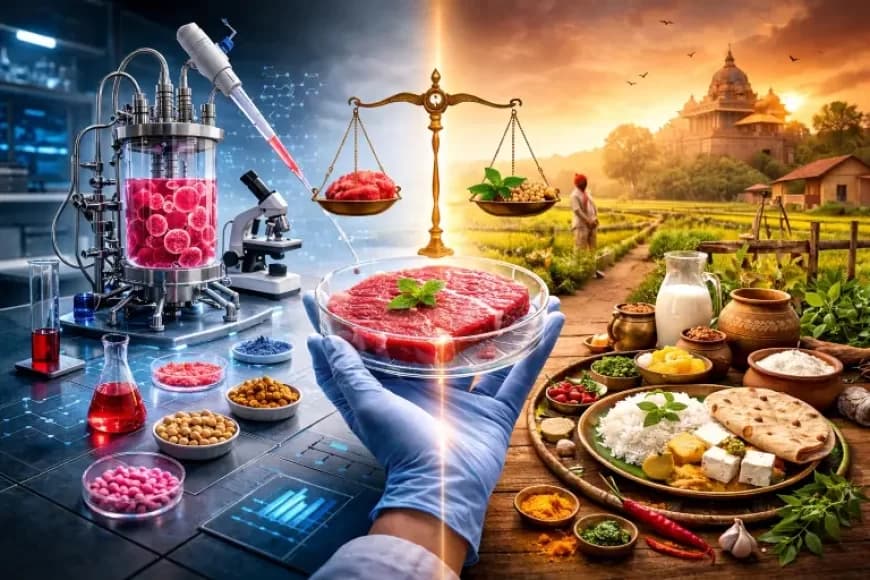
India’s food industry is entering a new era as lab-grown meat and precision fermentation products move closer to real market entry. In 2026, the conversation is no longer about whether these products are possible—but whether Indian consumers and regulators will accept them.
With the FSSAI actively drafting standards, the “pure vs lab-made” clash is now becoming a national policy and cultural debate.
India’s Food Culture Meets Biotechnology in 2026
India is globally known for its deeply emotional relationship with food—where eating is often linked to spirituality, tradition, and identity. That’s why the rise of cultured meat, synthetic dairy, and precision fermentation proteins is creating a unique friction.
Unlike Western markets where lab-grown food is mostly positioned as a climate innovation, in India it is being judged through the lens of purity, process, and religious compatibility.
The “Sattvic vs Lab-Grown” Conflict: Why Acceptance Is Not Simple
Purity in India is About Origin, Not Just Ingredients
In many Indian households, “pure food” means more than being vegetarian or chemical-free. The concept of Sattva (purity and harmony) is connected to the belief that food carries energy based on how it is produced.
This creates a challenge for cultured products because many consumers see lab-grown meat as “manufactured,” even if it is scientifically safe.
Supporters Call It the Ultimate Form of Ahimsa
On the other side, some modern spiritual voices argue that lab-grown meat could be the most ethical form of consumption because it avoids slaughter. For them, cultured meat aligns with Ahimsa (non-violence)—a powerful moral principle in India.
Processed Food Stigma Remains a Barrier
Despite its cruelty-free positioning, lab-grown meat may still face resistance because it could be perceived as “over-processed.” Traditional consumers may label it as heavy, unnatural, or disconnected from the earth-based food cycle.
Vegetarian Labeling in India: The Biggest Regulatory Minefield
Can Lab-Grown Meat Ever Be Considered Vegetarian?
One of the most sensitive questions is whether cultured meat can be treated as vegetarian food.
Even if no animal is killed, cultured meat is still made using animal cells. Under current consumer understanding, that makes it “non-veg” by default.
Green Dot vs Brown Dot: The Problem for Cultured Products
India’s food labeling system is strict:
Green Dot = vegetarian (no animal-derived ingredients, except milk)
Brown/Red Dot = non-vegetarian
Lab-grown meat doesn’t fit neatly into either category, which is why industry experts and stakeholders are pushing for a new third label—possibly a separate symbol to mark biotech-derived foods.
This would prevent confusion and protect consumer trust.
Precision Fermentation Dairy May Be a Faster Win Than Meat
Compared to cultured meat, precision fermentation dairy is expected to find easier acceptance in India.
These products use microorganisms like yeast to create milk proteins such as whey and casein, without involving animals. However, the biggest resistance may come from cultural beliefs tied to “traditional dairy,” especially desi cow milk.
In a country where milk is often seen as sacred and emotionally tied to rural livelihood, the debate becomes as political as it is scientific.
FSSAI Drafting Cultured Meat Standards Under “Non-Specified Food” Rules
Lab-Grown Meat Still Has No Dedicated Food Category
As of early 2026, India does not have a separate law specifically designed for lab-grown meat or synthetic dairy. These products are currently governed under:
Food Safety and Standards (Approval for Non-Specified Food and Food Ingredients) Regulations
This means companies must seek approval before selling such products.
Prior Approval and Scientific Dossier Requirement
Any startup or FMCG brand planning to introduce cultured meat must submit a detailed safety and scientific dossier to the FSSAI, including ingredient sources, production process, and health impact studies.
Serum-Free Growth Media Is a Major Controversy
One of the biggest concerns being discussed is the use of Fetal Bovine Serum (FBS), which is derived from animal sources.
There is growing pressure on regulators to ensure lab-grown meat production uses serum-free and animal-free growth mediums, especially considering India’s cultural and ethical sensitivities.
This could become a key requirement in future standards.
Parliamentary Debate Adds Politics: “Cow, Culture and Rural Economy”
Concerns Over Rural Dairy Livelihoods
In Parliament, lab-grown dairy is not being discussed only as an innovation—it is being viewed as an economic disruption.
Lawmakers have raised fears that synthetic dairy could harm India’s rural dairy economy, which supports millions of small farmers.
Demand for Strong Packaging Disclaimers
There is also growing political demand that synthetic dairy products should carry clear packaging warnings such as:
“This is not dairy milk.”
Some proposals suggest the disclaimer should be as visible as the brand name itself.
New Biotech Label Symbol Under Discussion
Since current veg/non-veg symbols may not work for biotech foods, proposals have emerged for a new symbol—possibly a distinct dot color or geometric symbol—to avoid misleading consumers.
How Nestlé, HUL and FMCG Giants Are Planning Their Smart Protein Strategy
Avoiding the Word “Synthetic”
Major FMCG companies understand that in India, words like “lab-made” and “synthetic” can instantly trigger distrust.
Instead, brands are likely to use terms such as:
Cultured protein
Bio-identical nutrition
Smart protein
Next-gen dairy
Sustainability Messaging Will Lead Marketing
Many global brands are expected to highlight benefits like:
reduced land use
reduced water consumption
lower greenhouse gas emissions
This messaging is targeted mainly at urban Gen Z consumers who are already climate-conscious.
Stealth Integration Into Familiar Products
Rather than launching a premium “lab-grown steak,” brands may introduce biotech proteins inside familiar categories like:
protein shakes
chocolates
health supplements
bakery items
This strategy builds comfort without directly challenging cultural habits.
Localization Will Decide Success
Instead of Western-style positioning, companies are expected to localize product formats such as:
cultured keema
precision-fermented paneer
hybrid meat snacks
protein-rich ready-to-eat meals
India’s adoption is likely to depend on how well biotech foods blend into the everyday thali.
Hybrid Products Emerging as the 2026 Bridge Strategy
A major industry trend is the rise of hybrid products, where cultured fat or protein is mixed with plant-based ingredients.
For example:
90% plant-based base
10% cultured fat for taste improvement
This reduces regulatory friction while improving flavor—making it a practical entry route for companies.
What Comes Next: Smart Protein Guidance Document Expected by Late 2026
According to industry expectations, the FSSAI is likely to release a more detailed Smart Protein Guidance Framework by late 2026.
If finalized, it could become a turning point for India’s alternative protein industry, defining:
labeling rules
safety benchmarks
growth medium standards
import and manufacturing approvals
For now, India remains cautious—but clearly open to innovation if it can be aligned with consumer trust and cultural transparency.
India’s Real Battle Is Not Science, It’s Sentiment
India’s lab-grown food future will not be decided only by laboratories or policy documents—it will be decided in the Indian kitchen.
The success of cultured meat and precision fermentation dairy depends on whether brands can shift the narrative from “made in a lab” to “made without harm.”
If the industry gets labeling, transparency, and cultural messaging right, 2026 could be the year India begins building its own smart protein revolution.
FAQ
1. Is lab-grown meat legal in India in 2026?
Lab-grown meat is not fully commercialized yet, but companies can apply for approval under FSSAI’s “Non-Specified Food” regulations.
2. Will lab-grown meat get a vegetarian green dot label in India?
Most likely no. Since cultured meat contains animal cells, it may not qualify for the green dot. A new symbol may be introduced for biotech foods.
3. What is precision fermentation dairy?
Precision fermentation dairy is made by using microorganisms like yeast to produce milk proteins such as whey and casein, without using animals.
4. Why is FSSAI focusing on serum-free media in cultured meat?
Because some cultured meat production uses animal-derived fetal bovine serum, which raises ethical and cultural concerns in India. Serum-free alternatives may become mandatory.
5. Will synthetic milk impact India’s dairy farmers?
Many policymakers believe it could disrupt the rural dairy economy if priced cheaper than traditional milk, which is why Parliament is discussing disclaimers and safeguards.