
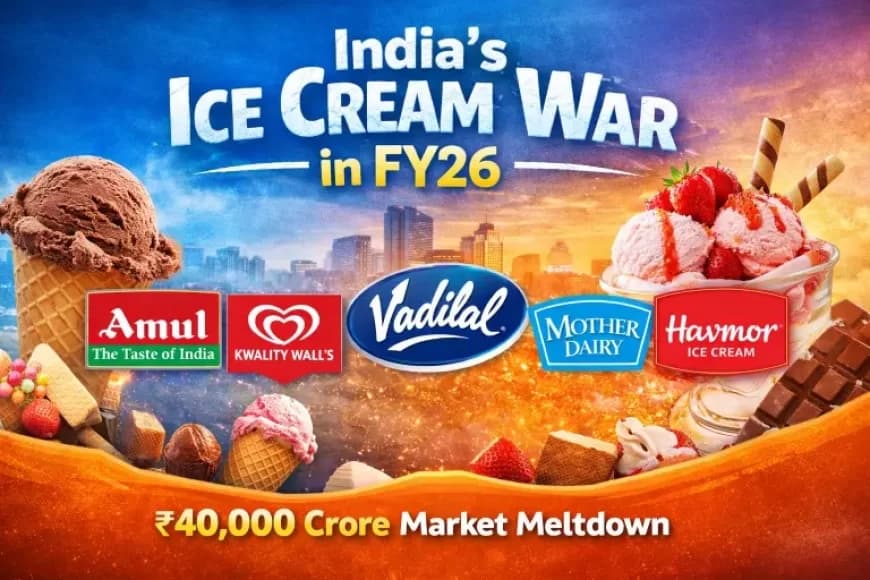
India’s ice cream industry is undergoing a sharp reset in FY26. What was once a simple race of flavours has now turned into a complex contest shaped by corporate restructuring, regulatory definitions, and a fast-growing premium segment. With the market estimated between ₹38,000–₹42,000 crore and growing at 13–15% annually, the industry is being forced to rethink everything—from ingredients to distribution.
India Ice Cream Market FY26: Size, Growth and Structure
The Indian ice cream market is broadly divided into organized and unorganized segments, with the organized players now driving most of the value growth. Extended summers, rising disposable incomes, and instant delivery platforms have transformed ice cream from a seasonal treat into a year-round indulgence.
Industry executives point out that FY26 is less about volume expansion and more about brand positioning, premium pricing, and operational efficiency.
Top Ice Cream Brands in India: FY26 Market Snapshot
The organized market remains dominated by a few large players, though competition is intensifying.
1. Amul
Amul continues to lead the market with an estimated 40% organized market share. Its strategy hinges on aggressive messaging around “real milk ice cream”, positioning itself against products made with vegetable fats.
2. Kwality Wall’s
Following its demerger from Hindustan Unilever, Kwality Wall’s now operates as Kwality Wall’s (India) Ltd (KWIL). As an independent entity, it is focusing on faster decision-making, cost restructuring, and defending its “frozen dessert” portfolio.
3. Vadilal Industries
Vadilal is betting big on exports and premium retail formats like its Happinezz parlours, targeting both Indian metros and overseas markets.
4. Mother Dairy
Mother Dairy continues to dominate traditional Indian flavours, especially kulfi and rabri-based innovations, appealing to consumers seeking familiarity with a modern twist.
5. Havmor
Backed by Lotte Wellfood, Havmor is integrating into a broader snacks-and-desserts strategy aimed at scale and cross-category growth.
The Real Milk vs Frozen Dessert Debate
One of the most visible battles in FY26 is over product nomenclature. Regulations clearly distinguish between ice cream made from milk fat and frozen desserts using vegetable fat, yet consumer understanding remains blurred.
Amul’s sustained campaigns around “pure milk” have reshaped public perception, often casting frozen desserts as inferior. Brands selling frozen desserts counter that vegetable fats allow better pricing, longer shelf life, and in some cases lower cholesterol—but the messaging gap persists.
This debate has become as much a marketing war as a regulatory one.
Why HUL Spun Off Kwality Wall’s
The demerger of Kwality Wall’s from Hindustan Unilever in late 2025 surprised many in the FMCG sector. The rationale, however, is straightforward.
Ice cream is a capital-intensive, cold-chain-dependent business with operating margins far lower than soaps, personal care, or packaged foods. As an independent company, KWIL can now raise capital, invest in cold storage, and respond faster to market trends—something difficult within a diversified FMCG giant.
Quick Commerce Is Reshaping Ice Cream Consumption
The rise of 10–15 minute delivery platforms has altered buying behaviour dramatically. Ice cream is now an impulse purchase ordered alongside groceries and snacks, rather than a planned outing.
Industry estimates suggest quick-commerce platforms now account for around 20% of urban ice cream sales. While this benefits large brands with strong logistics, it is squeezing smaller regional players who struggle with listing fees and deep discounting requirements.
Key Trends Shaping FY26
Premiumisation Over “Healthy” Claims
Despite the noise around sugar-free and low-fat options, indulgent, high-calorie ice creams still contribute nearly 70% of sales.
Regional Expansion Battles
Southern giant Arun Ice Cream is expanding aggressively beyond its home markets, intensifying competition in western and eastern India.
Longer Summers, Higher Sales
Recurring heatwaves have extended the peak season from three to almost five months, lifting annual revenues across the sector.
What Lies Ahead for India’s Ice Cream Industry
FY26 marks a turning point. Brands that fail to premiumise, optimise cold-chain logistics, or clearly communicate product value risk falling behind. As regulation tightens and consumer awareness improves, transparency and trust will become as important as taste.
The Indian ice cream market is no longer just about flavours—it is about strategy, structure, and survival.
FAQs: Indian Ice Cream Market FY26
Q1. What is the size of the Indian ice cream market in FY26?The market is estimated between ₹38,000–₹42,000 crore, growing at 13–15% annually.
Q2. What is the difference between ice cream and frozen dessert?Ice cream uses milk fat, while frozen desserts use vegetable fat, as defined by Indian food regulations.
Q3. Why did HUL demerge Kwality Wall’s?Ice cream is capital-heavy with lower margins compared to HUL’s core FMCG categories, making a standalone structure more efficient.
Q4. Is quick commerce good for ice cream brands?Yes for large brands with scale, but challenging for smaller players due to fees and discount pressure.
Q5. Which segment is growing fastest?Premium and impulse formats like sticks, cones, and chocolate-based tubs are seeing the strongest growth.