
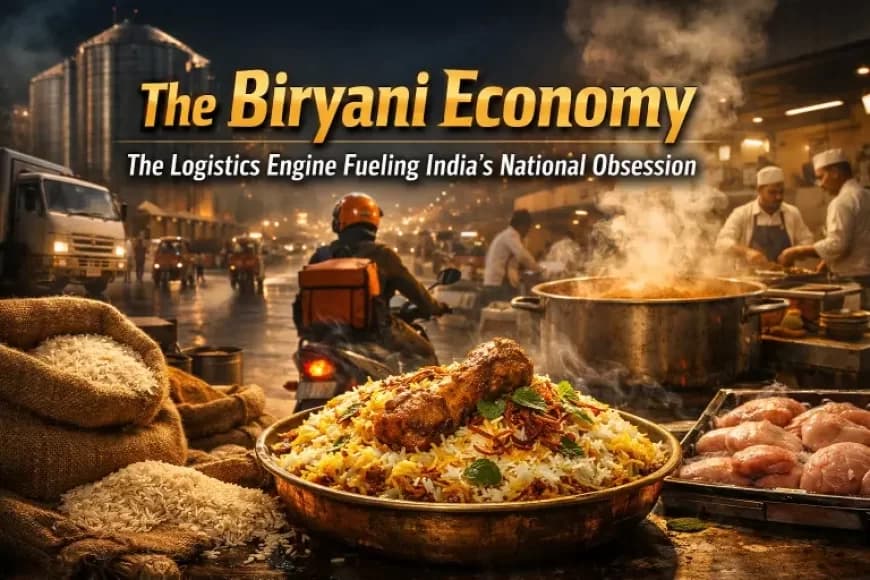
If the Indian food service industry were a stock market, Biryani would be the blue-chip stock that has refused to dip for a decade. For the tenth consecutive year, this royal dish has retained its crown as the country’s most-ordered item, proving that regardless of economic shifts, India’s appetite for aromatics and slow-cooked meat is the one constant variable in a volatile market.
But beyond the flavor lies a staggering feat of logistics. The "Biryani Economy" has evolved from a culinary preference into a massive industrial engine, moving millions of tonnes of grain and meat every single day.
Here is a breakdown of the machinery behind the obsession.
The "Biryani Index": The Scale of 2025
The latest market data for the fiscal year 2025 reveals a consumption volume that is accelerating rather than plateauing. The numbers are nothing short of industrial.
On major delivery platforms alone, Indians ordered a staggering 93 million plates of Biryani in 2025. To visualize that velocity: roughly 3.25 Biryanis are ordered every single second across the country. During peak demand windows—like New Year's Eve—kitchens across the nation were collectively dispatching over 1,300 orders per minute, turning delivery fleets into a high-speed Biryani distribution network.
The Growth Curve: 2024 vs. 2025
The jump in consumption over just 12 months highlights a deepening penetration of food delivery into Tier-2 cities and a shift in when India eats.
Total Volume Surge: The annual Biryani order volume on Swiggy jumped from 83 million in 2024 to 93 million in 2025, marking a solid 12% growth in just one year.
Order Velocity: The speed of consumption accelerated significantly, rising from roughly 2.5 orders per second in 2024 to 3.25 orders per second in 2025.
The "Snack" Shift: A major change in consumer behavior was observed where the Chicken Burger replaced the humble Samosa as the most ordered snack item, signaling a shift toward western fast food for light eats.
The Midnight Economy: The peak demand window shifted from the traditional dinner slot (8 PM – 10 PM) to the 12 AM – 3 AM window, cementing Biryani as the default fuel for India's nightlife and late-night workforce.
Peak Intensity: The highest single-minute order volume (recorded on NYE) spiked from approximately 1,000 orders per minute in 2024 to 1,336 orders per minute in 2025.
Regional Power Shift: While Hyderabad retained its title as the Biryani capital, Delhi NCR saw a massive surge in volume, driven largely by the new late-night consumption trend.
The Supply Chain: A Logistical Miracle
Delivering three plates a second is not a culinary challenge; it is a logistical one. The ecosystem rests on three massive pillars: Grain, Protein, and Cloud Infrastructure.
1. The Rice Trail (The Aging Constraint)
Commercial Biryani cannot be made with "new" rice; the starch content makes it sticky, ruining the texture. The industry standard requires Basmati aged for 12–18 months.
Contract Farming: Major Biryani chains do not buy off the shelf. They engage in contract farming, locking in prices and supply more than a year in advance.
The Silo Effect: This rice is stored in humidity-controlled silos to "age" effectively before ever reaching a kitchen. The supply chain moves thousands of tonnes of "Extra Long Grain" Basmati from the fields of Punjab and Haryana to high-demand centers like Bangalore and Chennai daily.
2. The Protein Pipeline (Cold Chain Integration)
With Chicken Biryani accounting for nearly 60% of all orders, the poultry supply chain has had to industrialize.
The "Biryani Cut": Cloud kitchens operate on speed. They cannot waste time butchering. They receive "Biryani Cut" chicken—pre-dressed, pre-weighed pieces (usually 75g)—delivered daily via refrigerated trucks.
Just-In-Time Inventory: Because cloud kitchens operate in tight 300-500 sq ft spaces, they lack massive freezer capacity. They rely on algorithmic ordering where fresh meat stock is replenished every 24 hours based on predicted demand.
3. The "Cloud" Factory Model
The sheer volume of 93 million orders is physically impossible for traditional dine-in restaurants to handle alone. The solution is the Hub-and-Spoke Cloud Kitchen.
The Hub: A central kitchen prepares the Akhni (spice base) and marinades in 100kg industrial vats. This ensures that a Biryani in Mumbai tastes exactly like one in Pune.
The Spoke: Hundreds of satellite "ghost kitchens" receive these bases. Their specific job is "Final Mile Cooking"—layering the rice and meat in the Handi and applying the Dum (steam).
Predictive Thawing: Kitchens use demand forecasting algorithms. If data shows a match day or a rainy Friday, the system automatically instructs staff to thaw 30% more inventory hours before the orders even arrive.
The Last Mile & Packaging Innovation
The final hurdle is the delivery itself. Biryani relies on trapped steam (Dum) for moisture, but steam destroys cardboard packaging.
The Thermal Engineering: The industry has standardized on rigid Polypropylene (PP) containers with engineered micro-vents. These vents release just enough steam to prevent the rice from becoming soggy while retaining enough heat to keep the meat tender for the average 45-minute delivery window.
Batching Efficiency: Because demand is so high, algorithms "batch" Biryani orders heavily. A single rider can often pick up 3-4 orders from one hub to deliver to a single neighborhood cluster, maximizing delivery speed.
The "Biryani Economy" is a masterclass in modern commerce. It successfully merges India's oldest culinary traditions with its newest logistical technologies. As 2025 comes to a close, the data is clear: the Biryani boom is not a fleeting trend, but the backbone of India's food delivery sector.
Frequently Asked Questions (FAQs) About the Biryani Economy
1. What is the most ordered dish in India in 2025?
For the 10th consecutive year, Biryani remains India's most ordered dish. According to Swiggy’s 2025 trend report, Indians ordered over 93 million plates of Biryani in 2025, cementing its status as the country's undisputed comfort food.
2. How many Biryanis are ordered per minute in India?
The data shows a staggering velocity of consumption. On Swiggy alone, approximately 194 Biryanis were ordered per minute in 2025. This translates to roughly 3.25 orders every second, a significant increase from the 2.5 orders per second recorded in 2024.
3. Which city is the Biryani Capital of India?
Hyderabad continues to hold the title of the "Biryani Capital of India," contributing the highest volume of orders annually. However, 2025 data indicates that Delhi NCR has become a massive contender, particularly driving the surge in late-night delivery volumes.
4. How do cloud kitchens manage to deliver Biryani so quickly?
Cloud kitchens use a Hub-and-Spoke model to ensure speed and consistency. A central "Hub" prepares the base spice mix (akhni) and marinades in bulk, which are then sent to satellite "Spoke" kitchens. These satellite kitchens only handle the final assembly and Dum (steaming), allowing them to dispatch fresh orders within minutes of receiving them.
5. Why is Chicken Biryani more popular than Mutton or Veg Biryani?
Chicken Biryani accounts for the vast majority of orders (57.7 million on Swiggy in 2025) due to its affordability and universal appeal. It serves as the primary protein driver for the "Biryani Economy," whereas Mutton is often reserved for premium occasions and Veg Biryani (often debated as Pulao) has a smaller, niche audience.
6. What is the "Midnight Biryani" trend mentioned in 2025 reports?
A major shift in 2025 was the surge in orders between 12 AM and 3 AM. Biryani has evolved from a standard dinner option to the default "nightlife fuel" for students, shift workers, and party-goers, prompting many delivery chains to operate 24/7.
7. How has the Biryani order volume changed from 2024 to 2025?
The market witnessed a 12% year-on-year growth. While total orders on Swiggy stood at 83 million in 2024, they rose to 93 million in 2025. The peak order intensity also spiked, with New Year's Eve 2025 recording a massive 1,336 orders per minute across platforms.
8. What kind of rice is used for commercial Biryani?
Commercial kitchens strictly use Extra Long Grain Basmati rice that has been aged for 12 to 24 months. "New" rice is avoided because it releases too much starch, making the dish sticky. Major chains engage in contract farming to secure this aged inventory months in advance.
9. How is Biryani packaging designed to keep food hot?
To maintain the "Dum" flavor without making the rice soggy, restaurants use rigid Polypropylene (PP) containers with engineered micro-vents. These vents release excess steam to prevent moisture buildup while retaining enough thermal heat to keep the Biryani hot for the average 45-minute delivery window.
10. Why is Biryani considered a "logistics miracle"?
Biryani is considered a logistics miracle because it is the most "batched" item in food delivery. High demand allows delivery algorithms to group 3-4 orders from a single kitchen to the same neighborhood, maximizing efficiency. Additionally, the supply chain coordinates the daily movement of tonnes of fresh meat and aged grain with zero-error predictive modeling.