
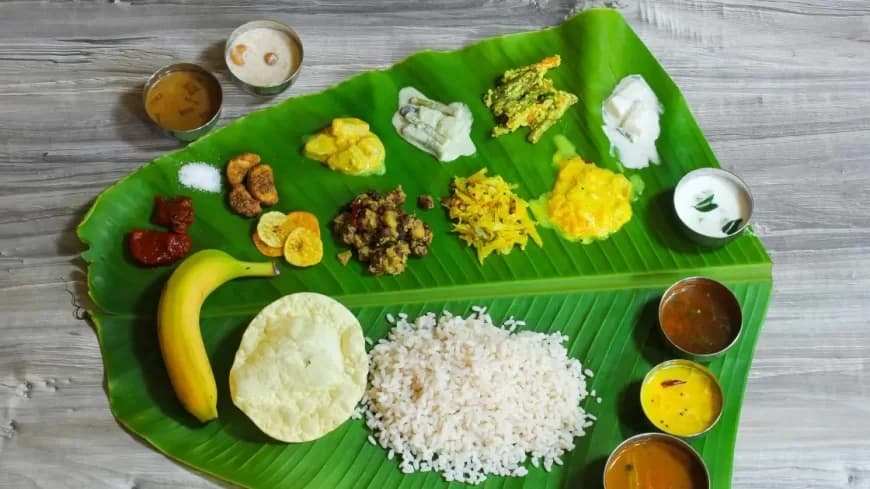
Few meals in the world can claim the grandeur of the Onam Sadya, Kerala’s iconic vegetarian feast. Imagine a banana leaf spread out like a canvas, layered with more than two dozen dishes—each a burst of color, aroma, and taste. From the fiery tang of puli inji to the mellow sweetness of payasam, this is not just food. It is Kerala’s history, agriculture, and spirit served together in one extraordinary banquet.
Onam, the ten-day harvest festival, is the stage for this culinary spectacle. It is a season when families return home, kitchens come alive, and recipes handed down for generations take center stage. For Keralites, the Onam Sadya recipe is not just about cooking—it is about remembering, celebrating, and sharing.
Sadya, which simply means “banquet” in Malayalam, is anything but simple. It is Kerala’s answer to the royal feast, except it is purely vegetarian and deeply rooted in local produce.
The Kerala vegetarian feast is designed with philosophy as much as with flavor. Every dish balances the six essential tastes—sweet, sour, salty, bitter, pungent, and astringent. Every serving has meaning: the crunch of banana chips to start, the tang of sambar to sharpen appetite, the creaminess of olan to soothe, and finally, the decadence of payasam to complete the journey.
But beyond taste, Sadya represents equality. Whether rich or poor, all sit cross-legged in rows, eating from the same banana leaf, reminding us that food is the ultimate unifier.
Kerala’s Onam food traditions are as precise as they are poetic. The banana leaf is not a plate, but a stage. Dishes are served in order, beginning at the top left corner with pickles and ending at the bottom with payasam. Each has its place, each its timing.
Tradition dictates that guests are served by hand, often in near silence, as the focus remains on food and community. And while a temple may feed thousands in a single sitting, the love and care behind each dish never wavers.
What makes Sadya truly special is its inclusiveness—families cook together, neighbors share dishes, and entire villages gather to eat as one. In a world where meals are often rushed, Onam insists that food is worth slowing down for.
A Feast of Many Flavors: The Sadya Dishes List
To describe an Onam Sadya recipe is to take a tour of Kerala itself. Each dish tells a story of geography, tradition, and seasonal abundance. Here are the stars of the feast:
Parippu Curry – Lentils rich with ghee, humble yet soulful.
Sambar – Vegetables and tamarind in a tangy lentil broth, Kerala’s signature.
Avial – A medley of vegetables, yogurt, and coconut, bound by curry leaves.
Olan – Ash gourd and pumpkin bathed in coconut milk, light yet luxurious.
Kootu Curry – Yam and black chana, bold with roasted coconut.
Erissery – Pumpkin and cowpeas, sweetened with jaggery and tempered with spices.
Thoran – Finely chopped vegetables stir-fried with coconut, crisp and fragrant.
Kaalan – Yam or banana simmered in spiced yogurt, sharp and satisfying.
Inji Curry / Puli Inji – A ginger-tamarind chutney that is sweet, sour, and fiery all at once.
Pachadi & Kichadi – Yogurt-based side dishes with pineapple, beetroot, or cucumber.
Pickles – From mango to lemon, adding bold punches of flavor.
Banana Chips & Sharkara Varatti – The iconic double act: one salted, the other coated in jaggery.
Papadam – That all-important crunch.
Payasam – The grand finale, whether it’s the rice-based Palada Payasam, jaggery-rich Ada Pradhaman, or lentil-sweetened Parippu Payasam.
Together, these dishes form a symphony, each note complementing the other.
Cooking Onam Sadya at Home
For many outside Kerala, recreating a full Onam Sadya recipe at home feels daunting. But it needn’t be. Think of it not as a single meal, but as an orchestra where every dish plays its part.
Start with the essentials: rice, sambar, avial, thoran, banana chips, papadam, and payasam. As you gain confidence, add olan, erissery, and pachadi. With each passing year, you will discover not just the dishes, but the rhythm of preparation—the chopping, the grinding of coconut, the tempering of mustard seeds in hot coconut oil.
What matters is not the number of items on the leaf, but the care and joy that go into each spoonful.
The Legacy of a Leaf
In the end, the Onam Sadya is not about recipes alone—it is about memory. It is the sound of a crowded dining hall, the aroma of roasted coconut, the laughter of cousins serving one another, and the final indulgence of payasam, ladled out generously.
This Kerala vegetarian feast endures because it celebrates more than food. It celebrates family, community, and the land that nourishes. The Onam food traditions remind us that abundance is not measured by wealth, but by the willingness to share.
So this Onam, whether you cook a simple Sadya at home or experience it in Kerala itself, let the banana leaf be your plate and the feast your story.