
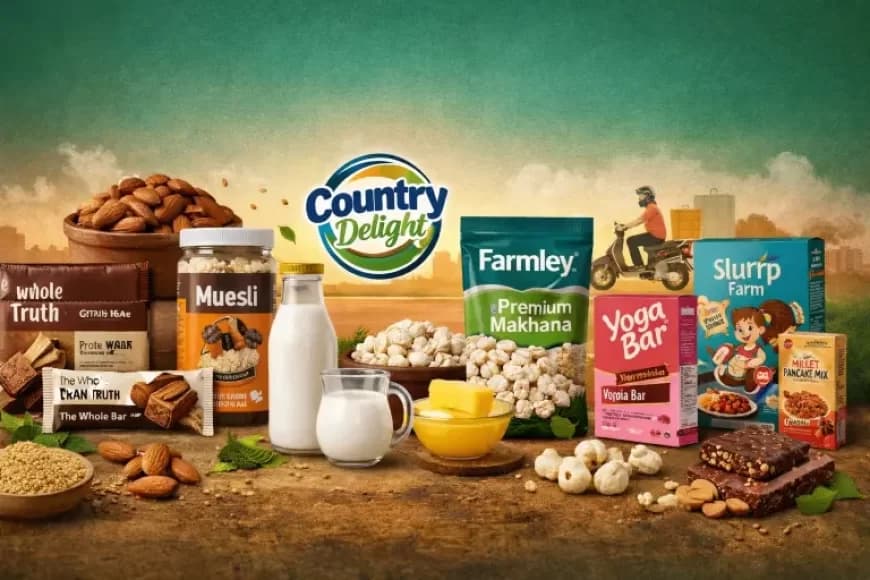
India’s clean-label food market is no longer limited to premium urban consumers. In FY25 and early FY26, clean-label products have become a mainstream expectation, powered heavily by quick commerce platforms like Zepto, Blinkit, and Swiggy Instamart.
From protein bars to millet snacks and chemical-free dairy, a new set of brands is rapidly scaling revenue—often prioritizing growth over profitability.
Clean-Label Brands in India Are Scaling Faster Than Ever
The clean-label movement in India is being driven by rising health awareness, ingredient-conscious buying, and demand for “no preservatives” products. Unlike earlier years, consumers are now actively checking labels for additives, artificial flavours, and hidden sugars.
Quick commerce has further accelerated this shift by making healthy products instantly available—turning clean eating into an impulse purchase rather than a planned decision.
Top 5 Clean-Label Leaders in India (FY25–Early FY26)
1. The Whole Truth (TWT) Leads India’s Protein Snacking Boom
The Whole Truth (TWT) has emerged as one of India’s fastest-growing clean-label nutrition brands, with strong traction in protein bars, chocolates, and muesli.
In FY25, the company reported revenue of around ₹216 crore, a sharp rise compared to FY24. The brand continues to invest heavily in marketing and expansion, keeping profitability secondary for now.
TWT is also among the strongest performers in the “healthy snacking” segment across major quick commerce apps, where protein bars are increasingly being ordered as instant post-workout or on-the-go snacks.
Key growth driver: Quick commerce + repeat purchase nutrition products.
2. Country Delight Expands Beyond D2C Milk Into Instant Delivery
Country Delight has built a strong reputation around traceability, chemical-free dairy, and freshness-based positioning. The brand’s full-stack supply chain model has helped it scale rapidly in India’s organized dairy segment.
With revenue estimated at around ₹1,380 crore in FY24, the brand is expected to move closer to the ₹1,800–₹2,000 crore range in FY25, driven by dairy, ghee, and fresh produce.
What’s changing now is the brand’s move toward faster delivery models, reflecting how consumer expectations have shifted toward “fresh in minutes” rather than “fresh tomorrow morning.”
Key trend: Freshness claims are now being reinforced through speed of delivery.
3. Farmley Becomes a Clean-Label Snacking Giant in FY25
Farmley has become a dominant name in India’s clean-label snack category, especially for makhana, roasted nuts, seeds, and dry fruit mixes.
In FY25, the company recorded revenue of approximately ₹394 crore, growing strongly over FY24. Importantly, Farmley has also improved operational efficiency, narrowing losses while expanding aggressively across both offline retail and quick commerce.
The brand is now available in 20,000+ stores, but its biggest growth push is coming from quick commerce, where impulse-driven snack buying is exploding.
Farmley’s improved unit economics suggests it may be closer to profitability compared to many peers in the segment.
Key growth driver: Q-commerce demand + retail distribution expansion.
4. Yoga Bar Gains Stronger Reach After ITC Acquisition
Yoga Bar, now under ITC, continues to hold a strong position in India’s energy bar and muesli market. With ITC’s distribution support, Yoga Bar has expanded beyond its original metro-heavy audience.
In FY25, the brand posted revenue of around ₹202 crore, showing steady growth in the 20–25% range. Industry tracking suggests Yoga Bar remains among the top brands in the healthy snack bar segment, competing against both startups and FMCG giants.
The ITC backing is proving critical in pushing the brand into Tier 2 and Tier 3 cities, where demand for “healthy packaged food” is rising rapidly.
Key advantage: ITC’s supply chain + national distribution scale.
5. Slurrp Farm Builds a Strong Millet-Led Kids Nutrition Market
Slurrp Farm, operated by Wholsum Foods, is emerging as a key clean-label brand in India’s millet-based children’s food category.
In FY25, the brand recorded revenue of around $11.5 million (approx ₹96 crore) and is aiming for a significantly higher run-rate as demand for millet snacks grows across households.
Slurrp Farm has also strengthened its brand visibility due to celebrity association and has expanded its positioning beyond children through a new millet-focused adult nutrition brand.
Quick commerce is becoming a major channel for Slurrp Farm, particularly in the “baby food” and “healthy millet snacks” segments.
Key driver: Millet trend + parent-focused clean eating movement.
How Quick Commerce Is Powering Clean-Label Growth in India
Quick commerce is now shaping the clean-label market more than traditional e-commerce. In 2025 and 2026, instant delivery is becoming the strongest sales engine for nutrition-focused brands.
Why quick commerce is winning:
1. “Impulse Health” Is a New Buying Habit
Consumers are ordering protein bars, makhana, and healthy snacks instantly—especially after workouts or during office breaks.
2. Speed Builds Trust for “Freshness” Brands
For brands like Country Delight, fast delivery strengthens the promise of freshness and low preservative usage.
3. Discovery Is Easier Than Ever
Quick commerce apps are functioning like digital shelves, helping consumers discover clean-label brands without needing a store visit.
Profitability Still a Challenge for Most Clean-Label Startups
Despite rapid growth, many clean-label brands remain in a “scale-first” phase. High customer acquisition costs, marketing spends, and platform-driven competition are keeping profitability under pressure.
Some brands are seeing losses widen as they expand aggressively, while others are slowly improving unit economics by balancing offline retail with online growth.
At the same time, these startups are now facing increasing competition from established FMCG and snack giants, who are launching “healthier” product lines to protect market share.
Future Outlook: Clean-Label Will Become the Default FMCG Standard
FY25 and early FY26 data indicates that clean-label is no longer a niche trend—it is rapidly becoming the baseline expectation in packaged food and daily nutrition categories.
As quick commerce platforms expand deeper into Tier 2 and Tier 3 cities, clean-label brands will likely see even faster growth. However, the next major challenge will be sustaining margins while fighting rising competition from legacy FMCG players.
The coming year could be defined by one major shift: brands that balance growth with profitability will become the long-term winners.
FAQ: Clean-Label Brands in India (FY25–FY26)
Q1. What does clean-label mean in India?
Clean-label refers to products with simple, transparent ingredient lists, minimal additives, no harmful preservatives, and fewer artificial flavours or chemicals.
Q2. Which are the top clean-label brands in India in FY25?
Based on FY25 and early FY26 performance, the top brands include The Whole Truth, Country Delight, Farmley, Yoga Bar, and Slurrp Farm.
Q3. Why is quick commerce important for clean-label brands?
Quick commerce platforms like Blinkit, Zepto, and Swiggy Instamart help clean-label brands grow faster by enabling instant purchases, repeat buying, and easy product discovery.
Q4. Are clean-label brands profitable in India?
Many clean-label startups are still prioritizing expansion over profits. Some brands are narrowing losses, but the segment remains highly competitive and marketing-heavy.
Q5. Which clean-label segment is growing fastest in India?
The fastest-growing categories include protein snacks, makhana and roasted nuts, millet-based products, and traceable dairy due to strong health awareness and urban demand.