
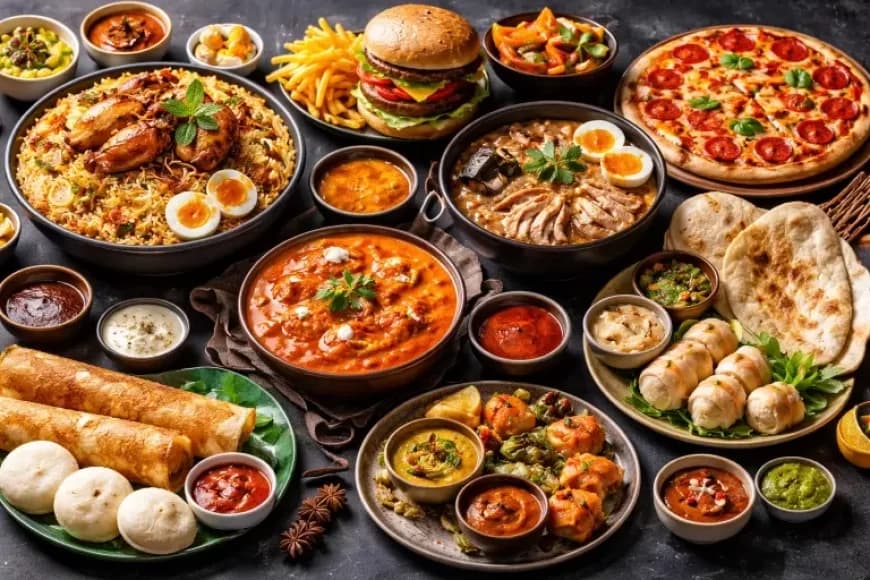
India’s food and beverage sector is undergoing a structural transformation. Consumption in 2026 is no longer defined only by taste or tradition—it is shaped by data, delivery density, time-based demand, health preferences, and cultural influence.
Insights from annual reports and consumption dashboards of Swiggy, Zomato and HVS ANAROCK reveal five cuisines that dominate India’s plates—both online and offline.
Biryani: From Signature Dish to a Standalone Food Category
Biryani has crossed the threshold from being a popular dish to becoming India’s most reliable food category. In 2025 alone, food delivery platforms recorded over 93 million biryani orders, translating to nearly 194 orders every minute across the country.
Chicken biryani accounts for close to 60% of total biryani consumption, followed by mutton and veg variants. Festival-linked consumption remains a major driver—Ramadan alone contributed nearly 6 million biryani orders, highlighting its role as both an everyday and celebratory meal.
Late-night consumption data places biryani as the second most-ordered item between 12 AM and 2 AM, driven by students, night-shift workers and urban households. Offline, Tier-2 cities such as Hyderabad, Lucknow and Kolkata continue to show high dine-in footfall, while biryani-only brands have emerged as anchor tenants in mall food courts.
Key Insight: Biryani is no longer seasonal or occasion-based—it is a national staple with predictable, repeat demand.
North Indian & Mughlai: The Backbone of India’s Dine-In Economy
While biryani dominates delivery volumes, North Indian and Mughlai cuisine remains the largest contributor to dine-in revenue. It ranks as the number one cuisine for table reservations and family dining across India.
Delhi-NCR continues to outperform all major metros, recording over 4.22 crore orders across delivery and dine-in formats—significantly higher than Mumbai or Bengaluru. Online data shows that North Indian food peaks sharply around 8:25 PM, often referred to internally by platforms as “India’s national dinner time.”
Group ordering behaviour reveals that dishes like butter chicken and dal makhani are among the most gifted and shared meals, reinforcing their role in social dining. A major 2026 trend is the shift from generic North Indian menus to heritage and region-specific brands, with consumers actively seeking Punjabi, Awadhi, Kashmiri and Old-Delhi style food identities.
Key Insight: Trust, familiarity and authenticity—not novelty—are driving North Indian cuisine growth.
South Indian Cuisine: Health, Breakfast and Daily Consumption Leader
South Indian cuisine has positioned itself as India’s cleanest and most functional food choice, especially in urban and tech-driven markets. In 2025, veg dosa alone crossed 26.2 million orders, while idli emerged as the most ordered breakfast item nationwide, with 11 million orders.
Demand is strongest between 7 AM and 11 AM, making South Indian food the most time-specific cuisine in India. A major data highlight for 2026 is the surge in high-protein and millet-based variants—ragi dosa, millet idli and protein-rich sambhar—which together saw a 23-million order jump in cities like Bengaluru and Hyderabad.
Footfall data shows South Indian outlets performing exceptionally well in office clusters, metro stations and railway hubs. Vijayawada Junction alone recorded 1.4 lakh South Indian food orders, underlining its role as preferred travel food.
Key Insight: South Indian cuisine is no longer regional—it is India’s default health and breakfast solution.
Burgers & Pizzas: The Indianised QSR Powerhouse
Burgers and pizzas have fully transitioned into local comfort food, driven by flavour localisation and aggressive QSR expansion. Burgers ranked as the second most ordered item overall in 2025 with 44.2 million orders, followed closely by pizzas at 40.1 million orders.
The highest consumption window lies between 3 PM and 7 PM, confirming their dominance in the snack and impulse-eating segment. Chicken burgers alone contributed 6.3 million orders, making them the most consumed non-veg snack item.
The Indian QSR market is valued at $30.37 billion in 2026, with homegrown brands expanding rapidly into Tier-2 and Tier-3 cities. Affordability, speed and consistency remain the key drivers.
Key Insight: QSR success in India depends on localisation and scale, not western identity.
Pan-Asian Cuisine: From Indo-Chinese to Micro-Cuisine Dining
Pan-Asian cuisine is India’s fastest-evolving food category. While momos remain a mass favourite—crossing 12 million orders—the real growth story lies in Korean and specialised Asian cuisines.
Korean food recorded 4.7 million orders in 2025, marking one of the highest year-on-year growth rates across all cuisines. Consumer preferences are shifting away from deep-fried Manchurian toward lighter, cleaner dishes such as ramen, sushi and stir-fried bowls.
Footfall is strongest in premium dining hubs and bar clusters, where consumers increasingly choose single-cuisine Asian restaurants over multi-cuisine outlets.
Key Insight: Pan-Asian growth is driven by culture, experience and specialisation—not volume.
The Hidden Growth Engine: Hyper-Local Indian Cuisines
Beyond the top five categories, data points to a strong rise in hyper-local regional cuisines. Pahadi cuisine from Himachal and Uttarakhand recorded a 9x increase in demand, while Malabari and Rajasthani food nearly doubled in online searches and orders.
Consumers are increasingly trading “North Indian” or “South Indian” labels for geographically precise food identities, signalling a deeper maturity in food discovery behaviour.
Key Insight: India’s next food wave will be regional, story-driven and deeply local.
How India Will Eat Going Forward
The 2026 Indian food landscape is no longer driven by trend alone—it is governed by data, time windows, city behaviour and cultural signals. Biryani anchors volume, North Indian cuisine secures trust, South Indian food leads daily health consumption, QSR fuels impulse eating, and Pan-Asian food delivers experience-led growth.
For restaurants, cloud kitchens and food brands, the future lies in menu focus, localisation and understanding when—not just what—India eats.
FAQs
1. Which cuisine has the highest food delivery orders in India?Biryani leads all cuisines with over 93 million orders annually.
2. What is India’s most popular breakfast cuisine?South Indian food, especially idli and dosa, dominates breakfast consumption nationwide.
3. Why is Korean food growing fast in India?Cultural influence, lighter meals and premium dining appeal are driving Korean cuisine demand.
4. Are regional Indian cuisines gaining popularity?Yes, hyper-local cuisines like Pahadi, Malabari and Rajasthani are seeing rapid growth.
5. What is the biggest food trend for restaurants in 2026?Cuisine specialisation and region-specific branding over generic multi-cuisine menus.