
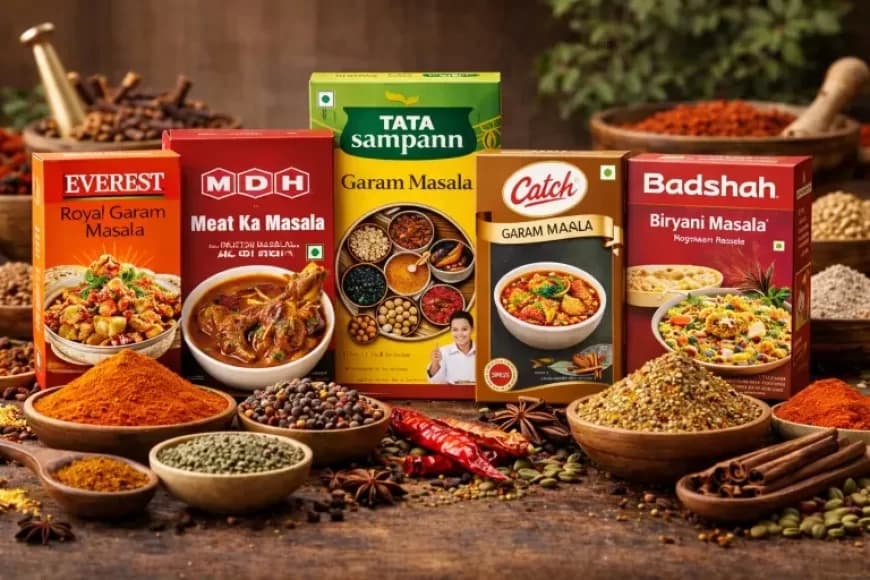
In FY 2025–26 India’s spice market—now worth over ₹45,000 crore—shifted decisively from commodity trading to branded, premium offerings. Everest, MDH, Tata Sampann, Catch and Badshah together drove branded growth through product innovation, export expansion and rapid adoption on quick-commerce platforms.
Market snapshot: branded spices and quick commerce
The organised branded spice segment is expanding faster than the unorganised market, with an estimated branded CAGR of 12–15% versus roughly 8% for the overall sector. Value-added blends and ready-to-cook masalas are lifting export earnings and margins while quick-commerce apps (Blinkit, Instamart, Zepto and other regional players) have become important channels for urban repeat and impulse purchases.
1. Everest — Scale, reach and steady growth
Indian market share (branded): ~14–15%Estimated FY26 revenue: ~₹3,600+ croreYoY growth: ~6–10%Quick-commerce share (among top five): ~25–30%
Everest remains the dominant national leader by distribution and volume. Its core strength is frequency — everyday staples and blended masalas that drive high repeat purchases across general trade, modern retail and instant delivery apps. Everest also holds a strong export footprint across the Middle East, GCC and diaspora markets, where blended masalas remain its top sellers. Growth is steady and volume-driven rather than premium-led, protecting margins but moderating explosive YoY spikes.
2. MDH — Heritage, trust and margin resilience
Indian market share (branded): ~11–12%Estimated FY26 revenue: ~₹2,500–2,800 croreYoY growth: ~5–8%Quick-commerce share (among top five): ~15–20%
MDH’s advantage is brand trust built over decades. Its integrated sourcing and tight quality control support healthy profitability even as growth is measured. MDH’s exports span 80–100+ countries, with rising traction in developed markets where authentic Indian blends fetch premium pricing. On quick-commerce MDH performs well on staple SKUs, though much of its volume still comes from traditional retail.
3. Tata Sampann — The fastest-scaling premium challenger
Indian market share (branded): ~5–7%Estimated FY26 revenue: >₹1,000 crore (brand level)YoY growth: ~40%Quick-commerce share (among top five): ~18–22%
Tata Sampann has emerged as the category disruptor with a clear “purity + science” positioning — unpolished, oils-intact spices that appeal to health-forward millennials. Its rapid distribution rollout via Tata Consumer channels and aggressive digital marketing have driven exceptional YoY growth and strong over-indexing on quick-commerce platforms. Internationally, Tata Sampann is growing premium demand in the US and other western markets for clean-label Indian spices.
4. Catch — Innovation, convenience and urban traction
Indian market share (branded): ~8–9%Estimated FY26 revenue: ₹1,200–1,500 croreYoY growth: ~20–30%Quick-commerce share (among top five): ~12–16%
Catch has built scale through product differentiation — low-temperature grinding (LTG), table-top shakers and convenience formats that suit urban kitchens and HORECA customers. These formats perform well on quick-commerce where consumers buy small volumes often and on impulse. Catch’s exports are concentrated in GCC and Southeast Asia, often targeting hospitality channels with convenience SKUs.
5. Badshah — Accelerating under Dabur’s umbrella
Indian market share (branded): ~4–5%Estimated FY26 revenue: ~₹450–500 crore (brand-level estimate post-acquisition scaling)YoY growth: ~25–35%Quick-commerce share (among top five): ~6–10%
Badshah has used Dabur’s distribution and marketing muscle to scale quickly. The acquisition has expanded Badshah’s national retail reach and opened international distribution corridors into Europe, Africa and the Middle East via Dabur’s networks. Quick-commerce share is growing but still lower than Everest or Tata Sampann while the brand consolidates national visibility.
Exports and the value-added shift
India’s spice exports are moving up the value chain: blended masalas, ready-to-cook mixes and branded convenience packs are growing faster than bulk raw spice shipments. The top five branded players account for a disproportionate share of value-added exports, leveraging global distribution ties and diaspora demand to lift average realisations.
Quick-commerce: why it matters
Quick-commerce is not just a sales channel — it is a discovery and trial engine. Urban shoppers use instant delivery for recipe-driven, impulse or top-up purchases; brands with strong digital promotions, smaller SKUs and attractive listings (Tata Sampann, Catch) see higher velocity on these platforms. Estimates suggest ~8–12% of urban packaged spice sales in major metros now come via quick-commerce, with premium brands over-indexing.
FY 2025–26 demonstrated that scale and trust (Everest, MDH) coexist with rapid premium disruption (Tata Sampann, Catch) and strategic rollouts (Badshah + Dabur). Over the next 24 months expect branded spices to extend leads through traceability, clean-label certification and deeper quick-commerce integration. Export growth in value-added segments should lift margins and encourage further product innovation across price points.
FAQ — quick answers for readers and search
Q1: Which company leads India’s organised spice market in FY26?A: Everest is the market leader in the organised branded spice segment with about 14–15% share.
Q2: Who recorded the highest YoY growth among top brands?A: Tata Sampann recorded the fastest growth, roughly 40% YoY, driven by premium positioning and digital distribution.
Q3: How big is quick-commerce for spices?A: Quick-commerce accounts for an estimated 8–12% of urban packaged spice volume in major metros and is rising, especially for premium and convenience SKUs.
Q4: Are Indian spice exports shifting toward value-added products?A: Yes — there is a clear move from raw spice shipments to blended masalas and ready-to-cook mixes, improving margins and export earnings.
Q5: Will heritage brands lose ground to challengers?A: Not immediately. Heritage brands like MDH and Everest retain trust and distribution; challengers are growing rapidly in premium and digital channels—but both models can co-exist and expand the overall packaged spices market.