
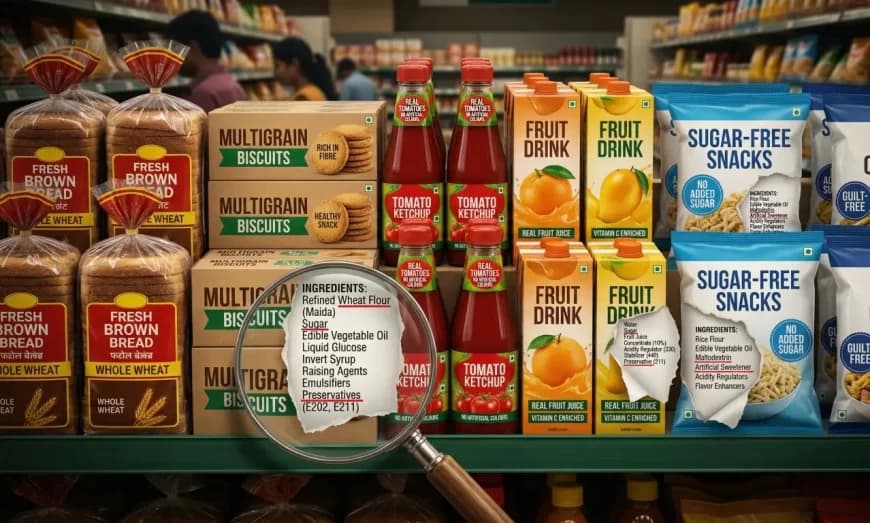
If food packets could talk honestly, many supermarket shelves would fall silent. From “fresh” ketchup to “brown” bread and “sugar-free” snacks, Indian consumers are surrounded by health claims that feel reassuring—but are they real? Growing evidence suggests that a large share of packaged food labels in India are crafted more to persuade than to inform.
So the real question is: Are you choosing your food—or is the packaging choosing for you?
Supermarkets Are Not Grocery Stores Anymore. They’re Advertising Zones.
Every packaged food item today competes like a billboard. Bright colours, farm imagery, nutrition buzzwords—everything is engineered to create trust in three seconds.
Consumer research and regulatory observations show that nearly 60% of food-related marketing claims can be misleading or exaggerated, especially in ultra-processed foods. These claims work by creating a health halo—once we believe something is “healthy,” we stop questioning it.
And that’s exactly where the problem begins.
Be honest—how often do you read the back label before buying?
“Made With Fresh Ingredients”: Fresh When Exactly?
What the Packet Suggests
A bottle of ketchup with shiny tomatoes and words like fresh and farm-picked.
What the Label Actually Says
“Made with fresh tomatoes.”
That wording matters.
Under current food regulations, fresh applies primarily to raw foods. When brands say “made with fresh,” they are referring to ingredients that may have been processed months earlier into pastes or concentrates.
In reality:
Most mass-market ketchups use tomato paste, not fresh pulp
Sugar can make up nearly 25% of the bottle
Preservatives and stabilisers complete the formula
Question worth asking:If ketchup is 1/4th sugar, why don’t we treat it like a dessert?
Brown Bread: Healthy Choice or Just Brown-Coloured Maida?
Why This Matters
“Brown” sounds wholesome. “Farm-style” sounds rustic. But neither guarantees nutrition.
In many cases:
The brown colour comes from caramel colouring or molasses
Refined flour (maida) still dominates the recipe
Even “whole wheat” breads can legally include refined flour
A quick test many consumers swear by:If bread is extremely soft and sticky, chances are it’s refined flour-heavy.
Your turn:Do you buy brown bread because of fibre—or because it looks healthier?
No Added Sugar ≠ Low Sugar
This is one of the most misunderstood food claims in India.
“No added sugar” often means:
Sugar wasn’t added directly
But fruit juice concentrates, maltodextrin, or dextrose were used instead
From a blood sugar perspective, the body often treats these almost the same as sugar.
So while the label feels safe, the nutritional impact may not be.
Let’s discuss:Should “no added sugar” be allowed if blood sugar spikes remain the same?
Multigrain Isn’t a Health Guarantee Either
Multigrain sounds impressive—until you realise it’s about variety, not quantity.
A biscuit can legally be:
90% refined flour
2–3% mixed grains
Still marketed as “multigrain”
Recent reviews of Indian food listings show that fibre and nutrition claims are frequently overstated or supported by synthetic additives rather than real grains.
Food for thought:Is “multigrain” just the new version of “brown”?
Why This Is Bigger Than Just One Wrong Purchase
This isn’t about wasting ₹30 on a packet of biscuits. It’s about long-term impact.
India faces a sharp rise in diabetes and lifestyle diseases
Ultra-processed foods are linked to multiple non-communicable diseases
Consumers eat more when they believe food is healthy
You don’t just lose money—you lose awareness.
The 5-Second Label Habit That Can Change Everything
Next time you shop, try this:
Ignore the front of the pack
Read the first three ingredients
Check serving size claims
Count how many additives you don’t recognise
If the ingredient list looks like a chemistry exam, it’s not everyday food.
Final Thought: Real Food Doesn’t Need Convincing
An apple doesn’t say “fat-free.”Rice doesn’t claim “heart smart.”Real food doesn’t shout—it simply exists.
The louder a packet screams about health, the more carefully it deserves to be read.
Now Over to You
Have you ever felt misled by a food label?
Which claim do you trust the least—fresh, brown, or sugar-free?
Should food packaging rules in India be stricter?
FAQs
Are misleading food labels legal in India?
Food labels are regulated by the Food Safety and Standards Authority of India, but many marketing terms fall into grey areas.
Is brown bread better than white bread?
Not always. Nutrition depends on ingredients, not colour.
What should diabetics watch on labels?
Total carbohydrates and total sugars—not just “added sugar.”
Are packaged “healthy” snacks reliable?
Many are ultra-processed. Always verify ingredients.
Can consumer awareness change food marketing?
Yes. Consumer pushback has already forced brands to revise claims.