

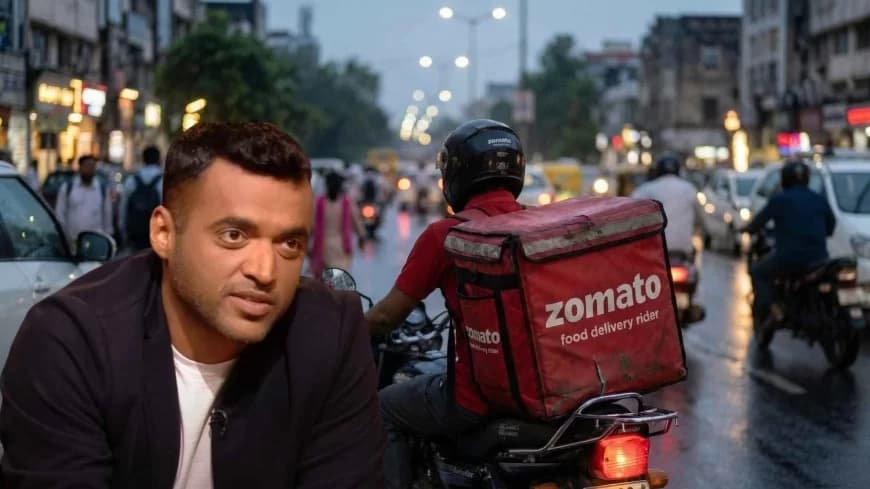
Amid rising concerns over the safety and working conditions of gig workers, Zomato co-founder and CEO Deepinder Goyal has clarified how the company’s much-debated 10-minute delivery model actually works. Responding to criticism and questions following a gig workers’ strike, Goyal said speed is driven by store proximity and system efficiency—not by pressuring delivery partners to rush.
What Deepinder Goyal Is Saying About 10-Minute Delivery
Addressing users on social media, Goyal explained that Zomato’s quick delivery promise is built on dense store networks, especially through its quick-commerce arm Blinkit.
According to him:
Orders are picked and packed in roughly 2.5 minutes
Delivery partners usually travel less than 2 km
Average riding speed is about 15 kmph
Riders do not see delivery countdown timers
There are no penalties for late deliveries
“Our 10-minute delivery promise is enabled by the density of stores around your homes, not by asking delivery partners to drive fast,” Goyal said.
Insurance, Hiring, and Gig Work Clarification
Goyal stated that all delivery partners working with Zomato are covered under medical and life insurance policies. Anyone with a valid driving licence and a clean background check is eligible to join the platform.
He also highlighted that delivery work is not designed as a permanent career. According to Goyal, most partners work for a few months in a year and then move on. The annual attrition rate among delivery partners stands at around 65%, underlining the temporary nature of gig work.
Traffic Rule Violations: Company Pressure or Social Reality?
Responding to allegations that delivery apps indirectly encourage unsafe riding, Goyal rejected the claim. He said there are no incentives linked to breaking traffic rules.
“If delivery partners were the only ones breaking traffic rules, I would take the blame,” he said, adding that impatience on Indian roads is a wider societal issue. He also pointed out that delivery partners attract more attention because they wear uniforms, making their actions easier to associate with a brand.
The Other Side: Challenges and Risks for Delivery Partners
While the company maintains that riders are not pressured, delivery partners still face several real-world challenges, including:
Traffic congestion and poor road conditions
Weather-related risks
Income uncertainty due to demand-based earnings
Customer expectations shaped by ultra-fast delivery promises
Even without explicit penalties, experts say psychological pressure to complete more orders can lead riders to take risks, especially during peak hours.
Are Current Benefits Enough for Gig Workers?
Zomato’s insurance coverage and flexible working model are often cited as key benefits. For many, gig work offers quick income and autonomy. However, labour groups argue that insurance alone may not be sufficient.
Key concerns include:
Limited income support during injury recovery
No paid leave or long-term social security
Lack of structured career growth
As India’s gig economy expands, the debate continues on whether platforms should offer stronger protections beyond insurance, while maintaining flexibility.
Efficiency vs Worker Security
Deepinder Goyal has made it clear that Zomato’s 10-minute delivery model is rooted in logistics and technology, not rider speed. While the company insists it does not exploit delivery partners, the discussion has reopened larger questions around gig worker safety, income stability, and long-term security.
Going forward, the sustainability of quick commerce will depend not just on faster systems, but on how effectively platforms balance customer convenience with the well-being of the people powering these deliveries.
FAQ: Zomato 10-Minute Delivery & Gig Workers
Q1. Does Zomato penalise delivery partners for late deliveries?
No. Zomato CEO Deepinder Goyal has clarified that there are no penalties for late deliveries.
Q2. How does Zomato manage 10-minute deliveries safely?
The model relies on nearby stores, fast order picking, and short travel distances—not on high riding speeds.
Q3. Are Zomato delivery partners insured?
Yes. All delivery partners are provided medical and life insurance coverage.
Q4. Is food delivery considered a long-term job at Zomato?
No. The company views it as temporary gig work, with most partners working for a short duration.
Q5. Why are delivery riders often seen breaking traffic rules?
Zomato says riders are more visible due to uniforms, while traffic violations are a broader societal issue, not driven by company incentives.