
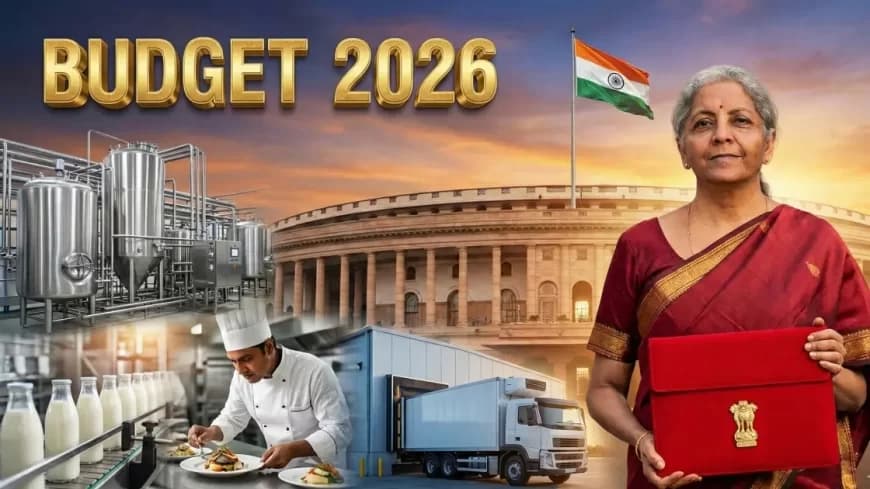
As the Union Budget 2026–27 approaches, India’s food processing, restaurant and dairy sectors are pressing for structural reforms. Industry bodies are seeking an expanded PLI scheme, GST corrections, and targeted support to unlock high-value dairy exports to the EU and UK.
With the current PLI scheme nearing its final year, Budget 2026 is being seen as a decisive moment for long-term competitiveness and global market access.
Why Budget 2026 Matters for the Food & Restaurant Sector
India is the world’s largest milk producer, yet its share in global dairy exports remains negligible. At the same time, restaurants and food manufacturers continue to struggle with high input costs, limited tax credits and infrastructure gaps.
According to industry estimates for FY 2025–26:
India produces around 240 million tonnes of milk, ranking #1 globally
Dairy exports remain below $500 million, despite massive domestic capacity
Food processing GVA stands near ₹2.24 lakh crore, with scope for faster growth
Budget 2026 is expected to address these structural bottlenecks.
PLI Scheme Phase 2: What the Industry Wants
Expanding Beyond Large Corporates
The existing Production Linked Incentive (PLI) scheme has helped scale capacity but largely benefited large manufacturers. Industry stakeholders are now demanding a PLI Phase 2 that meaningfully includes MSMEs, which form the backbone of India’s food processing ecosystem.
New Product Categories Under PLI
Key demands include incentives for:
Plant-based and alternative proteins, targeting global vegan markets
Traditional Indian dairy products like ghee, paneer and ethnic sweets, aligned with export-grade standards
Integrated cold chain infrastructure to reduce dairy and perishables wastage, estimated at 4–6%
Cheaper Access to Processing Machinery
Manufacturers are also pushing for a reduction in customs duty on imported food processing machinery—from the current 7.5–15% to around 5%—for equipment not made domestically.
GST Reforms and the Inverted Duty Challenge
Packaging GST Anomaly
One of the most persistent problems is the inverted duty structure:
Packaging materials attract 18% GST
Many processed food products are taxed at 5% or 12%
This leads to blocked input tax credit and cash flow stress. Industry bodies are seeking a reduction in GST on food-grade packaging to 12% or lower.
Restaurant GST and ITC Debate
Restaurants currently pay 5% GST but are denied ITC on rent, raw materials and services—raising operating costs significantly.
The National Restaurant Association of India has proposed a dual GST structure:
5% GST without ITC for small outlets
12% GST with ITC for organised restaurant chains
This optional system, industry leaders argue, would improve compliance and sustainability.
Dairy Exports to EU and UK: The Real Opportunity
Despite producing nearly a quarter of the world’s milk, India accounts for less than 0.5% of global dairy exports. The biggest hurdle is non-tariff barriers imposed by the European Union and the United Kingdom.
Key Export Barriers
Strict sanitary and phytosanitary (SPS) norms
Antibiotic residue limits
Lack of farm-to-fork traceability
Requirement for milk from FMD-free zones
What Budget 2026 Could Do
Industry lobbying has focused on:
Funding Foot and Mouth Disease (FMD)-free dairy zones with a proposed outlay of ₹500–1,000 crore
Establishing EU-accredited testing laboratories in India to reduce repeated consignment checks
Creating a dedicated support fund for ongoing India–UK and India–EU FTA negotiations, with dairy access as a priority
Strategic Timing: Why These Reforms Are Urgent
Global dairy supply is tightening as traditional exporters face environmental and regulatory constraints. At the same time, European markets are actively diversifying supply chains under a “China Plus One” strategy.
India, with its rising milk production and growing processing capacity, is uniquely positioned to fill this gap—provided quality assurance and tax reforms align quickly.
A Defining Budget for Food and Dairy
Union Budget 2026 could become a turning point for India’s food processing, restaurant and dairy sectors. If PLI expansion, GST rationalisation and export-focused infrastructure funding come together, India could move closer to its ambition of becoming a global food manufacturing and export hub.
For the industry, the coming budget is not just about incentives—it is about fixing structural inefficiencies that have limited scale for decades.
FAQs: Budget 2026 and India’s Food Industry
Q1. Why is PLI Phase 2 important for food processing?
PLI Phase 2 could expand incentives to MSMEs, new product categories and cold chain infrastructure, boosting exports and reducing wastage.
Q2. What GST changes are restaurants demanding in Budget 2026?
Restaurants are seeking the option to pay 12% GST with input tax credit, alongside the existing 5% GST without ITC.
Q3. Why are Indian dairy exports restricted in the EU and UK?
Strict SPS norms, antibiotic residue limits and the requirement for FMD-free milk have limited Indian dairy access.
Q4. How can Budget 2026 help dairy exports grow?
By funding disease-free zones, EU-accredited labs and trade negotiation support, the budget can reduce non-tariff barriers.
Q5. What is the long-term export target for India’s dairy sector?
Industry estimates suggest India could scale dairy exports to $8–10 billion over the long term with structural reforms.