

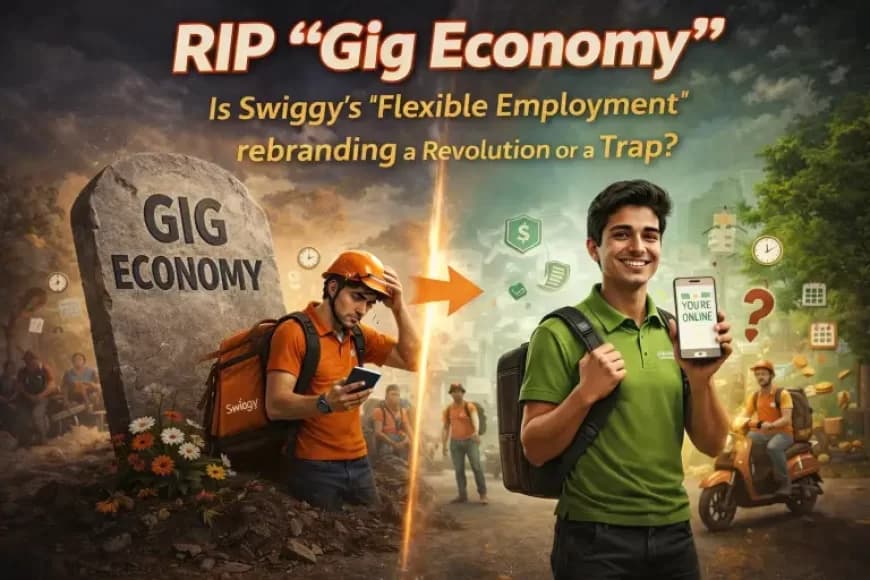
India’s gig economy debate took a sharp turn after food delivery major Swiggy publicly pushed to retire the term gig worker and replace it with flexible employment. Announced at a global stage in Davos, the move has sparked fresh questions around labour rights, regulation, and the future of platform-based work in India.
Swiggy’s Davos Statement and the Timing Behind It
At the World Economic Forum Annual Meeting in Davos in January 2026, Swiggy Food Marketplace CEO Rohit Kapoor urged policymakers and industry leaders to stop referring to delivery partners as “gig workers”.
Instead, Kapoor proposed a new classification — Flexible Employment — describing it as India’s “third pillar of employment”, alongside formal salaried jobs and entrepreneurship.
Why Now?
The timing is crucial. Globally, the term gig economy has increasingly become associated with job insecurity, weak social protection, and algorithm-driven work pressure. In India too, regulatory scrutiny around platform labour has intensified, especially with discussions around the Social Security Code.
Gig Work vs Flexible Employment: What’s the Difference?
At first glance, the change may appear semantic. However, experts say the legal and financial implications are significant.
The Case for Rebranding
Platforms argue that the traditional employer–employee framework does not fit platform-based work.
Workforce diversity: Many delivery partners are students, part-time earners, or temporary workers.
Ease of entry: Platforms provide quick income opportunities without formal hiring barriers.
Work flexibility: Partners can switch between platforms like food delivery, ride-hailing, or hyperlocal services.
According to Swiggy, this flexibility would be compromised if partners were treated as full-time employees with fixed hours and contracts.
Critics Call It a Strategic Shield
Labour experts and worker groups view the rebranding with skepticism.
Key Concerns Raised
Avoiding employee status: Recognising workers as employees would require benefits like PF, paid leave, and health insurance.
Regulatory loopholes: Labeling workers as “flexible” may help platforms argue against applying existing labour laws.
Image management: The term sounds empowering but does not guarantee income security or career growth.
The Reality on the Ground for Delivery Partners
While flexibility is often projected as the biggest advantage of platform-based work, the everyday experience of delivery partners tells a more complex story.
Working Hours:
Platforms highlight the freedom to log in and log out at will. In practice, earnings are closely tied to peak-hour incentives, streak bonuses, and surge periods, which often push partners to work long, rigid shifts during evenings, weekends, or bad weather.
Earnings Stability:
Companies promote the potential to earn high incentives. However, as more delivery partners join the platform, per-order payouts tend to fall, making it harder to maintain consistent or predictable income levels.
Career Growth:
Delivery work is often positioned as a temporary stepping stone. On the ground, opportunities for upward mobility remain limited, with most partners continuing in the same role without clear pathways to supervisory or managerial positions.
Social Security and Safety Nets:
Platforms usually provide insurance coverage only during active delivery hours. If a partner falls ill, meets with an accident off-duty, or takes a day off, income drops to zero, with no paid leave or long-term security.
Industry studies indicate that a significant share of delivery partners work 10–12 hours a day, six days a week, mirroring full-time employment — but without access to benefits such as provident fund, paid leave, or gratuity.
What This Means for India’s Labour Policy
Swiggy’s third pillar narrative signals a larger policy battle ahead. The key question is not just terminology, but responsibility.
Will platforms voluntarily fund social security benefits?
Or will the government step in with taxpayer-backed safety nets?
As India’s platform economy expands, regulators will be under pressure to balance innovation with worker protection.
The push for flexible employment is likely to gain traction across platform companies. However, without concrete benefit frameworks, the rebranding risks being viewed as optics rather than reform. The coming months — especially debates around labour codes — will determine whether flexibility and security can truly coexist.
Frequently Asked Questions (FAQs)
1. Why does Swiggy want to stop using the term ‘gig worker’?
Swiggy believes the term no longer reflects the diversity and flexibility of its workforce and carries negative global perceptions.
2. Does ‘flexible employment’ change workers’ legal rights?
Not yet. Critics argue it could delay or weaken the push for employee-level benefits unless backed by regulation.
3. Are Swiggy delivery partners considered employees?
Currently, they are classified as independent partners, not formal employees.
4. How many delivery partners does Swiggy have in India?
Swiggy reported working with around 2.5 million delivery partners in the last year.
5. Will the government regulate flexible employment?
The issue is under discussion, especially in relation to India’s Social Security Code, but no final framework has been implemented yet.