
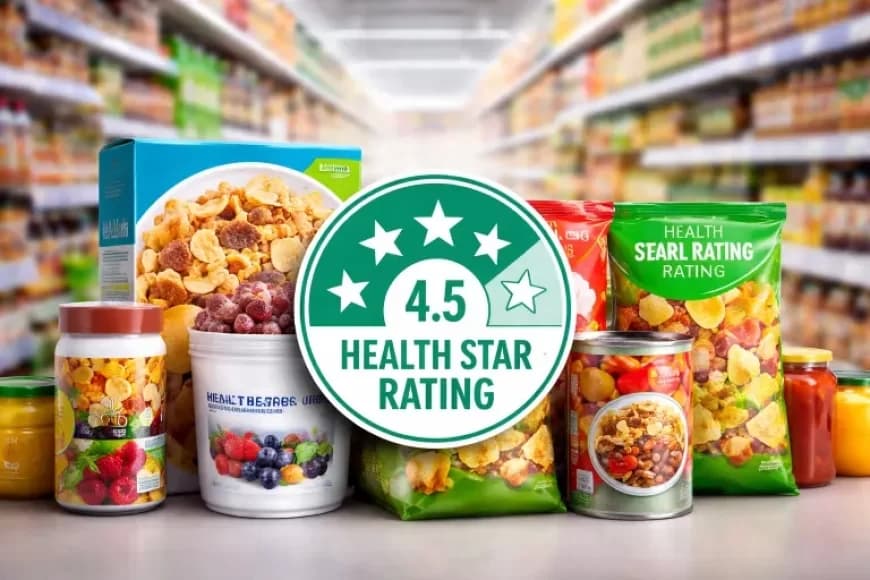
Australia has taken a major public health step by officially approving mandatory Health Star Ratings (HSR) on all packaged foods. Starting February 2026, food companies will no longer be able to selectively display nutrition ratings only on products with high scores.
The decision is expected to reshape the food retail landscape, push brands toward reformulation, and influence other global markets watching Australia’s regulatory approach.
Australia Health Star Rating Becomes Mandatory: What Happened?
Australia’s food and health ministers have voted to make the Health Star Rating system compulsory, ending its long-running voluntary status. Until now, brands had the option to display the HSR label or avoid it completely.
But government audits showed that many companies were using the system mainly as a marketing advantage rather than a transparency tool—highlighting healthier products while keeping low-rated products unlabelled.
This shift makes Australia one of the strongest global examples of front-of-pack nutrition labeling enforcement.
Why Australia Ended Voluntary Health Star Ratings
For more than a decade, the Health Star Rating was based on industry participation. However, recent evaluations found that the voluntary model failed to deliver fair consumer awareness.
Key findings that triggered government action
Products likely to score high ratings were far more likely to display stars.
Products expected to receive low ratings largely avoided the label.
Consumers were left without clear comparison tools while shopping.
This pattern raised concerns that the voluntary approach was unintentionally encouraging misleading front-of-pack marketing, especially for ultra-processed foods.
How the Health Star Rating System Works (HSR Calculator Explained)
The Health Star Rating system assigns a score from 0.5 stars to 5 stars based on nutritional quality per 100g.
The algorithm weighs negative nutrients against positive nutrients to calculate the final rating.
Nutrients That Reduce the HSR Score
The system penalizes foods high in:
Saturated fat
Sugar
Sodium
Energy (kilojoules)
These are commonly linked to obesity, heart disease, diabetes, and high blood pressure.
Nutrients That Improve the HSR Score
Foods can gain points for:
Fruits, vegetables, nuts, legumes (FVNL)
Protein
Dietary fibre
Calcium (in dairy-based products)
This structure encourages manufacturers to improve nutritional profiles rather than rely purely on branding claims.
Big Impact on FMCG Brands and Packaged Food Manufacturers
The mandatory rollout is expected to force major FMCG companies to rethink product formulation and marketing strategy.
Major Changes Expected Across the Industry
Food businesses are likely to face:
Product reformulation to reduce sugar and salt
New packaging designs for every SKU
Brand repositioning for products that score low
Many companies may attempt to improve star ratings by adjusting ingredients, but regulators are expected to monitor whether improvements are genuinely beneficial.
Can the Health Star Rating System Be Manipulated?
Some health experts have raised concerns that scoring systems can sometimes be “worked around” through technical changes—for example, adding fibre isolates or modified ingredients to increase ratings without improving real health outcomes.
To address these concerns, Food Standards Australia New Zealand (FSANZ) has strengthened oversight of the rating calculator to ensure better accuracy and transparency.
Global Ripple Effect: Why Other Countries Are Watching Australia
Australia’s decision is expected to influence policy discussions worldwide, particularly in the Asia-Pacific region.
Countries exploring stricter packaged food labeling may treat this move as a benchmark for:
Consumer protection laws
Anti-obesity policies
Nutrition-driven reforms in the food sector
What it means for Indian FMCG exporters
Indian snack, packaged food, and ready-to-eat exporters selling into Australia may need to:
Redesign packaging for compliance
Recalculate nutrition panels
Improve formulations to avoid low HSR ratings
This could become a major factor in how Indian food brands compete in Australian supermarkets.
A New Era of Food Transparency
Australia’s decision to make Health Star Ratings mandatory from February 2026 signals a major shift toward nutrition transparency and consumer empowerment. For consumers, it makes healthier decision-making easier. For the food industry, it creates pressure to reformulate products and compete on nutritional value—not just marketing.
If successful, the policy may set a global precedent and encourage other nations to adopt similar mandatory front-of-pack labeling systems.
FAQ: Australia Mandatory Health Star Rating 2026
Q1. When will Health Star Ratings become mandatory in Australia?
Health Star Ratings will become mandatory on packaged foods starting February 2026.
Q2. What is the Health Star Rating (HSR) system?
HSR is a front-of-pack nutrition label that rates packaged foods from 0.5 to 5 stars based on their nutritional quality.
Q3. Why did Australia make Health Star Ratings compulsory?
Australia moved to mandatory labeling because the voluntary system was being used selectively—brands displayed high ratings but avoided showing low scores.
Q4. How is the HSR score calculated?
The score is calculated using an algorithm that balances negative nutrients like sugar, sodium, saturated fat, and calories against positives like fibre, protein, and FVNL content.
Q5. Will this change force companies to reformulate products?
Yes. Experts expect widespread reformulation to reduce sugar and sodium levels, as brands will want to avoid low star ratings that could impact sales.