

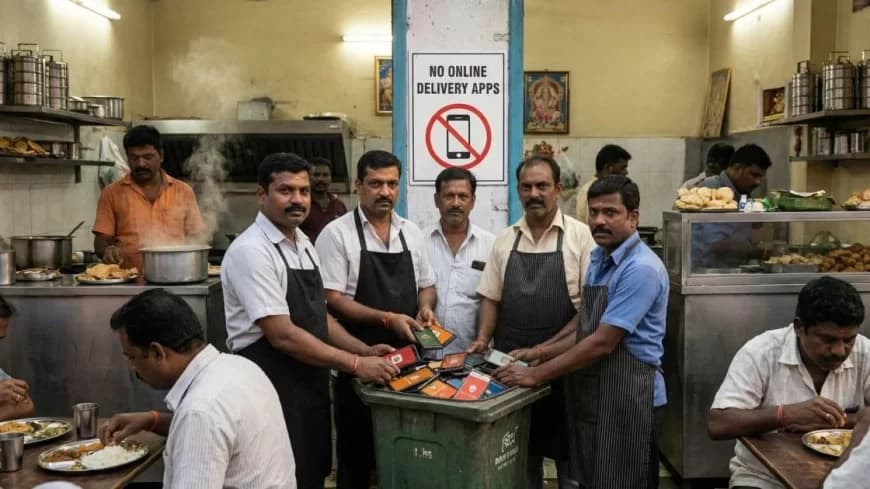
Food delivery apps have become a critical lifeline for India’s restaurant industry—but not without friction. A new nationwide survey reveals that more than one-third of restaurants would stop using food delivery platforms if given the choice, highlighting rising concerns around costs, control, and long-term sustainability.
35% of Restaurants Would Exit Food Delivery Apps if They Could
According to a recent study by the National Council of Applied Economic Research (NCAER), around 35% of restaurants currently listed on food delivery platforms say they would prefer to quit if alternatives were viable. The research, sponsored by Prosus, surveyed 640 restaurants across 28 Indian cities, spanning Tier 1, Tier 2, and Tier 3 markets.
Despite dissatisfaction, nearly two-thirds of restaurants continue using delivery apps, underlining how deeply embedded these platforms have become in daily operations.
High Commissions Are the Biggest Pain Point
Commissions Nearly Tripled in Four Years
The survey identifies platform commissions as the single biggest driver of dissatisfaction. Average per-order commissions have increased sharply—from under 10% in 2019 to nearly 25% by 2023.
For many restaurant owners, this means higher order volumes do not translate into healthier profits. While medium and large restaurants sometimes manage to negotiate better terms, smaller and independent outlets often lack bargaining power.
Key takeaway: High sales on delivery apps do not always mean high margins.
Why Most Restaurants Still Stay on Delivery Platforms
Visibility, Reach, and Customer Access
Despite cost pressures, restaurants acknowledge the advantages of delivery apps. The study found that:
Nearly 60% expanded their delivery reach beyond local neighbourhoods
Over 50% attracted new customers
Many were able to increase menu variety and order frequency
For newer restaurants, delivery platforms often act as a discovery engine—something difficult to replicate independently.
Delivery Platforms Boost Revenue, But Lower Margins
Interestingly, the report notes that restaurants operating on delivery platforms tend to earn higher overall profits, even though their profit margins are thinner compared to offline-only outlets.
Platforms also contribute to greater formalisation of the sector by encouraging digital payments, GST compliance, licensing, and data-driven operations such as inventory and accounting.
Post-Covid Shift: Stabilisation, Not Growth
The dependence on food delivery apps surged during the Covid-19 pandemic but has since stabilised. In several Tier 3 cities, platform-driven revenues have even seen a slight decline as dine-in traffic recovers and local customer loyalty strengthens.
This suggests that while delivery apps remain essential, they may no longer be the primary growth engine they once were.
A Relationship Built on Trade-Offs
The survey paints a clear picture: restaurants do not see food delivery apps as perfect partners, but as necessary ones. High commissions, limited transparency, and platform dependence clash with benefits like scale, convenience, and customer acquisition.
The future of this relationship will likely depend on how platforms address restaurant concerns—particularly around pricing fairness, commission structures, and long-term profitability.
Can Food Delivery Become More Sustainable for Restaurants?
Food delivery apps are no longer optional for most Indian restaurants, but neither are they universally loved. As the ecosystem matures, the challenge will be finding a balance between platform growth and restaurant sustainability. Transparent pricing, flexible commissions, and stronger support systems may determine whether restaurants stay by choice—or by compulsion.
Frequently Asked Questions (FAQs)
Why do 35% of Indian restaurants want to quit food delivery apps?
Mainly due to high commissions, low margins, and limited control over pricing and customer data.
How much commission do food delivery apps charge restaurants in India?
On average, commissions rose from about 9–10% in 2019 to nearly 25% by 2023.
Do restaurants earn more money by using delivery apps?
Yes, overall profits are often higher due to increased volume, but profit margins per order are usually lower.
Why don’t restaurants leave food delivery platforms despite dissatisfaction?
Because platforms provide visibility, customer access, logistics support, and sales during non-peak hours.
Will restaurants reduce dependence on delivery apps in the future?
Possibly. As dine-in recovers and direct ordering channels grow, some restaurants may diversify away from heavy platform reliance.