

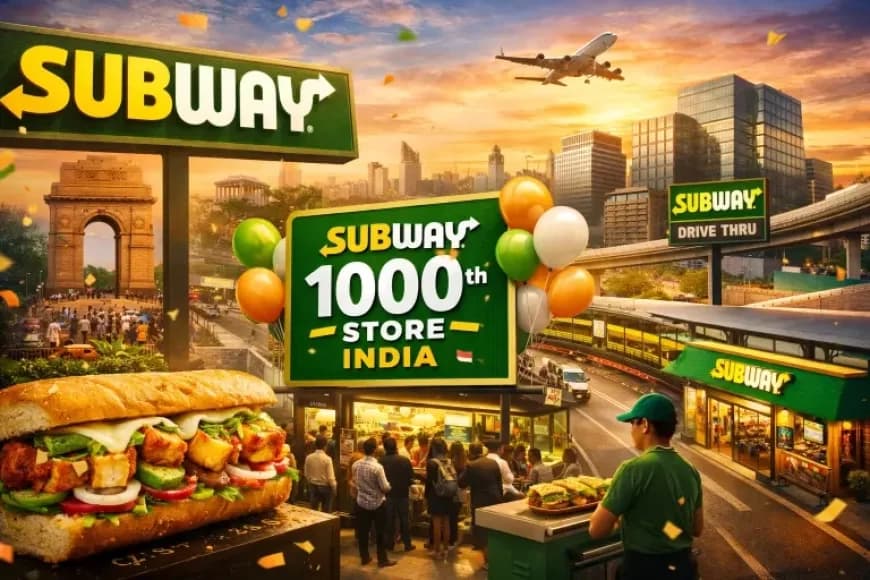
Subway has never been the loudest voice in India’s quick service restaurant (QSR) race. But with the opening of its 1,000th outlet in Gurugram, the global sandwich chain has delivered one of the clearest signals yet that scale, not noise, is now its strategy.
The milestone marks Subway’s evolution from a niche western sandwich brand into a serious mass-market player in India’s ₹80,000-crore QSR industry.
A Milestone That Reflects Momentum, Not Just Math
The 1,000-store mark is significant not because of the number itself, but because of how Subway got there. Over the past three years, the brand has added close to two outlets every week—an expansion rate that places it among the fastest-growing QSR chains in the country.
Unlike early expansion waves driven by mall-heavy strategies, Subway’s recent growth has been deliberately quieter, deeper, and far more distributed across urban India.
The 2021 Reset That Changed Everything
Subway’s India journey was not always this decisive. For years, growth was steady but fragmented, spread across multiple franchise operators without a unified long-term vision.
That changed in 2021, when the brand signed a master franchise agreement with Everstone Group, through its consumer platform EverBrands.
The move brought capital, operational discipline, and a clear mandate: scale fast, but sustainably. Everstone’s prior experience with Burger King India helped shape a more structured rollout plan, focused on repeat consumption rather than flagship visibility.
Since then, Subway has added more than 350 outlets—well ahead of its original pace targets.
From Destination Dining to Everyday Access
One of the most visible shifts in Subway’s India strategy has been its approach to real estate.
Instead of chasing premium malls and high-street locations, the brand is prioritising proximity. The logic is simple: Subway wants to be where consumers already are, not where they plan a visit.
Street-facing neighbourhood outlets, stores inside tech parks and hospitals, and locations along highways and transit hubs now form the backbone of its expansion. The brand is positioning itself less as an “outing meal” and more as a reliable daily option.
Making the Sandwich Work for Indian Tastes
Menu localisation has played a critical role in Subway’s resurgence. While global consistency remains important, India’s preference for hot, spicy, and vegetarian food demanded adaptation.
Over time, Subway has leaned into:
Warm, grilled, and cheese-forward offerings
A vegetarian-dominant menu led by paneer and kebab-style fillings
Smaller, more affordable formats aimed at the snacking market
These changes have helped the brand shed its image as a cold sandwich chain and compete more directly with local QSR formats.
Why India Has Become Central to Subway’s Global Story
India’s growing importance comes at a time when Subway is re-evaluating its footprint in mature markets like the United States, where store closures and saturation have slowed growth.
In contrast, India offers scale, demographic tailwinds, and a consumer base that is increasingly seeking convenience without excess indulgence. Subway’s positioning as a “lighter” everyday meal gives it access to the weekday lunch and office crowd—an audience that eats out frequently but selectively.
Next: Tier-2 Cities and the Next 1,000 Stores
With 1,000 outlets now operational, Subway is already looking beyond metros. The next phase of growth will be driven by Tier-2 and Tier-3 cities, where QSR penetration remains low but aspirations are rising.
Challenges will follow—supply chain complexity, pricing pressure, and regional taste variations—but Subway now has a playbook tested at scale.
Subway’s India story is no longer about catching up. It is about consolidation and quiet dominance. By focusing on access, localisation, and execution, the brand is reshaping its role in India’s QSR hierarchy—without needing to shout about it.
In a market crowded with aggressive launches and heavy advertising, Subway’s rise suggests that in India’s food business, consistency may be the most disruptive strategy of all.
FAQs
Q1. When did Subway cross 1,000 stores in India?Subway reached the milestone in 2026 with the opening of its Gurugram outlet.
Q2. Who operates Subway in India?The brand is operated by Everstone Group through its EverBrands platform.
Q3. What is driving Subway’s rapid growth in India?An access-led expansion strategy, menu localisation, and strong institutional backing.
Q4. Is Subway planning further expansion in India?Yes, the company plans to nearly double its store count over the next five to six years.
Q5. Why is India important for Subway globally?India offers high growth potential at a time when mature markets are slowing.