
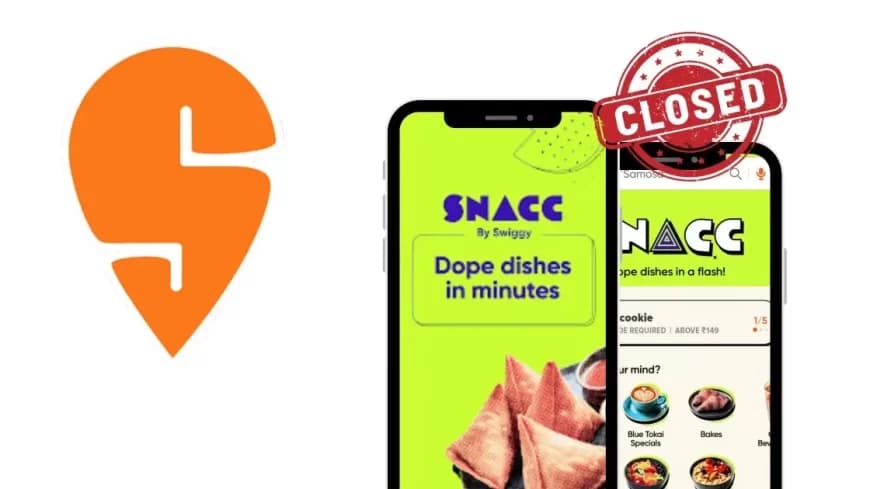
Food delivery major Swiggy has officially discontinued its standalone 15-minute food delivery app, SNACC, just a year after launching it in January 2025. The decision was communicated internally on February 19, 2026, as part of a broader push toward long-term profitability and operational efficiency.
The move signals a strategic reset for Swiggy as it recalibrates its quick-commerce ambitions amid rising financial and regulatory pressures.
Why Did Swiggy Shut Down SNACC?
Weak Unit Economics in Quick Food Delivery
The 10–15 minute food delivery model proved difficult to sustain. Unlike grocery deliveries under Instamart, ready-to-eat meals carry higher wastage risks and depend heavily on high order density to break even.
Maintaining dedicated dark stores and micro-kitchens significantly increased fixed costs. With inconsistent demand in limited operational zones, profitability remained elusive.
Regulatory Pressure on 10-Minute Deliveries
In January 2026, the Ministry of Labour and Employment reportedly advised quick-commerce platforms to discontinue aggressive 10-minute delivery guarantees due to safety concerns for gig workers.
Worker unions had raised issues regarding delivery pressure and road safety, adding compliance risks to the already challenging business model.
Financial Performance Concerns
Swiggy reported a consolidated net loss of ₹1,065 crore in Q3 FY26. The “Platform Innovations” segment, which included SNACC, saw revenues decline sharply while losses expanded.
As investors increasingly focus on profitability over rapid expansion, the company chose to streamline operations and focus on core revenue-generating verticals.
What Was SNACC?
SNACC was introduced to compete with ultra-fast food services like Blinkit Bistro and Zepto Cafe.
Key Features of SNACC:
Delivery Time: 10–15 minutes
Operating Cities: Bengaluru, Gurugram, Noida (selected areas)
Model: Dark stores and centrally stocked hubs
Menu Focus: Breakfast items, coffee, tea, bakery snacks, healthy bowls
Brand Partnerships: Collaborations with brands like The Whole Truth
By pre-stocking ready-to-eat items, SNACC bypassed restaurant preparation time to enable hyper-fast deliveries. However, scaling this model sustainably proved challenging.
Importantly, Swiggy confirmed that there will be no layoffs, and employees from SNACC are being absorbed into other business verticals.
Swiggy’s Strategic Shift: Focus on Bolt and 99Store
While SNACC has been discontinued, Swiggy is not exiting the quick delivery space.
The company plans to strengthen:
Bolt – Fast deliveries from nearby restaurants within 10–15 minutes.
99Store – Affordable meal offerings integrated into the main Swiggy app.
Unlike SNACC’s standalone infrastructure, Bolt operates within the existing restaurant ecosystem, reducing inventory risk and operational overhead.
This integration-based model could offer better margins while maintaining speed — a key differentiator in India’s competitive food delivery market.
What This Means for India’s Quick Commerce Market
The shutdown reflects a broader industry reality: ultra-fast food delivery is significantly harder to monetize than grocery quick commerce.
High fixed costs, regulatory scrutiny, and increasing investor demand for sustainable growth are forcing platforms to rethink expansion strategies.
With competitors like Blinkit Bistro and Zepto Cafe still experimenting in the segment, the coming year will determine whether ultra-fast ready-to-eat delivery can become profitable at scale.
Profitability Over Speed
Swiggy’s decision to close SNACC highlights a shift from aggressive hyper-growth to disciplined financial management. Rather than pursuing standalone experiments, the company is consolidating its quick delivery capabilities within its core platform.
As India’s food-tech and quick-commerce market matures, sustainable margins—not just delivery speed—will define the next phase of competition.
FAQs: Swiggy SNACC Shutdown
1. Why did Swiggy shut down SNACC?
Swiggy discontinued SNACC due to weak unit economics, high operational costs, regulatory concerns, and a renewed focus on profitability.
2. When was SNACC launched and closed?
SNACC was launched in January 2025 and shut down on February 19, 2026.
3. Will SNACC employees lose their jobs?
No. Swiggy confirmed that employees are being reassigned to other business verticals.
4. Is Swiggy exiting 15-minute food delivery completely?
No. Swiggy will continue offering fast deliveries through Bolt within its main app.
5. How does this impact competitors like Blinkit and Zepto?
The shutdown raises questions about the long-term viability of ultra-fast ready-to-eat delivery models, but competitors are continuing to experiment in this space.