

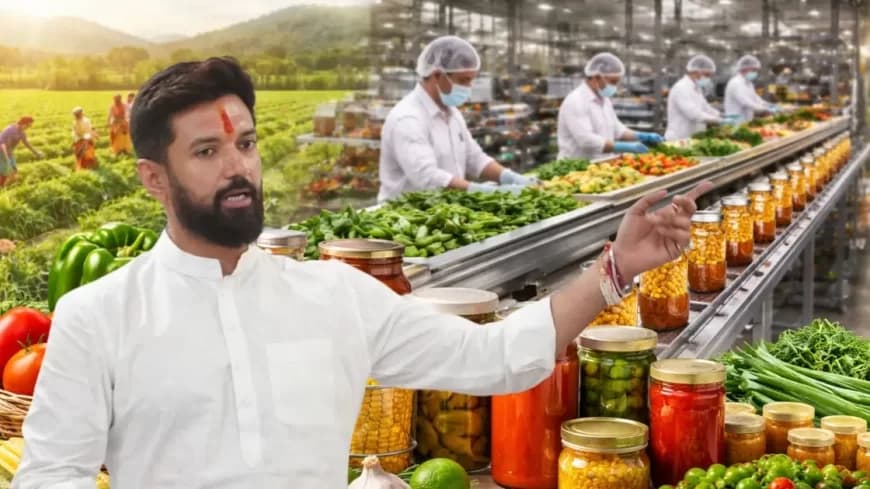
In a major push to transform India’s agri-economy, the Centre has announced plans to raise the country’s food processing level to 25%, more than double the current share of around 12%. The announcement was made during the two-day Chintan Shivir of the Union Ministry of Food Processing Industries (MoFPI) being held in Udaipur, Rajasthan.
The move signals a clear policy shift—from focusing largely on crop production to building a strong value-added, nutrition-focused food processing ecosystem.
India’s Food Processing Push: From Farms to Factories
Addressing policymakers and industry stakeholders, Union Minister Chirag Paswan said India has reached self-sufficiency in food production and must now concentrate on processing, branding, and global competitiveness.
According to the Ministry, expanding food processing is critical to cutting post-harvest losses, improving farmer incomes, and strengthening India’s position in global food supply chains.
Why the 25% Food Processing Target Matters
India is one of the world’s largest producers of fruits, vegetables, cereals, and milk, yet a significant portion of this output is lost due to inadequate storage, logistics, and processing facilities.
By increasing processing levels to 25%, the government aims to:
Reduce wastage of perishable produce
Boost farmer earnings through value addition
Improve availability of safe, nutritious processed food
Attract private investment in food manufacturing
The target also aligns with India’s long-term goal of becoming a global hub for processed and packaged food exports.
Balancing Processing Growth and Public Health
A key theme emerging from the Udaipur discussions is the need to balance industrial growth with health and nutrition concerns. Minister Paswan stressed that future food processing policies would prioritise quality, safety, and nutrition—not just convenience.
He noted that advanced processing technologies must enhance shelf life and usability without compromising health standards, amid rising consumer awareness around packaged foods.
Key Announcements from the Udaipur Chintan Shivir
New Incubation Facility for Regional Crops
On the sidelines of the event, MoFPI inaugurated a Common Incubation Facility at the Krishi Upaj Mandi Samiti in Udaipur. The centre will focus on processing minor forest and regional products such as jamun, custard apple, amla, and aloe vera—crops with strong local availability but limited market reach.
Employment and Rural Development Focus
The Ministry highlighted that food processing already contributes about 13% of manufacturing employment in India. The expanded policy push is expected to create new jobs, particularly for youth and women in rural and semi-urban areas.
What Lies Ahead for India’s Food Processing Sector
Following the Chintan Shivir, the Centre is expected to strengthen existing schemes such as PMFME and roll out targeted incentives for micro-enterprises, startups, and cold-chain infrastructure. Modern logistics, quality compliance, and private sector participation will be critical to achieving the 25% processing goal.
As India looks to move from being a global food producer to a global food processor, execution on the ground will determine whether this ambitious target can be met within the coming decade.
FAQs
Q1. What is India’s current food processing level?
India currently processes around 12% of its total agricultural produce.
Q2. Who announced the 25% food processing target?
The target was announced by Union Food Processing Minister Chirag Paswan at the MoFPI Chintan Shivir in Udaipur.
Q3. Why is the government focusing on food processing now?
The focus is to reduce post-harvest losses, increase farmer incomes, create jobs, and improve India’s global competitiveness in food exports.
Q4. How will this policy impact farmers?
Higher processing levels can provide better price realisation, reduce wastage, and create local value-added markets for farm produce.
Q5. Which schemes support food processing in India?
Key schemes include PMFME, Production Linked Incentive (PLI) for food processing, and infrastructure support for cold chains and incubation centres.