

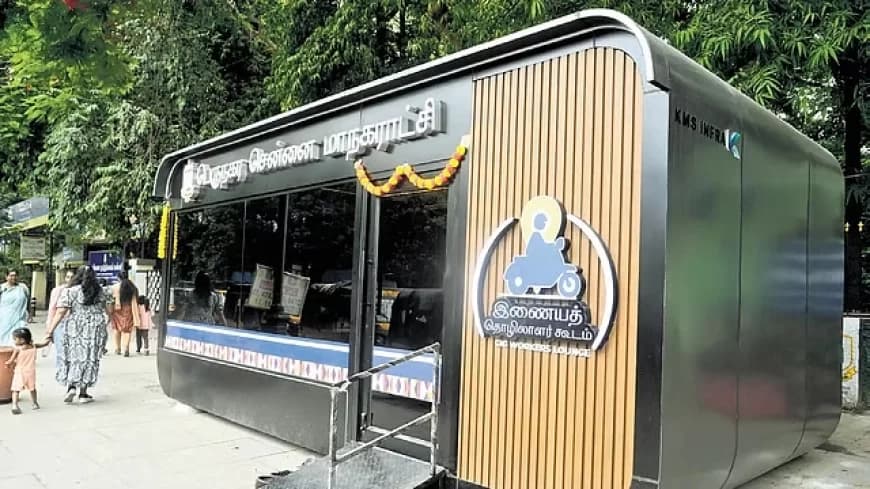
CHENNAI: In a development that has sparked debate on corporate responsibility and the use of public funds, Zomato has reportedly shut down its gig worker resting point in Anna Nagar, Chennai—just weeks after the Greater Chennai Corporation (GCC) inaugurated a government-funded air-conditioned lounge in the same area for food delivery and other gig workers.
Located barely 250 metres apart, the closure of Zomato’s facility comes amid concerns about rising maintenance costs and overlapping services. According to a delivery executive who spoke to TNIE, supervisors informed workers that with the new GCC lounge now operational, the company opted to shut its resting point due to high upkeep expenses.
However, a Zomato supervisory-level employee in Chennai denied that the Anna Nagar facility was permanently closed. He clarified that the resting point was being relocated to a larger space to better serve the workforce and that the closure was temporary.
Zomato had been running two worker rest stops within GCC limits—one in Anna Nagar and another in Velachery. Coincidentally, GCC has now floated tenders to set up new air-conditioned lounges in Velachery and KK Nagar with a proposed capital expenditure of ₹50 lakh, entirely funded by the city corporation.
This move has drawn criticism from labour activists and workers’ groups who argue that public funds are being used to cover what should be corporate responsibilities. Notably, none of the major delivery aggregators, including Zomato and Swiggy, have contributed to the initiative through Corporate Social Responsibility (CSR) funds or other means.
Sujata Mody, a prominent labour rights activist, expressed strong opposition to the government’s priorities. “Instead of enforcing labour laws for gig workers—such as fixed working hours, PF, and ESI coverage—the government is spending taxpayer money on initiatives that should be funded by these billion-dollar companies,” she said.
Mody further argued that the initiative not only subsidizes delivery platforms but also undermines the push for systemic reform. “This shifts the burden of worker welfare away from the companies and onto the public,” she added.
Delivery workers, while appreciative of the new lounges, echoed concerns over the long-term sustainability of these spaces. “What happens if the government changes after the elections? Will these lounges still be maintained?” questioned a 33-year-old delivery executive, who frequently uses the newly built AC lounge in Anna Nagar.
Several workers suggested that if GCC plans to expand the initiative, future lounges should be located in high-demand zones like Nungambakkam, East Coast Road, Maduravoyal, Poonamallee, and Madhavaram—areas with a dense restaurant network and significant delivery activity.
A GCC official clarified that although the project was initiated by the Labour Department, the execution was handed over to the Corporation due to its engineering capabilities. “Currently, both construction and maintenance are fully funded by the Corporation. We will monitor usage for three months before deciding on long-term funding strategies, which may include CSR partnerships,” the official said.
However, internal sources within GCC, speaking on condition of anonymity, admitted that there were discussions on whether corporations should be asked to co-fund the lounges. Despite concerns, the project was cleared in alignment with budget announcements made earlier by the state government.
As Chennai continues to grow as a hub for gig economy workers, the debate over who bears the responsibility for their welfare—governments or aggregators—remains unresolved.