

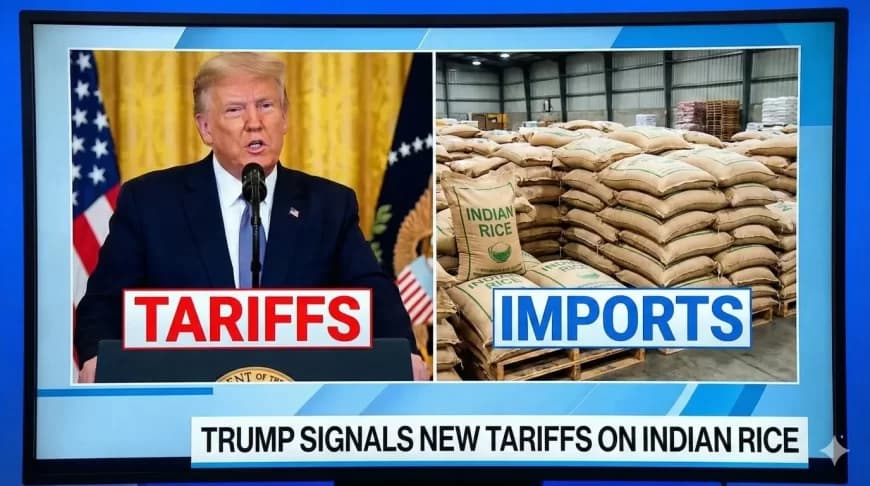
US President Donald Trump has once again sharpened his stance on agricultural imports, warning that he may impose fresh tariffs on rice arriving from India and other Asian exporters. The remarks, delivered during the announcement of a multi-billion-dollar relief package for American farmers, have triggered concern globally—but Indian rice exporters believe the impact on India’s shipments will be limited.
Trump Targets Agricultural Imports Amid Stalled Trade Talks
During a White House meeting, Trump accused major rice-exporting countries, including India, Vietnam and Thailand, of “dumping” cheaper varieties into the US market. He signalled that tariffs could be used as a quick fix to protect American farmers, especially in states where imported rice is seen as a threat to local growers.
The president also hinted at potential tariff action on Canadian fertiliser imports, saying that higher duties could encourage US domestic production.
“Tariffs solve the problem in two minutes,” Trump declared, promising American farmers stronger trade protections.
India’s Rice Exports to the US: What the Numbers Show
Basmati Rice Dominates India’s Exports
According to Indian Rice Exporters Federation (IREF) data, India shipped 274,213 MT of basmati rice to the US worth $337.10 million in FY 2024–25, making the US the fourth-largest global market for basmati.
Non-Basmati Exports Much Smaller
In the same period, non-basmati rice exports to the US stood at 61,341 MT, valued at $54.64 million, positioning the US as only the 24th biggest market for this category.
Total Value of India’s Rice Exports to US
Combined rice exports from India to the US touched $390 million (approx. ₹3,510 crore).
Exporters: ‘Trump Likely Referring to Non-Basmati Rice’
Industry experts suggest that Trump’s comments may be directed at non-basmati rice, since both Vietnam and Thailand—mentioned alongside India—export only non-basmati varieties to the US.
Ajay Bhallotia, General Secretary of the All India Rice Exporters Association, noted that basmati rice, with its premium aroma and grain quality, does not directly compete with US varieties.
“Basmati demand remains strong, and consumers of ethnic cuisines in the US prefer Indian rice. Any tariff increase will mostly affect retail prices, not exporters,” he said.
Why Higher Tariffs May Burden US Consumers, Not India
A Non-Substitutable Product
Indian basmati is a staple for South Asian, Middle Eastern and increasingly mainstream American cuisine. With no comparable local alternative, experts believe US consumers would absorb any price hikes.
Past Tariffs Have Not Hurt India’s Exports
Existing duties on Indian rice were already raised from 10% to 40% after Trump’s earlier tariff actions.Yet, exports remained stable as retailers passed the cost to consumers.
IREF data indicates:
Retail prices increased in the US market
Indian farmers and exporters continued receiving stable returns
Demand for basmati grew steadily due to rising popularity of global cuisines like biryani and pulao
Indian Rice Industry Remains Resilient
Export bodies emphasize that India’s rice export ecosystem is well-diversified, with strong markets across the Middle East, Europe, and Africa. Even if US tariffs rise further, the impact is expected to be limited.
Dev Garg, Vice President of Indian Rice Exporters, said:
“The US is important, but India’s global rice footprint is broad. We continue to strengthen trade ties and explore new markets.”
Potential Impact on India–US Trade Relations
The tariff threat emerges at a delicate stage in bilateral trade negotiations. Agricultural market access, subsidy disputes, and ongoing World Trade Organization (WTO) concerns have long been sticking points between the two nations.
Experts say a unilateral tariff hike could:
Trigger a fresh round of trade tensions
Invite retaliatory measures
Slow progress on pending trade agreements
However, the US administration has not issued any formal tariff notification yet.
While President Trump’s strong rhetoric has stirred debate, India’s rice industry appears unfazed for now. The unique nature of basmati rice, combined with a diversified export base, shields India from immediate risk. But exporters remain cautious, watching for policy action that could reshape future India–US agricultural trade.
FAQs
1. Will Trump’s proposed tariffs affect India’s basmati exports to the US?
Industry experts believe any impact will be limited, as demand for basmati is strong and American consumers will likely absorb price increases.
2. Which type of Indian rice is most exposed to US tariff risk?
Non-basmati rice, since Vietnam and Thailand—also mentioned by Trump—export only non-basmati varieties to the US.
3. How much rice does India export to the US annually?
India exports about $390 million worth of rice to the US each year, mostly premium basmati.
4. Have past tariffs reduced India’s rice exports to the US?
No. Even after tariffs increased from 10% to 40%, exports stayed stable because retailers passed costs on to consumers.
5. Why can’t US-grown rice replace Indian basmati?
Indian basmati has a unique aroma, flavour, texture, and elongation that US-grown varieties cannot match, especially for dishes like biryani.