

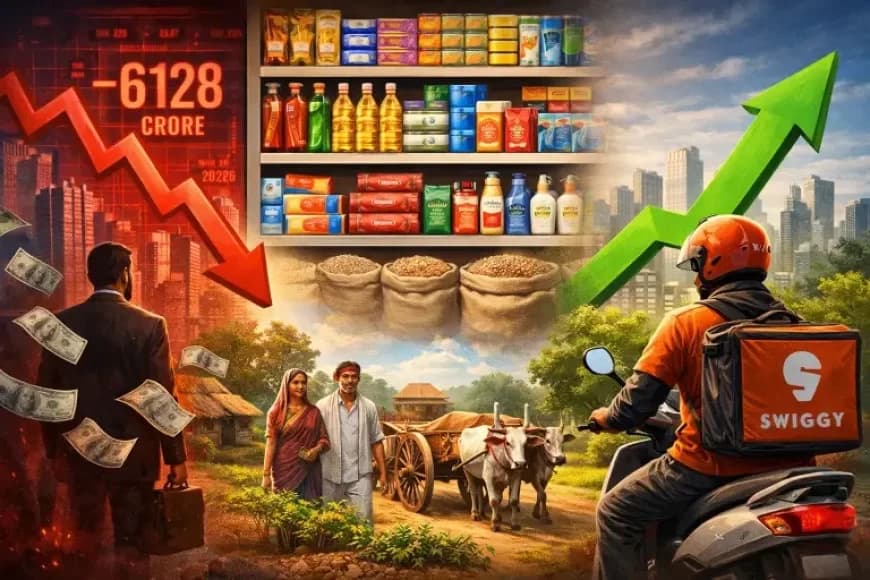
India’s FMCG sector has begun 2026 under sharp market scrutiny. Foreign institutional investors (FIIs) have exited the sector aggressively, citing expensive valuations, even as early indicators suggest a recovery in consumption volumes. The divergence between stock performance and business fundamentals is now shaping a crucial inflection point for long-term investors.
FMCG Leads FII Selling in Early 2026
In the first half of January 2026, FIIs sold FMCG stocks worth ₹6,128 crore, making it the most offloaded sector in the Indian equity market so far this year. Overall, foreign investors pulled out more than ₹22,000 crore from Indian equities during the same period, but the scale of selling in FMCG has surprised market participants.
Traditionally viewed as a defensive and stable segment, FMCG stocks had enjoyed strong investor confidence over the past few years. The recent reversal signals a reassessment of risk, valuation, and global capital allocation strategies.
Valuation Correction Drives Foreign Exit
Premium Pricing Under Pressure
Market analysts point out that Indian FMCG companies have been trading at steep premiums, with price-to-earnings ratios ranging between 50x and 80x, significantly higher than global peers. As global interest rates, currency movements, and risk appetite recalibrate in 2026, these valuations are increasingly being questioned.
According to market experts, the current sell-off reflects a valuation-driven correction, not a loss of faith in the long-term viability of FMCG businesses. FIIs appear to be rotating funds into relatively cheaper or cyclical sectors offering better near-term upside.
Volume-Led Growth Emerges as Key Theme for 2026
Shift from Price Hikes to Consumption Growth
Over the past two years, FMCG revenue growth was largely supported by price increases driven by inflation. That phase is now easing. With commodity costs stabilising, companies are focusing on driving volumes rather than raising prices.
Rural Demand Shows Early Recovery
Brokerage reports indicate early signs of stabilisation in rural demand, which had remained under pressure for several quarters. Expectations of high single-digit volume growth in upcoming quarters suggest that India’s core consumption engine may be regaining momentum.
This improving demand outlook contrasts sharply with the recent decline in FMCG stock prices, creating a disconnect between market sentiment and operating performance.
Diverging Trends Within the Consumer Space
While established FMCG players such as Hindustan Unilever and Nestlé India continue to face selling pressure, parts of the broader consumer ecosystem are seeing renewed interest.
Swiggy Gains Attention
Shares of Swiggy stood out after brokerage firm Nuvama issued a BUY call, citing technical indicators and oversold conditions. Analysts expect a potential 8–10% upside in the near term, even as the broader FMCG space remains under stress.
What This Means for Investors
For long-term investors, the current phase may not warrant panic-driven exits. While valuations are undergoing correction, improving volume growth, rural recovery, and easing cost pressures point to healthier fundamentals ahead. Historically, such divergences between stock prices and consumption trends have offered selective entry opportunities.
Correction Today, Consumption Tomorrow
The Indian FMCG sector is undergoing a meaningful reset in early 2026. Foreign investors are correcting for valuations, while domestic demand indicators suggest a gradual return to volume-led growth. How quickly this operational recovery reflects in stock prices will depend on earnings visibility and broader market stability, but the underlying consumption story remains intact.
Frequently Asked Questions (FAQs)
1. Why are FIIs selling FMCG stocks in 2026?
FIIs are exiting mainly due to high valuations in FMCG stocks and reallocating capital to sectors with better risk-reward dynamics.
2. Does FII selling mean FMCG fundamentals are weak?
No. The selling is valuation-driven. Business indicators such as volume growth and rural demand are showing early signs of improvement.
3. What is volume-led growth in FMCG?
Volume-led growth refers to higher sales through increased consumption rather than revenue growth driven by price hikes.
4. Is rural demand improving in India?
Early brokerage reports suggest rural demand is stabilising, which could support FMCG volume growth in upcoming quarters.
5. Should long-term investors exit FMCG stocks now?
Market experts suggest long-term investors assess fundamentals carefully, as corrections often create selective buying opportunities rather than reasons for panic selling.