

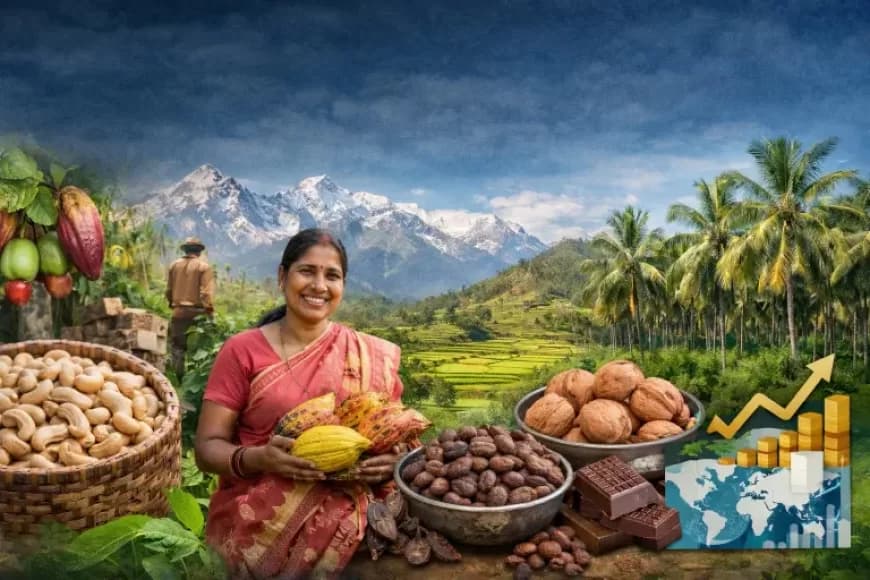
India’s Union Budget 2026–27 marks a decisive shift in agricultural policy, moving away from cereal-heavy growth towards high-value, export-oriented crops. With a record ₹1.63 lakh crore allocation for agriculture, the government is betting on crops like cashew, cocoa, coconuts and nuts to double farmer incomes and strengthen India’s global agri-trade position.
Why India Is Rethinking Its Grain-First Strategy
For decades, rice and wheat dominated India’s farming landscape. While they ensured food security, recent data shows stagnant income growth for cereal farmers.
According to official estimates:
India produced a record 3,577 lakh metric tonnes of foodgrains in 2024–25
Yet, real income growth for cereal farmers remained below 3% annually
Rice and wheat together occupy over 40% of cultivated land but contribute less than 25% of agricultural value
In contrast, high-value crops now contribute nearly one-third of agricultural Gross Value Added (GVA) while using far less land.
High-Value Crops vs Traditional Grains: The Income Gap
Crop Category Average Net Income per Acre Water Requirement Export Potential Rice / Wheat ₹30,000–₹50,000 Very High Low Cashew / Cocoa ₹1.5–₹3 lakh Moderate High Walnuts / Almonds ₹2–₹5 lakh Low–Moderate Very High Exotic Crops ₹6–₹12 lakh Low (precision-based) Premium
This widening income gap is the core reason behind the Budget 2026 pivot.
Budget 2026: Key High-Value Agriculture Interventions
Coconut Sector Modernisation
India accounts for over 31% of global coconut production, supporting nearly 30 million livelihoods. However:
Nearly 35% of coconut palms are over 60 years old
Productivity in India is 20–25% lower than in Indonesia and the Philippines
Budget 2026 introduces a targeted programme to:
Replace ageing trees with high-yield varieties
Promote processing of virgin coconut oil, coconut water and neera
Increase farmer realisation by 2–3 times through value addition
Cashew and Cocoa: From Import Dependence to Brand India
India processes nearly 1.5 million tonnes of cashew annually, yet imports over 60% of raw nuts from Africa.
Key Budget 2026 actions:
Expansion of cashew and cocoa cultivation into Chhattisgarh, Odisha, Maharashtra and the North East
Focus on domestic raw nut sufficiency
Export branding target under “Brand India 2030”
The global cocoa market alone is valued at $15 billion, offering India a significant opportunity if domestic output improves.
Himalayan Nut Mission: Competing with Global Imports
India imports over ₹12,000 crore worth of walnuts and almonds every year, mainly from the US and Chile.
Budget 2026 supports:
High-density walnut orchards in Jammu & Kashmir
Modern post-harvest infrastructure in Himachal Pradesh and Uttarakhand
Yield improvement to match global standards
The aim is to reduce import dependence while improving farmer income in hill states.
Technology Push: AI-Led Farming Decisions
To reduce the risk of crop diversification, the government has launched AI-based advisory systems such as Bharat-VISTAAR. These tools:
Analyse soil health, rainfall and price trends
Suggest crop switching at the village level
Help farmers plan long-gestation crops with better accuracy
Officials say this could reduce crop failure risk by up to 30% in early adoption zones.
Export, Employment and Environmental Gains
Agri-exports target: From $48 billion (2024) to $100+ billion by 2030
Employment: High-value crops generate 3–4x more post-harvest jobs
Water savings: Nut and plantation crops consume 30–50% less water than paddy
These factors align with India’s long-term climate and rural employment goals.
The Roadblocks Ahead
Despite the promise, challenges remain:
Tree crops require 5–15 years to reach peak productivity
Farmers need bridge income support and credit access
Market linkages and cold-chain infrastructure must scale quickly
Experts warn that without strong implementation, farmers may revert to short-cycle cereal crops.
A Structural Shift, Not a Short-Term Fix
Budget 2026 marks a structural change in Indian agriculture—from volume-driven output to value-led growth. If sustained over the next decade, this strategy could redefine farm incomes, exports and sustainability, making India not just food-secure, but farm-profitable.
FAQs
1. Why is Budget 2026 focusing on high-value crops?
To increase farmer income, boost exports and reduce pressure on water-intensive cereal farming.
2. Will rice and wheat farming be reduced?
No. Food security crops will continue under MSP, but diversification is being encouraged.
3. Which farmers benefit the most from this shift?
Farmers in coastal, hilly and tribal regions with suitable climates for nuts and plantation crops.
4. How long before farmers see income gains?
Short-term gains may come from better advisory and subsidies, while tree crops yield full returns in 5–10 years.
5. How does this impact agri-exports?
High-value crops can significantly raise India’s export earnings and global market share.