

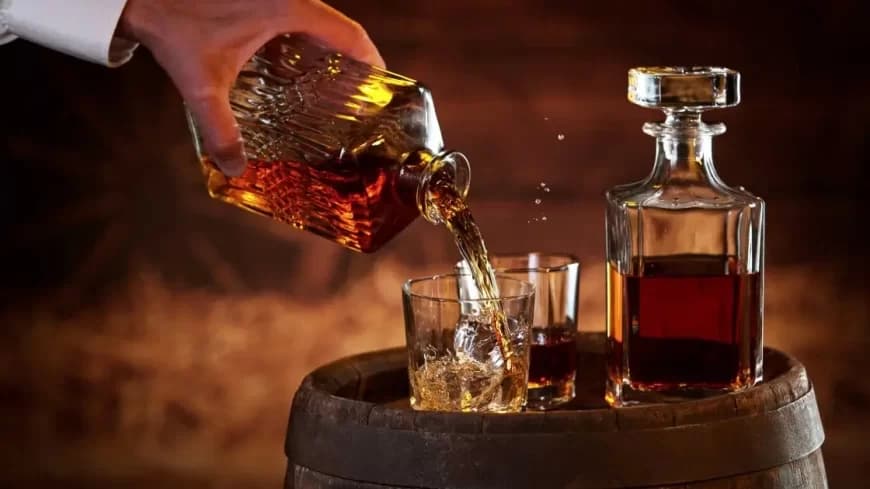
New Delhi, July 25 — After nearly three years of negotiations, India and the United Kingdom have officially signed a landmark Free Trade Agreement (FTA) on July 24, 2025. Among the most consumer-visible outcomes of this deal is the significant reduction in import tariffs on premium alcoholic beverages such as Scotch whisky and gin.
This historic agreement marks a new era in bilateral trade, expected to increase annual trade between the two nations by an estimated £25.5 billion, according to the UK government.
Tariff Cut: From 150% to 40% Over a Decade
The most notable highlight for Indian consumers is the phased reduction in customs duties on imported Scotch whisky and gin. Currently taxed at a staggering 150%, these duties will be halved to 75% in the first phase, with a gradual reduction to 40% over the next ten years.
This duty cut applies across categories — from Bottled-in-Origin (BIO) Scotch to bulk spirits used for Bottled-in-India (BII) products and Indian Made Foreign Liquor (IMFL) blending.
Who Benefits?
The International Spirits and Wines Association of India (ISWAI) has hailed the FTA as a milestone for the alcobev industry. ISWAI CEO Sanjit Padhi stated that the agreement "creates a more balanced and equitable trade environment" and would make premium spirits more accessible to Indian consumers, further fueling the trend of premiumisation.
Diageo India’s MD & CEO Praveen Someshwar echoed similar sentiments, emphasizing that the reduced tariffs would “positively impact the accessibility of premium Scotch whisky in India.”
Chivas Brothers Chairman Jean-Etienne Gourgues described the agreement as “a sign of hope in challenging times for the spirits industry,” while legal and tax experts from firms like Khaitan & Co projected better affordability and increased market share for UK-based liquor brands.
Will Prices Drop for Consumers?
While the reduced customs duties are good news on paper, how much of the benefit reaches the end consumer will depend heavily on state-level excise policies.
Experts estimate that premium brands like Johnnie Walker Black Label and Chivas Regal may become cheaper by ₹200–₹300 per bottle. Currently, Black Label retails at ₹3,100 in Delhi and ₹4,200 in Mumbai. For standard labels like Red Label and Ballantine’s, prices might fall by ₹100–₹150.
However, Vinod Giri, a noted liquor industry analyst, offered a more tempered view. “Most alcohol-related taxes are levied by states. Even if the full benefit of customs duty reduction is passed on, consumer prices are unlikely to drop by more than ₹100–₹300,” he said, suggesting that the biggest winners from the FTA are likely to be the companies, not the buyers.
A Billion-Dollar Whisky Market
India is no stranger to whisky. With a 200% rise in consumption over the last decade, the country reclaimed its title as the world’s largest Scotch whisky market by volume in 2024, overtaking France with 192 million bottles imported.
According to the Scotch Whisky Association, India’s whisky exports surged 26% in the first half of 2024, reaching $78.5 million. Premium whisky exports nearly doubled to $6.3 million, highlighting the rising appetite for high-end spirits among Indian consumers.
The Indian whisky market was valued at $21.13 billion in 2023 and is projected to grow at a CAGR of 4.61%, reaching $28.97 billion by 2030. The FTA is expected to further drive this growth, especially in the premium and super-premium segments.
A Colonial Legacy Turned National Favourite
Whisky’s roots in India go back to the colonial era. Introduced by the British during the Raj, Scotch initially catered to the elite. Interestingly, early resistance from Indians led to a commission being formed to "study" the quality of Scotch whisky. The verdict? It was declared harmless and of outstanding quality — suitable for high-society occasions.
Over the decades, Scotch whisky evolved from being a status symbol of colonial elites to a staple at Indian social gatherings and celebrations — a cultural transformation that continues today.
Bottom Line
While the India-UK FTA won’t drastically reduce whisky prices for Indian consumers overnight, it does represent a pivotal shift. It strengthens India’s role as a major global market for premium spirits, opens doors for British alcohol exporters, and signals a more open trade regime between two historic partners.
For consumers, the toast may be modest, but for the industry, it’s a full pour.
With inputs from News Agencies