

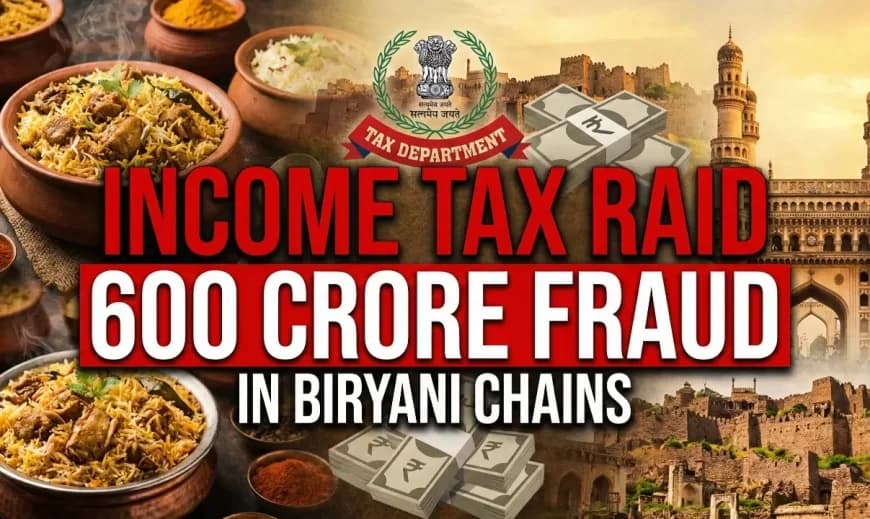
In a major crackdown on financial fraud in the food and hospitality sector, the Income Tax Department’s investigation wing in Hyderabad has unearthed one of the largest tax evasion networks linked to three leading biryani chains—Pista House, Shah Ghouse and Mehfil. Over three days of coordinated searches, officials uncovered an estimated Rs 600 crore in suppressed income, revealing a sophisticated method of wiping out cash transactions from billing systems.
How the Tax Evasion Mechanism Operated
Systematic Deletion of Cash Sales
Officials found that the restaurant groups recorded all orders in their internal software to enable kitchen workflow. But cash transactions were later selectively deleted—especially before monthly GST filings.
Two primary methods were identified:
Manual deletion: Cash orders were removed one by one.
Bulk deletion: A single command reduced daily cash tallies, erasing multiple entries at once.
UPI and card payments remained untouched due to traceable invoice numbers, making cash the only vulnerable component. Restaurant explanations citing “cancelled orders” were dismissed after officers observed that nearly half of all cash orders appeared “cancelled,” an impossible business pattern.
Hidden Cash, Fake UPI IDs and Secret Flats
Rs 10 Crore Cash Seized
Investigators seized nearly Rs 10 crore in unaccounted cash from hidden locations connected to the three restaurant groups. One flat linked to Mehfil was found to have been rented solely to house a locker containing unreported cash.
Employee UPI IDs Used as Collection Channels
A web of multiple UPI IDs created in employees’ names was uncovered. Each floor or service counter had its own QR code. These IDs were rotated every two months to avoid triggering bank scrutiny, and cash withdrawals were allegedly passed to the management.
Suspicious Movements Lead to More Discoveries
A person believed closely associated with one of the owners was tailed after repeatedly visiting a particular neighbourhood. A search of the location led to further recovery of unaccounted cash.
The Scale of Unreported Income
Preliminary estimates suggest:
Pista House: Rs 250–300 crore concealed
Shah Ghouse & Mehfil combined: ~Rs 150 crore concealed
The figure is expected to increase as investigators analyse peak-season sales, especially during Ramzan when haleem and biryani demand surges.
Operational structures also varied:
Pista House and Mehfil are run by single-family promoters.
Shah Ghouse operates via six companies with control among several family members.
Unhygienic Kitchen Conditions Also Documented
Though unrelated to taxation, search teams documented poor hygiene, rat infestation, and unsafe food-handling practices at certain locations. These findings have been recorded and may be forwarded to local food safety authorities.
International Real Estate Investments Under Scanner
Investigators also traced real estate investments in Dubai and other UAE locations linked to some promoters. These findings may prompt international information requests and cross-border financial scrutiny.
GST and Penalty Actions to Follow
Since GST liability is tied directly to sales turnover, reconstructed billing data is expected to trigger separate action. Once the Income Tax Department completes its data mapping and final quantification, the GST authorities are likely to issue notices.
Digital forensic teams are currently analysing:
Six years of billing logs
Server backups
Software communication records
Instructions shared with billing companies
Penalties may extend not only to the restaurant chains but also to the software firms involved in modifying billing systems.
The Hyderabad tax evasion case is shaping up to be one of the biggest financial frauds in India’s food sector. With digital forensics still underway and GST action pending, officials expect the final tax demand and penalties to be significantly higher than current estimates. The investigation continues to widen as more evidence surfaces.
Frequently Asked Questions (FAQs)
1. Which restaurant chains are involved in the Hyderabad tax evasion case?
The investigation covers three major biryani chains—Pista House, Shah Ghouse and Mehfil.
2. How much unaccounted income has been detected so far?
Officials estimate around Rs 600 crore in suppressed income, though the final figure may be higher after full data reconstruction.
3. What methods were used to delete transactions?
Restaurants allegedly used manual deletion of cash entries and bulk software commands to remove cash sales before GST filings.
4. How much cash has been seized in the raids?
Nearly Rs 10 crore in unaccounted cash was recovered from secret flats, lockers and other concealed locations.
5. Will GST authorities also take action?
Yes. Once reconstructed turnover data is finalised, the GST department is expected to issue notices, penalties and revised tax assessments.