

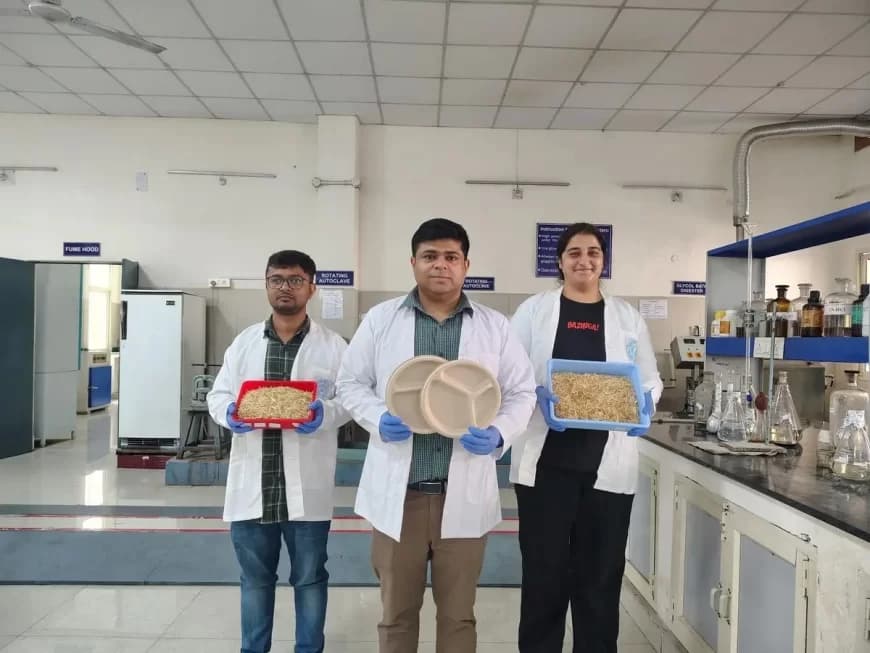
As North India gears up for another stubble burning season, researchers at the Indian Institute of Technology (IIT) Roorkee have introduced an innovative and sustainable solution — converting wheat straw into eco-friendly tableware. The breakthrough aims to reduce air pollution, curb farm waste, and offer a green alternative to single-use plastic.
Turning Farm Waste Into Sustainable Products
The INNOPAP Lab (Innovations in Paper and Packaging) at IIT Roorkee, in collaboration with Parason Machinery India Pvt. Ltd., has developed a process to transform wheat straw — a byproduct often burned after harvest — into biodegradable plates, bowls, and packaging materials.
According to Professor Vibhore K. Rastogi from IIT Roorkee’s Department of Paper Technology, the initiative not only helps reduce pollution but also creates new income opportunities for farmers, encouraging a circular economy where agricultural residue becomes a valuable resource.
“By utilizing wheat straw, we’re addressing environmental damage while creating wealth from waste. This is sustainability in action,” said Prof. Rastogi.
From Straw To Tableware: The Science Behind The Process
India generates over 350 million tonnes of agricultural waste annually, much of which is either burned or left to rot. The research team’s technology uses the high cellulose content (40–50%) in wheat straw to produce strong and durable pulp.
One kilogram of straw yields approximately 400–450 grams of pulp, which can be molded into various tableware products like:
Two-, three-, or five-compartment plates
Cups and bowls
Packaging materials and eco-cushioning for electronics
The tableware is durable, heat-resistant, food-safe, and fully compostable, embodying the philosophy of “Mitti se Mitti Tak” — returning to the earth without leaving a trace.
Replacing Single-Use Plastics With Natural Alternatives
The innovation aligns with India’s mission to phase out single-use plastic and promote biodegradable packaging solutions. By using agricultural residue, the IIT Roorkee model reduces both pollution from stubble burning and plastic waste in landfills.
This advancement also highlights the role of science and engineering in addressing environmental challenges through practical, scalable technologies.
Key Contributors To The Research
The project saw major contributions from Jasmine Kaur, a PhD student, and Rahul Ranjan, a postdoctoral researcher, both part of the INNOPAP Lab. Their efforts were crucial in developing and testing the molded pulp technology used in tableware production.
A Step Toward A Cleaner, Greener Future
IIT Roorkee’s innovation demonstrates how agricultural residues can be turned into value-added, eco-friendly products. The research team is now working on expanding applications to include biodegradable packaging for electronics and consumer goods — potentially revolutionizing India’s sustainable packaging industry.
FAQs on IIT Roorkee’s Wheat Straw Tableware Project
1. What is the main goal of IIT Roorkee’s wheat straw project?The project aims to reduce stubble burning by converting wheat straw into biodegradable tableware, providing an eco-friendly alternative to single-use plastic.
2. How does this technology help farmers?It creates an additional income source for farmers by purchasing wheat straw that would otherwise be discarded or burned.
3. What types of products can be made from wheat straw pulp?The pulp can be molded into plates, cups, bowls, and even eco-friendly packaging materials for electronics and other goods.
4. Is this tableware safe for food use?Yes. The products are heat-resistant, durable, and food-safe, making them suitable for everyday use and commercial applications.
5. What are the environmental benefits of this innovation?It reduces air pollution from stubble burning, decreases plastic waste, and supports a circular economy by turning agricultural residue into useful products.