

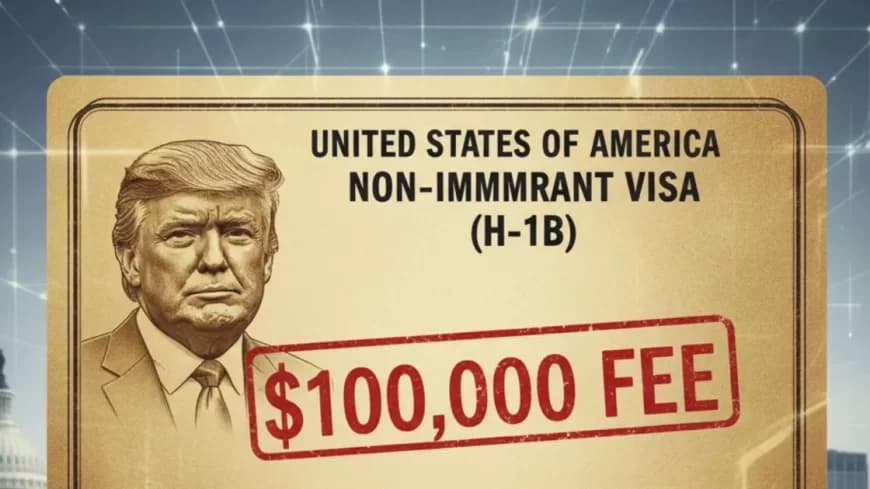
US President Donald Trump’s latest proclamation has shaken the tech industry, with a $100,000 fee now imposed on H-1B visa applications. Companies like Microsoft, Amazon, Meta, and JPMorgan have advised employees holding H-1B and H-4 visas to return to the United States before the September 21 deadline. But what does this mean for Indian chefs and food industry workers in the US?
Tech Giants React to Trump’s H-1B Fee
The new rule, titled “Restriction on entry of certain nonimmigrant workers”, mandates that any H-1B petition must be accompanied by a $100,000 fee. Without it, visa holders outside the US will not be allowed entry.
Microsoft urged employees with H-1B and H-4 visas to remain in the US “for the foreseeable future.”
Amazon asked staff abroad to return by the deadline, cautioning against international travel.
Meta advised employees to stay in the US for at least two weeks until the policy is clarified.
JPMorgan recommended its H-1B holders avoid travel and return before restrictions take effect.
The move has sparked uncertainty for thousands of skilled Indian workers, especially in the technology sector where H-1B visas are most common.
Do Chefs and Food Workers Fall Under H-1B?
Unlike software engineers and IT specialists, most food workers and chefs do not rely on H-1B visas. The H-1B program requires a specialty occupation—jobs typically needing at least a bachelor’s degree. Since restaurant cooks and chefs usually don’t fall into this category, they are not directly impacted.
Common Visa Categories for Chefs in the US
Instead of H-1B, chefs and hospitality workers usually enter the US through:
H-2B Visa → Seasonal or temporary jobs in restaurants and hospitality.
J-1 Visa → Internship and training programs for culinary workers.
O-1 Visa → For chefs with extraordinary ability (celebrity chefs, Michelin-starred experience).
EB-3 Green Card → Employer-sponsored skilled worker pathway for permanent residence.
Since Trump’s proclamation specifically targets H-1B and H-4, these visa categories remain unaffected for now.
Could the Policy Affect Food Industry Workers in the Future?
While chefs and food service workers are safe from this immediate rule, the broader immigration climate in the US has become more restrictive. Employers may grow cautious about sponsoring visas, and future extensions of such rules could potentially affect categories like H-2B.
Indian chefs—especially those seeking specialized culinary roles under H-1B or teaching positions—could face higher costs or stricter scrutiny if such fees expand beyond IT.
FAQs
1. Are Indian chefs in the US affected by the new $100,000 H-1B visa fee?No. Most chefs and food workers use H-2B, J-1, O-1, or EB-3 visas, not H-1B.
2. Which visa is most common for chefs in the US?The H-2B visa is widely used for temporary hospitality jobs, while J-1 visas are common for training and internships.
3. Can chefs apply for an H-1B visa?Only in rare cases, such as specialty cuisine experts or culinary instructors in academic institutions.
4. What does Trump’s proclamation mean for the Indian food industry in the US?There is no direct impact now, but a restrictive immigration climate may make it harder for restaurants to hire foreign talent in the future.
5. Which country has the highest number of H-1B visa holders?India leads globally in H-1B visa holders, especially in IT and technology fields.