

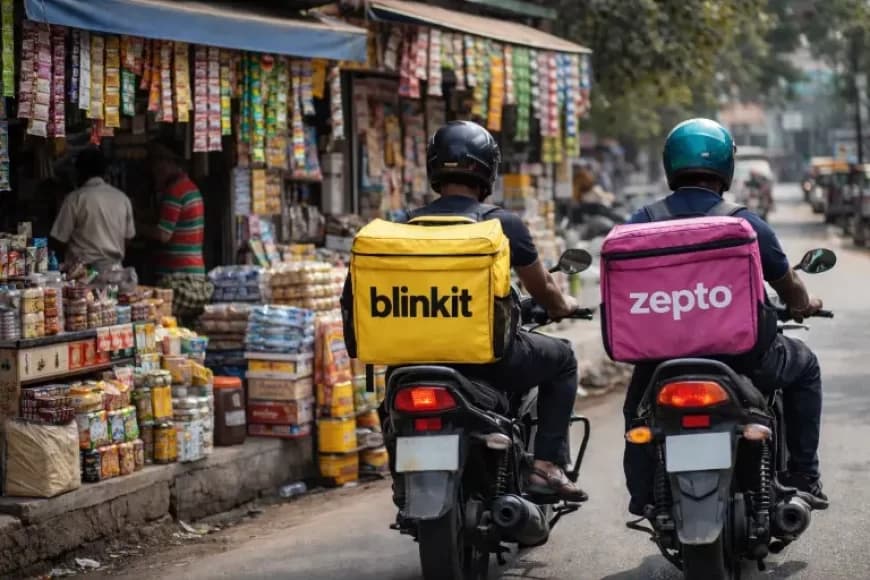
For nearly a decade, quick commerce has been portrayed as the biggest threat to India’s neighbourhood kirana stores. The rise of 10-minute grocery delivery led many to believe that local retailers would soon become irrelevant. However, data from 2025–26 tells a very different story—one where kiranas remain firmly in control of India’s grocery economy.
Quick Commerce Is Growing, But Kiranas Still Dominate
Quick commerce platforms such as Blinkit and Zepto are projected to reach a combined GMV of nearly $5.8 billion in 2026. Despite this rapid growth, kirana stores continue to command over 90% of India’s grocery retail market, making them the single most dominant retail format in the country.
Industry analysts point out that the biggest disruption from quick commerce has not been to kiranas, but to scheduled e-commerce players and modern supermarkets, which operate in the same high-value basket space.
The AOV Trap: Why Low-Value Baskets Favour Kiranas
A key reason kiranas continue to outperform digital platforms lies in what retail experts call the Average Order Value (AOV) trap.
For most quick commerce platforms to operate sustainably, orders need to cross the ₹500–₹750 range. This threshold is necessary to cover dark-store rents, delivery costs, and manpower expenses. Indian households, however, shop very differently.
Data shows that most families make frequent purchases worth ₹100–₹200, often multiple times a week. These micro-baskets are perfectly suited to kirana economics but are structurally loss-making for app-based delivery platforms.
The dominance of sachet-based consumption further strengthens kiranas. Small packs priced between ₹1 and ₹20 continue to account for a large share of daily grocery purchases—transactions that digital platforms struggle to serve profitably.
FMCG Companies Are Actively Protecting Kiranas
Major FMCG companies have increasingly recognised that kiranas are their most reliable distribution channel. As a result, brands such as Hindustan Unilever, ITC and Parle Products are restructuring product strategies to safeguard local trade.
Kirana-Exclusive Packs and Price Protection
Low-unit packs priced at ₹5, ₹10 and ₹20 are now increasingly reserved for general trade outlets. In contrast, quick commerce platforms are offered bundled or premium SKUs that fit higher basket values.
In parallel, distributor bodies like the All India Consumer Products Distributors Federation have pushed for stricter Market Operating Price (MOP) controls. These measures discourage brands from enabling deep discounting on apps that could undercut kirana pricing.
Technology Is Strengthening, Not Replacing, Kiranas
Contrary to popular belief, kirana stores are not resisting technology—they are adopting it selectively.
The government-backed Open Network for Digital Commerce (ONDC) is helping thousands of small retailers go online without paying high platform commissions. At the same time, FMCG-led B2B platforms like Shikhar have simplified inventory ordering, improved stock availability, and reduced supply gaps in rural and semi-urban markets.
This hybrid adoption allows kiranas to remain competitive while retaining control over pricing and customer relationships.
Trust and Credit: The Advantage Apps Can’t Replicate
Beyond technology and pricing, kiranas operate on something far more powerful—social trust. Informal credit systems, locally known as khata, continue to account for a significant portion of kirana sales, especially among households with irregular income cycles.
Local stores also function as hyper-efficient micro-warehouses. Many now accept orders through WhatsApp and deliver within minutes using in-house staff, often matching quick commerce speeds without charging platform fees.
India’s Retail Future Is Hybrid, Not Digital-Only
The Indian grocery market is not shifting from offline to online—it is evolving into a hybrid ecosystem where technology supports, rather than replaces, traditional retail. Quick commerce will continue to grow in urban, convenience-driven segments, but kiranas remain unmatched in affordability, frequency, and trust.
Far from disappearing, India’s 12 million kirana stores are quietly modernising—while still solving the most fundamental consumer problem: buying what’s needed today, within today’s budget.
FAQs
1. Is quick commerce replacing kirana stores in India?
No. Kiranas still control over 90% of India’s grocery market, especially for low-value and high-frequency purchases.
2. Why do kiranas perform better than quick commerce for groceries?
Kiranas cater to small basket sizes, sachet-based buying, and informal credit—areas where quick commerce struggles economically.
3. How are FMCG brands supporting kirana stores?
Brands are offering kirana-exclusive SKUs, limiting deep discounting on apps, and strengthening distributor protections.
4. What role does ONDC play for kiranas?
ONDC helps kiranas go digital without high commissions, allowing them to reach online customers sustainably.
5. Will quick commerce continue to grow in India?
Yes, but primarily among urban consumers with higher spending capacity and time constraints.