

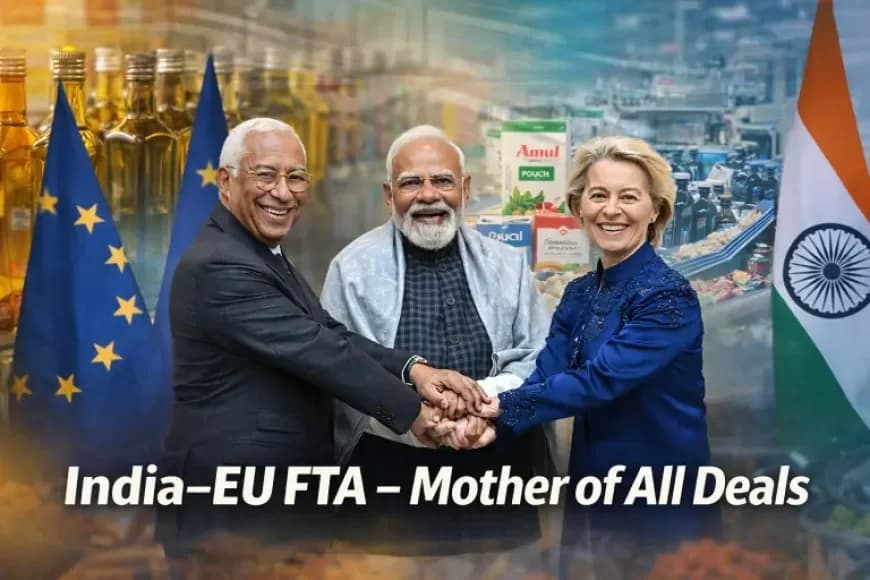
India and EU Seal Historic Free Trade Agreement
India and the European Union today signed the long-awaited Free Trade Agreement (FTA), widely described as the “Mother of All Deals.” The pact is set to reshape India’s food industry—from what consumers pay at supermarkets to how farmers and FMCG companies operate in global markets.
For readers of Indian Food Times, the impact is clear: cheaper premium food imports, protected domestic dairy, and stricter export rules that act like a new food safety gatekeeper.
Cheaper Premium Foods for Indian Consumers
Olive Oil, Chocolates, and Pasta to Get Affordable
One of the most visible outcomes of the India–EU FTA will be lower prices for imported European food products.
Olive oil imports will see tariffs (earlier up to 45%) phased out over the next few years. This could make heart-healthy olive oil more affordable for Indian households.
European chocolates, biscuits, and pasta, earlier taxed up to 50%, are expected to enter India at more competitive prices.
Wine and spirits see sharp duty cuts, offering relief to hotels, restaurants, and premium retail segments.
SEO keywords used: India EU FTA food impact, olive oil prices in India, European chocolates India.
Dairy Sector Protected: Relief for Indian Farmers
Dairy Declared a Sensitive Sector
India successfully kept dairy outside full tariff liberalisation, shielding millions of small farmers.
Domestic cooperatives like Amul and Nandini remain protected from zero-duty European cheese and milk powder.
This ensures price stability for Indian milk producers and avoids unfair competition from heavily subsidised EU dairy products.
SEO keywords used: Indian dairy protection EU FTA, Amul EU trade impact.
The New ‘FDA-Style’ Barrier: EUDR and Traceability
EU Deforestation Regulation (EUDR) Explained
While tariffs are coming down, non-tariff barriers are rising. The EU’s Deforestation Regulation (EUDR) requires exporters to prove their products are not linked to deforestation after 2020.
Affected Indian exports: coffee, tea, spices, rubber, soy.
Challenge: farmers and exporters must adopt digital traceability and geo-tagging.
Risk: small producers who fail to comply could lose access to EU markets.
This acts as a food safety and sustainability checkpoint—similar in impact to strict FDA regulations.
SEO keywords used: EUDR impact on Indian farmers, EU food safety rules India.
FMCG and Food Startups: Cheaper Machines, Tougher Competition
Lower Import Duties on Food Processing Machinery
The FTA cuts import duties on European food-processing and packaging machinery (earlier up to 44%).
Indian FMCG companies can now upgrade factories with advanced European technology.
Improved packaging, shelf life, and quality are expected across Indian food brands.
Pressure on Premium FMCG Brands
With European brands entering India at lower prices, domestic FMCG players face pressure in the ₹50–₹100 premium segment. Innovation and value differentiation will be key.
SEO keywords used: FMCG impact of India EU FTA, food processing machinery import duty.
CBAM: The Hidden Green Cost
The EU’s Carbon Border Adjustment Mechanism (CBAM), effective from 2026, indirectly affects food exports.
Higher costs for carbon-heavy inputs like fertilizers, aluminum, and steel packaging.
Indian exporters to the EU may face higher compliance costs unless they shift to greener supply chains.
What This Means for Indian Consumers and Businesses
Winners
Urban consumers seeking premium, healthy foods
Food startups upgrading manufacturing
Hospitality and premium retail sectors
Watch Areas
Export compliance costs for farmers
Competition in premium FMCG categories
Conclusion: A Consumer-Friendly but Compliance-Heavy Deal
The India–EU FTA is a landmark agreement that benefits consumers while protecting Indian dairy farmers. However, it also signals a future where traceability, sustainability, and compliance become non-negotiable for Indian food exporters and FMCG companies.
For Indian shoppers, cheaper olive oil and chocolates may arrive soon. For the food industry, the real challenge begins now.
FAQs: India–EU FTA and Food Industry
1. Will food prices reduce in India due to the India–EU FTA?
Yes, prices of imported products like olive oil, chocolates, pasta, and wine are expected to fall gradually.
2. Is Indian dairy affected by the India–EU Free Trade Agreement?
No. Dairy has been protected as a sensitive sector to safeguard Indian farmers and cooperatives.
3. What is EUDR and why does it matter to Indian farmers?
EUDR is an EU regulation requiring proof that exports are not linked to deforestation, increasing compliance costs for farmers.
4. How will the FTA impact Indian FMCG companies?
FMCG firms benefit from cheaper machinery imports but face tougher competition from European brands in premium segments.
5. What is CBAM and does it affect food exports?
CBAM is a carbon tax mechanism that raises costs for carbon-intensive inputs, indirectly affecting food exporters to the EU.