

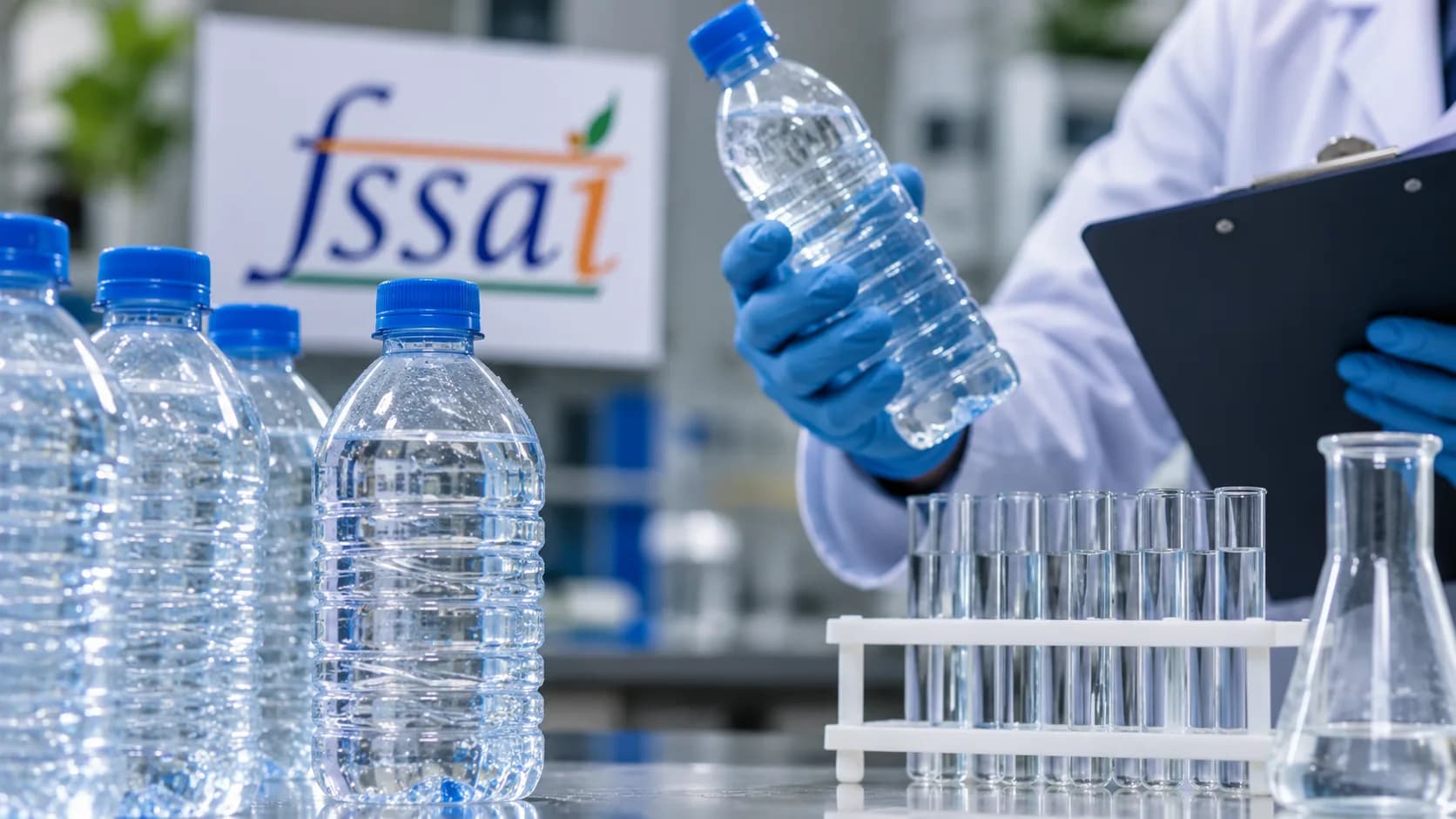
Somewhere in India's bottling plants, FSSAI inspectors are lifting samples and sending them to laboratories. FSSAI chief executive Rajit Punhani said on Wednesday that the regulator is collecting packaged drinking water samples across the country, with lab testing expected to take around two months. The results will say something about the water in your fridge. They will say less than most readers expect, and the reasons are worth understanding first.
What FSSAI has confirmed, and what it hasn't
Punhani spoke on the sidelines of a CII event. He placed water inside a year-long surveillance push that has already covered dairy, meat, eggs, cereals, energy drinks and sugary beverages. He also said the drive is not tied to any particular incident. He added that FSSAI will soon begin inspecting the "packaging materials" used for food, which should be food grade.
The timing invites a link to Bisleri. Days earlier, FSSAI had sanctioned prosecution against the company over a water sample. Some outlets describe the national drive as following that case. The regulator's own stated position is that it does not. IFT reports it on that basis.
Several details remain undisclosed. FSSAI has not published the number of samples, the states covered, the brands or the test parameters. It has not said whether mineral water is included or whether results will be made public. Unnamed sources told PTI that officials inspected the premises of all major packaged-water operators and collected samples. That is a sourced report, not an official statement.
What the law tests for, and what this drive tests for
Treat these as two separate questions. The first has a published answer. The second does not.
Regulation 2.10.8 of the food standards sets microbiological, physical and chemical requirements. These include absence of coliform bacteria, Salmonella and Shigella, limits on turbidity and total dissolved solids, and maximum levels for arsenic, lead, mercury and bromates.
FSSAI's own scheme of testing is more granular. It requires manufacturers to run microbiological tests monthly. Those cover coliforms, faecal streptococci, Staphylococcus aureus, Pseudomonas aeruginosa, Salmonella, Shigella and Vibrio cholerae, among others. Chemical parameters such as barium, copper, iron, manganese, nitrate, nitrite, aluminium and phenolic compounds are tested every three months. Pesticide residues are tested every six months, and the full 2.10.8 list is tested once in six months.
Whether FSSAI's regulatory samples in this drive will be run against that full list is not public. Readers should not assume they will.
Inside the bottle
Packaged drinking water isn't one product. It can come from groundwater, municipal supply, surface water or seawater. It may then be filtered, put through reverse osmosis, demineralised, remineralised and disinfected before sealing. Natural mineral water follows a stricter logic. FSSAI's scheme permits treatment of mineral water only if its mineral content is not modified. The two categories have separate rules and separate testing schedules.
Each treatment step solves one problem and can create another. Ozone kills microbes but can create bromate. The WHO identifies ozonation as the main reason bromate appears in drinking water. The amount depends on the bromide in the source water, among other factors, and the WHO's provisional limit is 10 micrograms per litre. Good manufacturing therefore starts before treatment, with testing the source.
Contamination can also arrive after treatment. Canada's food inspection agency notes that microbes can enter bottled water during production, transport of source water and bottling when good manufacturing practices are not followed. FSSAI's scheme addresses this directly. It restricts refillable containers to those of five litres and above, plus glass bottles. It requires sterility steps for glass lines and mandates migration tests for plastic jars, bottles and caps. A plant can pass a source-water test and still fail at the filling line.
None of this suggests bottled water is generally unsafe. It suggests that safety depends on process control, which is what the scheme tries to document.
From BIS mark to testing scheme
This is the most misunderstood part of the story. Here is what changed.
On 17 October 2024, FSSAI gazette-notified the removal of mandatory BIS certification for packaged drinking water and mineral water. Later that year, FSSAI placed both products in its high-risk food categories. That brought mandatory inspection before licensing, risk-based inspection every year and annual third-party audits for centrally licensed manufacturers.
The legal standard didn't disappear. Water must still meet the FSS regulations. The BIS mark simply stopped being a legal prerequisite. FSSAI's 17 December 2025 order made its scheme of testing compulsory for all food business operators from 1 January 2026.
The scheme replaces a certification mark with record-keeping. Manufacturers must test at FSSAI-notified, NABL-accredited laboratories and retain records. They must test source water before use and re-test when the source changes. The scheme has a built-in penalty for lapses. After a microbiological failure, production and dispatch can resume only after five consecutive satisfactory batches. Repeated non-compliance in six-monthly reports attracts risk-based inspection.
The shift also changes who holds the evidence. Under the old model, a third party certified the plant. Under the new one, the plant's own lab reports are the first line of proof, with FSSAI checks on top. That makes regulatory sampling, like the current drive, more important.
States are not moving in lockstep. Uttar Pradesh's food safety commissioner has directed that no new packaged-water unit receive a licence without a BIS certificate. This followed inspections of 811 units and 660 samples over the past year. The UP directive is reported by one outlet, and IFT has not seen the order itself.
What the Bisleri case does, and doesn't, show
The case is background. It isn't the story of an industry.
According to reports, FSSAI collected six samples from Bisleri's Verna plant in South Goa in September 2025. One, from Batch GO 270, showed bromate at 12 micrograms per litre against a limit of 10. Bisleri appealed. FSSAI's 23 November clarification says the primary lab (Envirocare Labs, Mumbai) recorded bromate at 0.012 mg/l against the 0.01 mg/l limit. The referral lab (NFL, Navi Mumbai) found bromate below the limit of quantification but detected PAHs at 0.144 µg/l. The clarification adds that a referral result is final when an operator appeals.
FSSAI's standard requires PAHs to be "not detectable." So the two labs' findings point in opposite directions. The first lab found a bromate failure and the referral lab found the bromate within limits. The referral lab found PAHs, which the first had not. FSSAI's own account says the sale-prohibition order followed the referral report, and covers only that batch.
The company's position differs on emphasis. Bisleri says FSSAI's finding concerns one Goa batch from September 2025 that is no longer in circulation. It says the company produces more than 50,000 batches a year. It also says an FSSAI-approved lab separately found bromate within limits, and that it sent those results to FSSAI's Western Regional Office on 2 February 2026. The company says it has not received any notice and could not find the reported notice on FSSAI's website.
FSSAI sanctioned prosecution, which isn't a conviction. A sample, a batch, a plant and a company are four different things, and the evidence so far concerns one sample.
Pawan Kumar Agarwal, a former FSSAI chief executive, framed it carefully in remarks to The Indian Express as relayed by NewsDive. He said a bromate finding doesn't by itself show deliberate addition, that the case does not support a broad conclusion about packaged water, and that FSSAI should explain the scientific basis of the PAH standard and the reason for the lab discrepancy. IFT could not independently reach him for this article.
One more observation, which is IFT's own. The sample was drawn on 30 September 2025 and prosecution was sanctioned on 22 November 2026, roughly 14 months later. Appeals and referral testing take time, and the sources don't say where the time went. A one-to-two-month turnaround for a nationwide drive therefore describes lab results, not final enforcement outcomes.
Can you check your own bottle?
Only partly. No visible feature tells you whether water meets chemical limits. Bromate, PAHs and pesticide residues are invisible, and clear water proves nothing about them. What you can verify is traceability, which is where accountability starts.
Dates and batch. Check the manufacturing or packing date, expiry and batch number. A batch code is how regulators trace and prohibit a product, as the GO 270 order did.
Licence number. The label should carry a 14-digit FSSAI licence number. FSSAI's Food Safety Connect app lets consumers verify an FSSAI licence or registration on a food packet. fssai
Seal and packaging. Reject bottles with broken, loose or reglued seals, deformed bottles or dirty caps.
Storage. Avoid bottles left in direct sun or heat at the shop. This is general storage practice, not a rule IFT found in FSSAI documents.
Refill jars. The scheme's rules on reusable containers apply to jars and glass, so check that 20-litre jars look clean and intact.
If something looks wrong, complaints can be filed through the Food Safety Connect app or the portal at foscos.fssai.gov.in/consumergrievance. FSSAI also runs a 24×7 toll-free helpline, 1800112100. Keep the bottle, the batch code and the shop name.
What happens next
Three things will decide whether this drive builds confidence.
First, publication. FSSAI hasn't said whether it will release brand-level or batch-level results. Without them, consumers get a headline and not a finding.
Second, interpretation. Parliament was told in February 2025 that 333 of 1,300 enforcement samples of packaged water were non-conforming in 2023-24, and 650 of 1,776 in 2022-23. That sounds alarming, but "non-conforming" is a broad term. FSSAI's wider food dataset separates unsafe and substandard samples from those flagged for labelling or claims defects. The next release should break failures down by type and by parameter.
Third, consequences. FSSAI's stated route is legal action against operators whose samples fail. Whether enforcement differs between large brands and small bottlers is a question the available data doesn't answer.
The bottom line
The drive is a routine-sounding act with high stakes. Every operator already has to test its own water, keep the records and survive inspection. What FSSAI is doing now is checking the checkers. The outcome that would serve consumers is neither a scare nor a clean bill of health. It is specific, published results, batch by batch and parameter by parameter, so that "safe" stops being a claim on a label and becomes something anyone can look up.
Also read: Nashik Kumbh Mela: Groundwater Tests Find Cancer-Linked Chemical at 1,000 Times the Safe Limit