
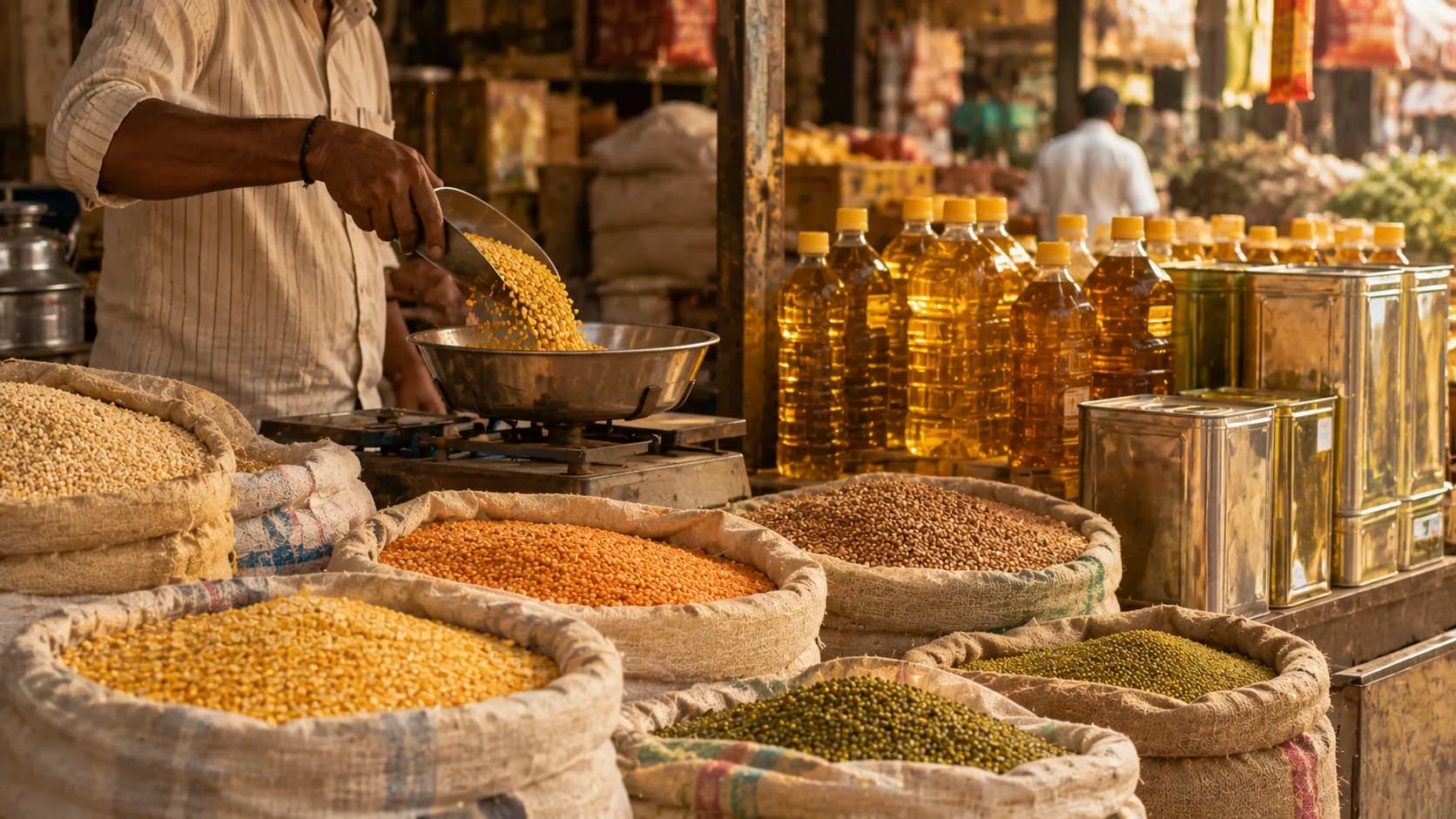
Ashok Kumar Lahiri says India imports over half its edible oil and calls for faster domestic production as food inflation climbs.
NITI Aayog Vice-Chairman Ashok Kumar Lahiri said on Friday that India is yet to achieve complete food security across all agricultural commodities, particularly given its status as the world's largest importer of edible oils.
Addressing an event in New Delhi, Lahiri said India meets more than half of its edible oil needs through imports, estimated at 17 million metric tonnes and valued at about $20 billion.
Pulses and edible oils on the plate
India is the world's largest producer and consumer of pulses and accounts for nearly a quarter of global consumption, estimated at 25–27 million tonnes a year, but it still depends on imports to meet its requirements. Lahiri noted that imports of edible oils and oilseeds come from countries such as Indonesia, Malaysia, Argentina, Brazil, Russia and Ukraine, while pulses come from Australia, Canada, Myanmar, Africa and Russia.
He argued that because pulses and cooking oils are part of everyday meals, any disruption in supply or a price shock could amount to what he called "a strategic disaster."
Inflation adds urgency
Lahiri's remarks came as retail inflation based on the Consumer Price Index stood at 6.09% in October 2026 and food inflation at 8.94%. He said India needs to boost its pulses production. He also said dal prices are not low, yet progress on pulses and edible oils should be much faster.
A case for crop diversification
Lahiri suggested that, given the need to move away from the dominance of wheat and paddy, the low water use of edible oils and pulses makes it sensible to promote them. He also stressed the need to reduce and eliminate waste in Indian agriculture.
Not a new concern
NITI Aayog has flagged the edible oil gap before. A 2024 NITI Aayog report found India imported 16.5 million tonnes of edible oils in 2022-23, with domestic production meeting only 40–45% of requirements. That report recommended higher import duties on edible oils and a wider duty gap between crude and refined oils.
On pulses, India has also used tariffs. A Canadian government briefing note says India imposed a 30% import duty on yellow peas from November 1, 2025.
What is not clear
The reports do not give a timeline or target for reducing imports, or a figure for pulses imports. The event's name was also not mentioned in the sources reviewed.