
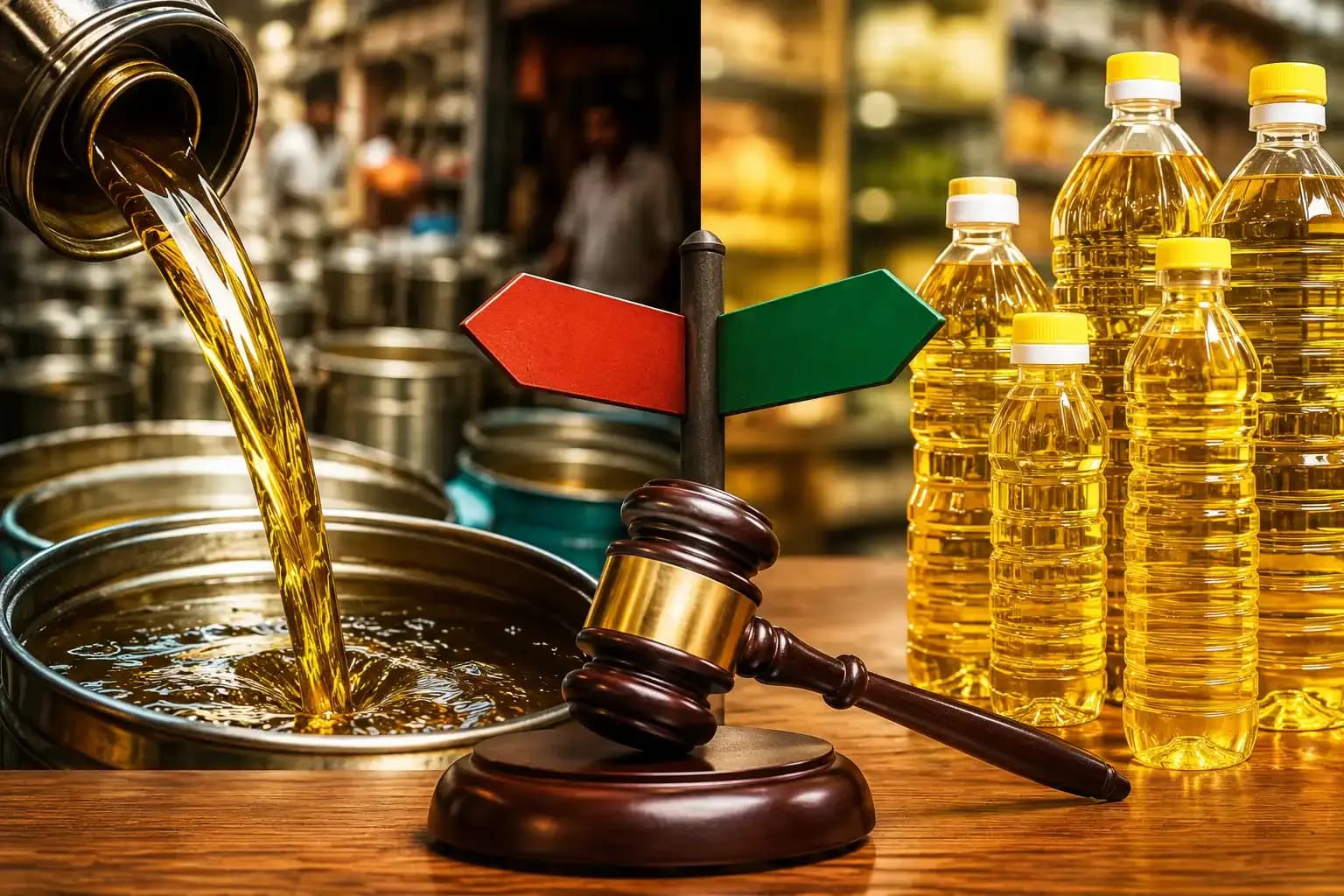
Maharashtra’s food-safety regulator has made a dramatic U-turn over its controversial crackdown on the sale of loose edible oil, withdrawing an enforcement order and a statement reaffirming the ban just hours after insisting that the policy was “non-negotiable.”
The sudden reversal has created fresh uncertainty for edible-oil traders, retailers and other businesses across the state, while the Maharashtra government moves towards a new standard operating procedure (SOP) intended to balance food safety with the concerns of traditional oil businesses.
The development comes days after Maharashtra FDA Commissioner Tukaram Mundhe announced a statewide crackdown on loose edible oil, citing concerns over adulteration, traceability, improper packaging and consumer safety.
FDA initially doubled down on loose oil ban
The Maharashtra Food and Drug Administration had taken a hard line on the sale of loose edible oil following inspections and sampling across the state.
Mundhe had maintained that the FDA’s compliance order requiring edible oil to be sold in properly sealed and labelled packaging was necessary to protect consumers and prevent adulteration.
The commissioner also rejected suggestions that the enforcement order should be diluted, saying that compromising on the food-safety requirements would not be appropriate.
However, that position changed within hours on Wednesday.
According to reports, the FDA administration subsequently withdrew both the statement and the compliance order, with officials indicating that discussions would now take place with the state government on framing a fresh SOP.
The abrupt change has raised questions about the status of the earlier enforcement framework and what businesses are expected to follow while the new policy is being prepared.
Why did Maharashtra move against loose edible oil?
The FDA’s original action was driven by concerns over the difficulty of establishing the source and quality of oil sold without proper packaging and labelling.
Loose oil, regulators argue, can make it considerably more difficult to establish:
the identity of the manufacturer or supplier;
the date of manufacture;
batch-level traceability;
the ingredients used;
whether different oils have been blended;
whether the product has been adulterated; and
whether appropriate food-grade packaging and storage practices have been followed.
The regulator had therefore sought stronger controls across the edible-oil supply chain, covering manufacturers, refiners, blenders, repackers, wholesalers, distributors, transporters and retailers.
FDA testing found substandard and unsafe samples
The FDA had cited its testing data to justify the crackdown.
During the 2025-26 financial year, the regulator reportedly tested 1,247 edible-oil samples. Of these, 1,142 were found compliant, while 77 were classified as substandard, 13 as unsafe and 15 as misbranded.
The FDA also reported seizures of approximately 3.20 lakh kg of stock valued at ₹5.31 crore during the period.
The violations detected during inspections reportedly included adulteration with cheaper oils, unauthorised blending, improper labelling and repackaging, poor storage conditions and the use of unsuitable containers.
These findings became a central justification for the FDA’s push towards sealed and traceable edible-oil sales.
Crackdown also covered repeated use of frying oil
The FDA’s broader food-safety drive was not limited to the sale of loose edible oil.
The regulator also intensified scrutiny of used cooking oil, particularly its repeated use in commercial kitchens and food businesses.
The FDA has been enforcing the limit for Total Polar Compounds (TPC) in repeatedly heated cooking oil. Oil exceeding the permissible level should not be reused for food preparation and is instead required to be channelled through authorised mechanisms such as the RUCO (Repurpose Used Cooking Oil) system.
The objective is to prevent degraded cooking oil from repeatedly entering the food chain.
Trader groups opposed blanket restrictions
The FDA’s approach, however, faced strong resistance from edible-oil traders and traditional businesses.
Industry representatives argued that an across-the-board prohibition on loose oil could adversely affect small retailers, traditional oil businesses and consumers who purchase edible oil in smaller quantities.
Trader groups also argued that legitimate businesses should not be treated in the same manner as operators involved in adulteration or illegal blending.
The All India Edible Oil Traders Federation and other representatives had urged the state government to reconsider the blanket approach and indicated that they could pursue legal and administrative avenues if the order remained unchanged.
Fadnavis seeks a “middle path”
The controversy eventually reached the state government.
Chief Minister Devendra Fadnavis indicated that the government wanted to find a middle ground—one that would maintain strict food-safety standards while protecting traditional businesses and smaller traders.
Rather than relying solely on an outright prohibition, the government is now looking at an SOP that could establish specific conditions under which the trade can operate while maintaining safety and traceability requirements.
The precise provisions of that SOP, however, have not yet been publicly finalised.
What happens to the loose-oil ban now?
This is the biggest question following Wednesday’s reversal.
The withdrawal of the FDA’s compliance order should not automatically be interpreted as a permanent lifting of all restrictions on loose edible oil.
Instead, the immediate position appears to be that the earlier enforcement framework has been withdrawn while the government works towards a revised mechanism.
That leaves several important questions unanswered.
Will legitimate traders be permitted to sell loose oil subject to testing and traceability requirements? Will small-volume sales receive exemptions? Will traditional oil mills receive a transition period? And what happens to enforcement actions already initiated under the earlier order?
The government’s proposed SOP is expected to provide clarity on these issues.
Sudden reversal puts regulatory spotlight on Maharashtra FDA
The speed of Wednesday’s reversal has made the episode particularly significant.
The FDA commissioner initially reaffirmed the enforcement position and described the order as non-negotiable. Within roughly an hour, however, the statement and compliance order were withdrawn.
For businesses operating across Maharashtra’s edible-oil supply chain, the immediate concern is now regulatory certainty.
The state government must balance two competing objectives: preventing adulteration and protecting consumers while avoiding measures that could unnecessarily disrupt legitimate traditional businesses.
For now, the blanket enforcement approach has been pulled back, but the underlying food-safety concerns remain.
The next major development will be the government’s proposed SOP—and whether it can create a workable system that gives the FDA effective control over adulteration and traceability without forcing legitimate loose-oil businesses out of the market.