


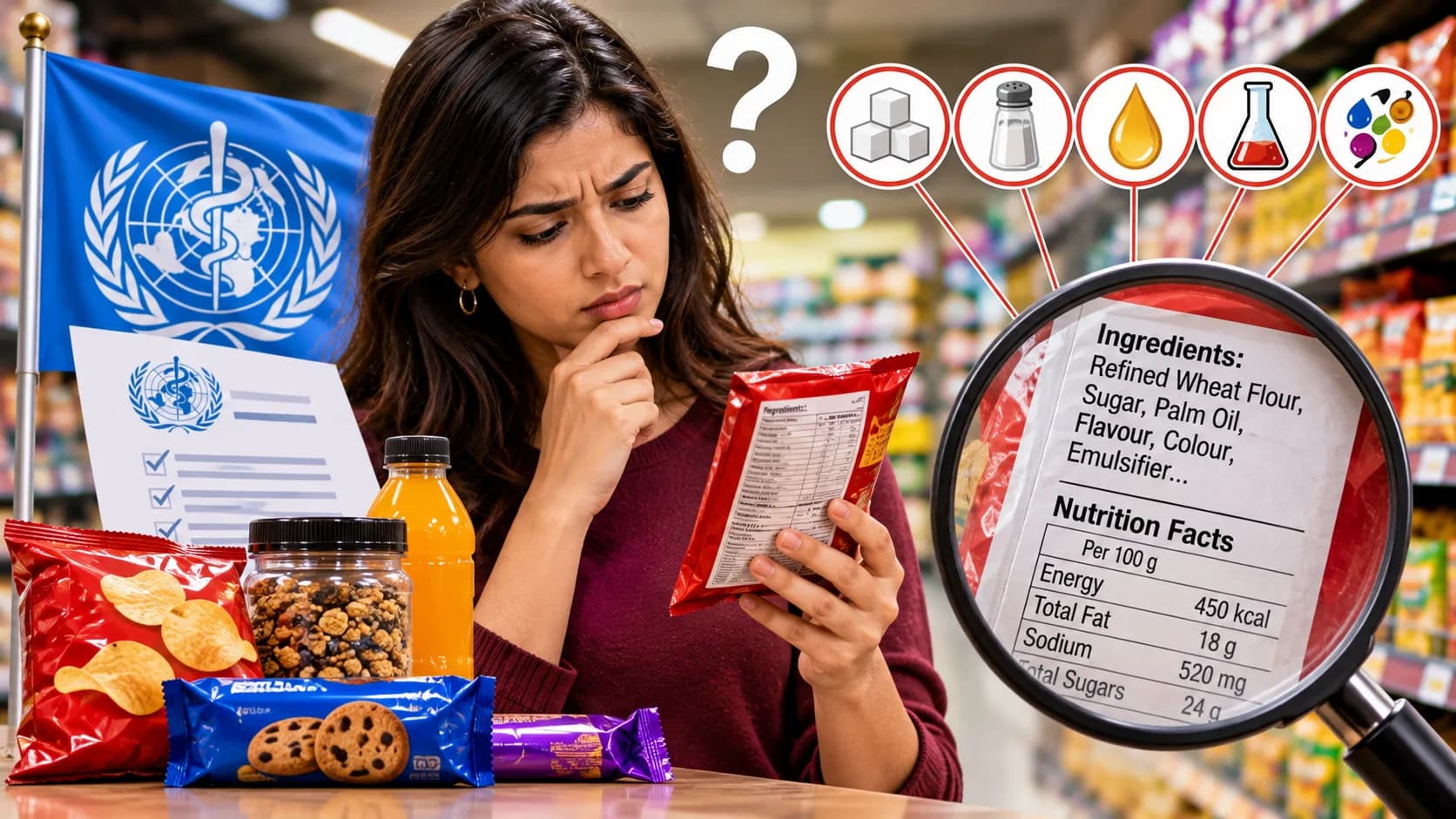
Two packets, one question
Put two packets of biscuits side by side. They list similar sugar, sodium and saturated fat. One is coloured and flavoured with a sweetener; the other is not. Should a regulator treat them the same?
That is the question behind a draft the World Health Organization released on 2 November 2026 and opened for public comment. Its title is Integrated Food Profiling Model for Regulatory Measures (WHO draft as linked by Food Safety Magazine). It does not ban anything and it is not law. It is a proposed yardstick that governments could use, if they choose, to decide which packaged foods deserve warnings, marketing limits or taxes.
What WHO is proposing
The draft sorts packaged foods into a group it calls "industrially produced foods to be consumed in moderation", according to FoodBev. A food lands in the group in either of two ways. It exceeds a limit for saturated fat, trans fat, sugars or sodium. Or it contains one or more specified flavours, colours or sweeteners. Meeting one test is enough.
The model does not grade foods by how heavily processed they are, and does not label them "healthy" or "unhealthy", Food Safety Magazine reports. Countries would adapt it to their own law. Possible uses listed include front-of-pack warnings, limits on marketing to children, fiscal measures and public food procurement.
Comments are open until 27 November 2026 at 23:59 CET, per FoodBev. WHO will review submissions before finalising the document; we have not seen WHO's own statement of that process.
Why sugar, salt and fat may not be the whole story
WHO's argument, as reported, is that nutrients alone miss how a product is built to appeal. Katrin Engelhardt, a technical officer in WHO's nutrition and food safety department, told Reuters: "This draft goes beyond traditional nutrient profiling." Reuters describes it as the first WHO guidance to include colours, flavours and sweeteners.
The evidence base is large. WHO analysed about 1.5 million food and beverage products from 84 countries and territories. About 1.1 million had validated nutrition declarations and ingredient lists, and the thresholds plus ingredient criteria captured 97.27% of those classed as ultra-processed under the Nova system, Food Safety Magazine says.
Read that number carefully. It says the model catches nearly all foods Nova calls ultra-processed. It does not say the model flags only such foods, and it does not make the model a definition of ultra-processed food. WHO itself, per the reports, describes the model as separate from Nova's focus on the extent of industrial processing.
The ingredients at the centre
The contested part is the ingredient list. WHO's draft says that including flavours, colours and sweeteners does not mean they are unsafe, according to FoodBev. They are included because of what they do: they make products more appealing, which may raise how much people eat.
That separates two questions regulators usually keep apart. Additive safety asks whether an ingredient is harmful at authorised levels. Food profiling asks which products policy should treat with caution. A colour can be fully permitted and still be a signal in a profiling model. The risk for readers is hearing "flagged" as "dangerous". Neither WHO's draft nor this article says that.
What we could not establish is how the draft treats natural versus synthetic colours, how it identifies flavours in a declaration, or whether it flags products that pass every nutrient test. Those answers sit in the draft's technical text, which we did not read.
Why industry is pushing back
The International Food and Beverage Alliance objects. Its secretary-general, Rocco Renaldi, told Reuters the draft risks "undermining established nutrition priorities and reformulation efforts". Reuters also lists industry concerns that were not attributed to a named speaker: higher reformulation costs, stricter labelling, class-action risk and higher taxes.
Supporters see it differently. Lindsey Smith Taillie of the University of North Carolina told Reuters the nutrient and ultra-processed-food approaches "have never been mutually exclusive", and that the model uses several criteria.
Both positions are arguments, not findings. Industry opposition is not proof the model is wrong; WHO's evidence is not beyond challenge. Independent scientific commentary on the draft is still to be sought.
What it could mean for India
India is already in the middle of a front-of-pack fight, and the WHO draft lands beside it.
In the Supreme Court case 3S and Our Health Society v Union of India, FSSAI filed an affidavit on 28 August 2026 proposing a red hexagon warning, with thresholds drawn from the ICMR-NIN Dietary Guidelines for Indians, 2024 (Verdictum). On 10 September the Court posed 13 questions, including on thresholds, label colour and whether reformulation could push makers towards more preservatives or emulsifiers.
A later filing, reported by Reuters via Qatar Tribune, moved to a single phase in which one nutrient of concern is enough to trigger the warning. FSSAI expects to finalise regulations in about four months, then allow a 365-day implementation period; the reports differ on whether that period is voluntary or mandatory. LiveLaw's report says the filing treats added fat and not saturated fat, and that level of processing would not be a criterion.
That is the key contrast. India's proposal is nutrient-based. WHO's draft adds ingredients. One overlap exists: the FSSAI filing would require a front-of-pack "contains non-caloric sweetener" warning, per Reuters, so sweeteners already appear in India's proposal, though through a separate warning and not a combined model.
Status as of 12 November 2026: a proposal under Supreme Court supervision, not a notified rule. We did not find reporting on the outcome of the 28 September hearing.
Would your favourite snacks be affected?
We cannot say, and the article should not guess. Applying WHO's criteria requires its exact thresholds and a product's full ingredient list and nutrition declaration. We did not have the first, and we did not verify labels for any product. Classification of instant noodles, biscuits, cereals or beverages is therefore unconfirmed. An illustrative comparison is possible once the draft's tables are read and labels are photographed.
What could change for consumers
If a country adopted the model, WHO lists the possibilities: warnings, marketing limits for children, taxes, procurement rules. Reformulation is a plausible response, as industry itself argues, but that is expectation, not outcome. Nothing here is policy in India. The consumer habit worth keeping is the same today: read the sugar, sodium and saturated fat lines, and the ingredient list, without treating every additive as a threat.
What happens next
Consultation closes on 27 November. WHO then reviews comments and publishes a final version. Whether India adopts any part depends on the Supreme Court case and on FSSAI's own regulations.
Should regulators judge nutrients alone?
The draft asks whether a food should be judged only by what is in it, or also by how it was made to appeal. Industry says that dilutes nutrition priorities. WHO's side says the two views complement each other. India's courts and regulator are still deciding even the first, narrower question.
Item | As reported | Status |
|---|---|---|
Title | Integrated Food Profiling Model for Regulatory Measures: Implementing the WHO Best Buys and Recommended Food Policies to Prevent Diet-Related NCDs | Reported |
Date | PDF named 2 Nov 2026; Reuters says published the week before 9 Nov | Reported; matches your brief |
Consultation deadline | 27 Nov 2026, 23:59 CET, online via WHO | Reported by FoodBev; confirm on WHO page |
Who may comment | Member states, academia, civil society, nutrition experts, others | Reported |
Category created | "industrially produced foods to be consumed in moderation" | Reported |
Nutrient criteria | Saturated fatty acids, trans fatty acids, sugars, sodium | Reported; thresholds not retrieved |
Ingredient criteria | Specified flavours, colours, sweeteners used for sensory purposes | Reported; list not retrieved |
Trigger | One or more nutrient criteria exceeded, or one or more specified ingredients present | Reported |
Safety statement | Inclusion does not mean the ingredients are unsafe | Reported |
Scope | Does not grade by processing level; not labelled healthy or unhealthy; not a regulatory instrument | Food Safety Magazine |
Possible uses | Front-of-pack labelling, marketing limits for children, fiscal measures, procurement | Reported |
Dataset | About 1.5 million products, 84 countries and territories; about 1.1 million with validated declarations | Food Safety Magazine |
Validation | Criteria captured 97.27% of nutrient-validated foods classed ultra-processed under Nova | Food Safety Magazine; method unseen |
WHO asks consultees for | Clarity of the model and criteria; application across food systems and regulatory contexts | FoodBev |
Product categories, exclusions | Not reported | Unresolved |
Natural vs synthetic colours | Not reported | Unresolved |
Should regulators judge nutrients alone?
WHO’s draft asks a question India’s own label debate has so far avoided: should a packaged food be judged only by what is in it, or also by how it was made to appeal? Industry says the second approach risks pulling attention away from nutrition. WHO’s side says the two views work together.
Nothing is settled. The draft is a consultation paper, open for comment until 27 November, and it binds no country. India’s red-hexagon warning is still a proposal before the Supreme Court. For shoppers, the advice is the same either way: read the sugar, sodium and saturated fat lines and the ingredient list, and don’t treat every additive as a threat. The bigger shift is that regulators are starting to ask what a food is built to make you want, not only what it contains.