

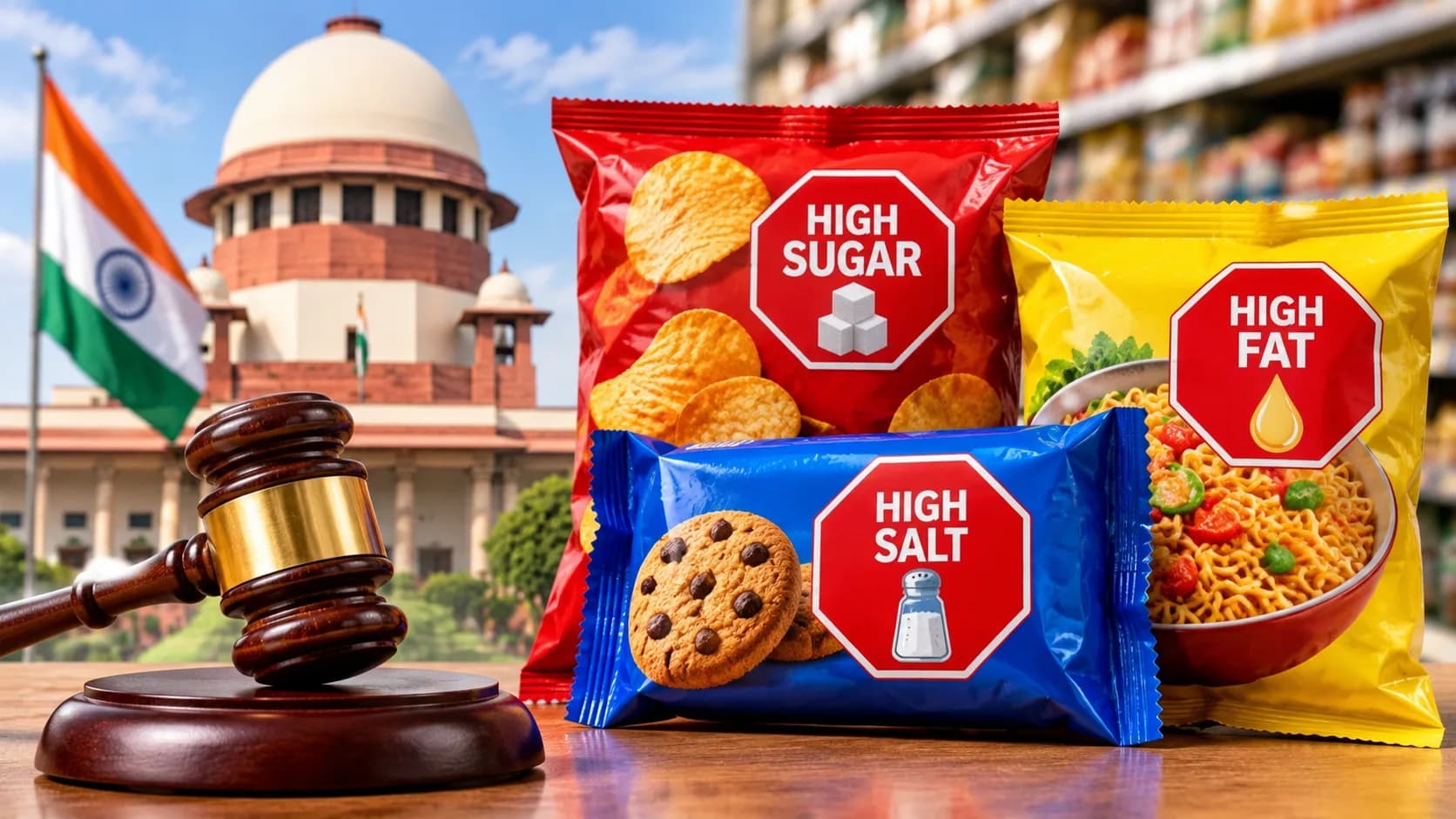
The Supreme Court of India has directed the Food Safety and Standards Authority of India (FSSAI) to strengthen front-of-package nutrition labelling rules for packaged food products. The decision, announced on November 26, 2026, aims to make nutritional information clearer and help consumers identify products containing excessive amounts of sugar, salt and fat.
Under the court's directions, packaged food products exceeding prescribed nutritional limits will have to display separate red hexagonal warning labels on the front of their packaging. These labels will carry clear warnings such as "High Sugar", "High Salt" and "High Fat", along with standardised pictorial representations.
Separate Warning Labels for Each Nutrien
The Supreme Court has directed that each nutrient of concern must have its own warning symbol instead of using a single combined label. This means a product containing high levels of all three nutrients could display three separate warning symbols.
The court has also directed that the warning labels should be sufficiently prominent and readable. Each hexagonal symbol should occupy approximately 4–5 per cent of the package's principal display panel, subject to the court's directions.
FSSAI to Revise Nutrition Labelling Rules
The food regulator has been asked to reconsider the nutritional thresholds used to identify products high in sugar, salt and fat. The revised framework must consider total sugars and saturated fat, along with salt, and should be based on scientific evidence.
The court's directions also aim to prevent delays in introducing the new labelling system and ensure that food manufacturers follow the revised requirements properly.
What This Means for Consumers
The new warning-label system could make grocery shopping easier by allowing consumers to identify products with excessive levels of certain nutrients without having to study complicated nutritional information on the back of packages.
Products such as packaged snacks, biscuits, instant noodles, sugary beverages and other processed foods may carry these warnings if they cross the prescribed nutritional limits.
Clearer labels could particularly help parents and families make more informed decisions about the food they purchase and consume.
Timelines for Implementation
The Supreme Court has accepted the FSSAI's proposed timeline of approximately four months to complete the regulatory process. Food businesses will receive a 365-day transition period after the regulations are finalised to make the necessary changes to their packaging.
This means the warning labels will not become compulsory on every packaged food product immediately. Their application will depend on the final regulations and prescribed nutritional thresholds.
A Step Towards Better Food Transparency
The decision marks an important development in India's food safety and consumer awareness framework. By making nutritional warnings more visible, the new system aims to encourage informed food choices and improve transparency in the packaged food industry.
It may also encourage manufacturers to review their product formulations and pay greater attention to nutritional quality. The effectiveness of the initiative will ultimately depend on clear regulations, proper monitoring and consistent implementation across the food industry.