
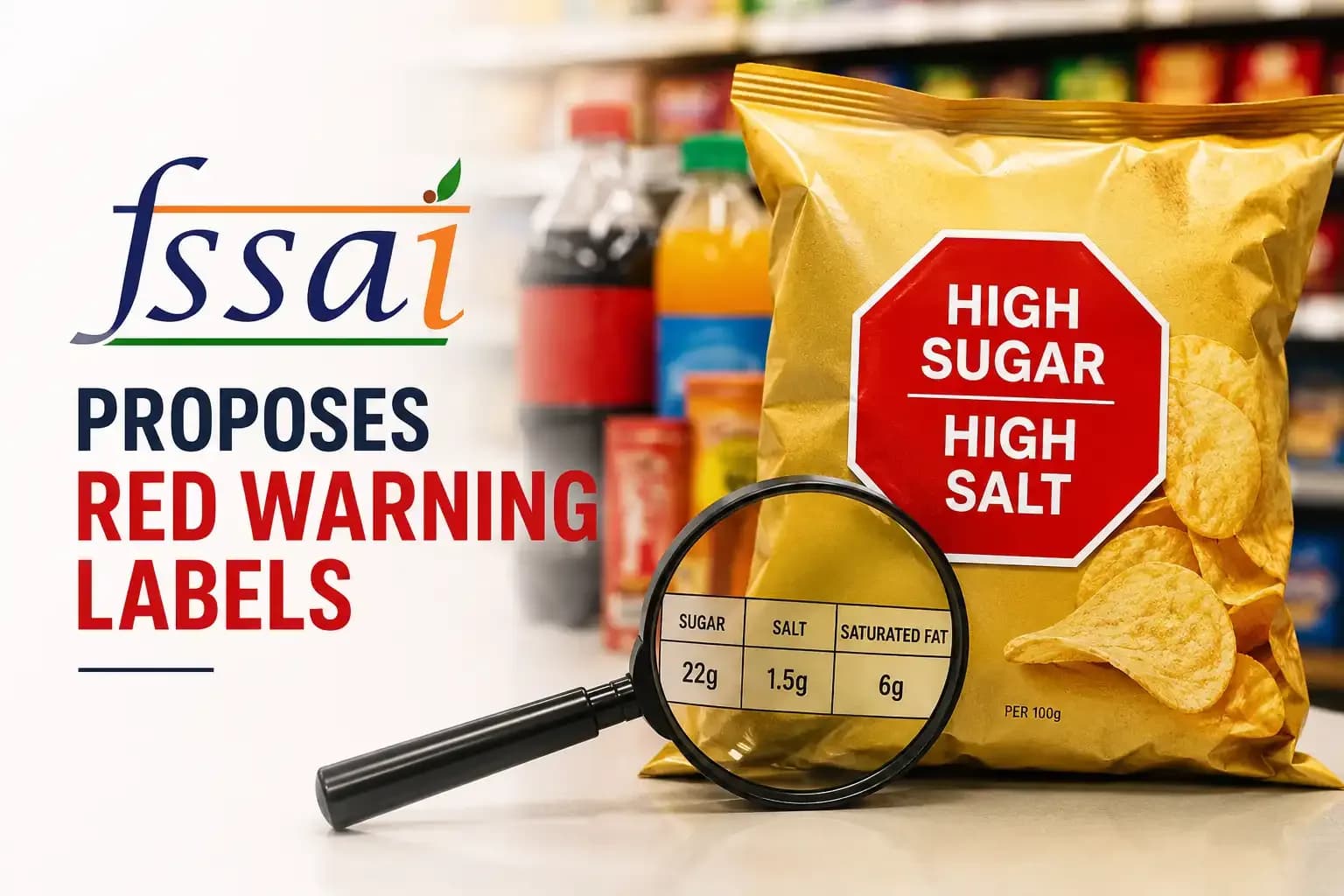
India could be heading towards a major overhaul of how packaged food products communicate nutritional risks to consumers, with the Food Safety and Standards Authority of India (FSSAI) proposing prominent red-coloured hexagonal warning labels for foods high in sugar, salt and saturated fat.
The proposal, placed before the Supreme Court on Friday, August 28, marks a significant shift in India's long-running debate over front-of-pack nutrition labelling and comes amid growing judicial scrutiny of the country's existing system.
Under the proposed framework, a packaged food or beverage would carry a front-of-pack warning when it is found to be high in at least two of the specified nutrients — sugar, salt or saturated fat. The objective is to make potentially unhealthy nutritional characteristics immediately visible to consumers rather than requiring them to interpret detailed information printed elsewhere on the package.
The proposal could have far-reaching consequences for India's fast-moving consumer goods (FMCG), packaged food and beverage sectors, potentially influencing everything from product formulation and packaging design to advertising and consumer marketing.
Supreme Court pressure drives regulatory rethink
The latest proposal follows months of scrutiny by the Supreme Court over India's approach to front-of-pack nutrition warnings.
The Court has repeatedly questioned the delay in implementing a prominent warning system and has emphasised the importance of giving consumers, particularly children, clear information about products containing high levels of nutrients associated with diet-related health risks.
The issue gained further momentum this month after the Supreme Court expressed strong dissatisfaction with the pace of regulatory action and questioned why FSSAI had not moved more decisively on front-of-pack warnings.
The Court had earlier asked authorities to consider prominent warnings such as “High Sodium Level”, “High Sugar Level” and “High Saturated Fat Level” on packaged food products.
FSSAI's latest proposal appears to be a response to that judicial pressure.
A significant shift from FSSAI's earlier position
The proposed red warning system is particularly notable because it represents a departure from an approach FSSAI had put forward earlier this month.
In an August 3 compliance affidavit, the regulator had proposed providing consumers with recommended daily limits alongside nutritional information. The figures discussed included 25 grams of added sugar, 10 grams of saturated fat and 5 grams of salt as recommended daily limits.
Critics argued that such a system would leave consumers to interpret nutritional figures themselves instead of providing a simple warning at the point of purchase.
The latest proposal moves towards an interpretive warning system, where the packaging itself would immediately signal that a product crosses specified nutritional thresholds.
Public-health advocates have generally favoured such warnings, arguing that consumers should not need to calculate or interpret complex nutritional information while shopping.
What would the red warning look like?
The proposed system would use a red hexagonal symbol prominently displayed on the front of qualifying packages.
The warning would identify the relevant nutritional concern, allowing consumers to recognise products high in the specified nutrients without having to turn the package around and examine the detailed nutrition panel.
The exact design, wording, dimensions and placement requirements, however, will depend on the final regulatory framework.
Similarly, the precise nutrient thresholds that determine when a product qualifies as “high” remain crucial details for the industry and consumers.
FMCG companies could face major changes
If implemented, the proposed labelling system could significantly affect India's packaged food and beverage manufacturers.
Products carrying prominent warnings could face greater scrutiny from consumers, particularly parents looking for food and beverages for children.
For manufacturers, the implications could extend well beyond packaging.
Companies may have to consider reformulating products to reduce sugar, salt or saturated fat and keep them below the applicable thresholds. Others may choose to retain existing formulations and accept the warning.
The changes could also affect packaging inventories, product launches, marketing strategies and the positioning of products promoted around health, wellness or family consumption.
For large FMCG companies with hundreds of products, even relatively small changes to nutritional thresholds could therefore translate into substantial formulation, testing and packaging costs.
Industry and public-health groups remain divided
The proposed warning system has been at the centre of a broader battle between industry concerns and public-health demands.
Food and beverage companies and industry associations have previously raised concerns that warning labels could oversimplify nutritional information and unfairly portray certain products.
Industry representatives have argued that consumers should receive sufficient information to make their own choices rather than being presented with labels that could create a negative perception of a product.
Public-health organisations, however, have taken the opposite view.
Their argument is that conventional nutrition panels are often difficult for consumers to interpret and that simple, highly visible warnings can help people identify products high in nutrients such as sugar, salt and saturated fat more quickly.
The Supreme Court's intervention has brought the disagreement into sharper focus.
India's front-of-pack labelling debate has a long history
India's attempt to introduce an effective front-of-pack nutrition system has been ongoing for several years.
One earlier proposal centred on the Indian Nutrition Rating (INR) system, under which packaged foods could receive a rating ranging from half a star to five stars based on their overall nutritional profile.
That approach faced criticism from public-health groups, who argued that an overall rating could potentially obscure the presence of particularly high levels of individual nutrients such as sugar, sodium or saturated fat.
Warning labels take a fundamentally different approach.
Instead of asking consumers to interpret an overall score, they provide a direct signal about specific nutritional concerns.
Potential impact on children's food and beverages
Children have emerged as one of the most important considerations in the debate.
Young consumers are heavily exposed to marketing for packaged snacks, confectionery, sweetened beverages, breakfast products and other processed foods.
A prominent front-of-pack warning could therefore change how parents assess these products while shopping.
FSSAI's proposed approach is aimed at making nutritional information more accessible and helping consumers make informed choices, particularly in relation to children and vulnerable groups.
The move also comes against the backdrop of growing concern over diet-related non-communicable diseases and the increasing consumption of processed and packaged foods.
Not a final mandate yet
Despite the significance of the proposal, it is important to note that the red warning labels are not yet a final mandatory requirement across packaged foods.
FSSAI has proposed the framework as part of its response to the Supreme Court proceedings. The final thresholds, design specifications, exemptions, implementation schedule and compliance requirements will have to be established through the regulatory process.
The proposal reportedly envisages phased implementation, giving food manufacturers time to comply with the new requirements.
Single-ingredient food products are also expected to be excluded under the proposed framework, although the final exemption list will be important for determining exactly which categories fall within the rules.
A potential turning point for India's food industry
The proposed red warning labels could become one of the most consequential food-regulatory changes in India in recent years.
For consumers, the change could make nutritional risks more visible at the point of purchase.
For manufacturers, it could create pressure to reformulate products, redesign packaging and reassess marketing strategies.
And for regulators, the challenge will be to establish clear, scientifically defensible thresholds while ensuring that the system is practical enough for India's vast and diverse food industry.
For now, the proposal represents a major step towards a more prominent front-of-pack warning system. Whether it becomes India's new standard for packaged-food labelling will depend on the final regulatory framework and the Supreme Court's consideration of the matter.
But one thing is clear: the way packaged food is presented to Indian consumers could be on the verge of a major change.