
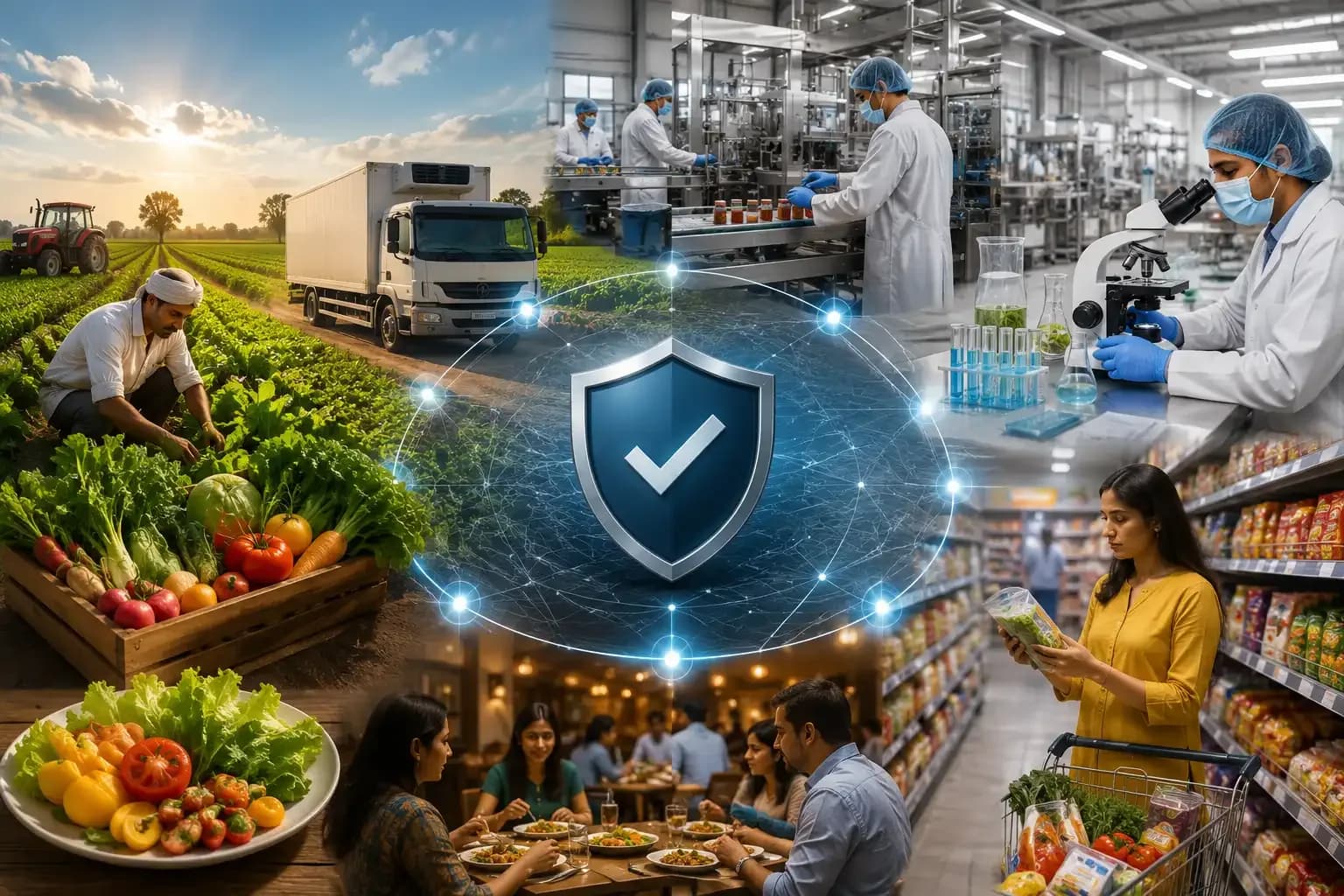
India may soon witness one of the most significant transformations in its food safety ecosystem as NITI Aayog is working on a comprehensive Farm-to-Fork Food Safety Reform aimed at making the country's food supply chain safer, more transparent, and globally competitive.
The proposed framework, currently under discussion with the Central Government, seeks to strengthen food safety by introducing end-to-end traceability, expanding food testing infrastructure, tightening action against food adulteration, encouraging compliance among food businesses, and improving monitoring across every stage of the food supply chain.
While the reforms are yet to receive final approval, industry experts believe the initiative has the potential to reshape how food is produced, processed, transported, sold, and consumed across India.
A Shift from Reactive Food Safety to Preventive Monitoring
For years, India's food safety system has largely focused on inspecting food products after they enter the market. The proposed Farm-to-Fork model represents a major shift by emphasizing prevention rather than reaction.
Instead of identifying problems only after food reaches consumers, the new approach aims to monitor every stage of the food journey—from farms and processing units to warehouses, retail stores, restaurants, and ultimately consumers.
The objective is to identify potential risks much earlier, reducing contamination, improving transparency, and enabling quicker corrective action whenever food safety issues arise.
End-to-End Food Traceability at the Heart of the Reform
One of the most significant proposals under the new framework is complete food traceability.
Authorities want every food product to be traceable throughout its lifecycle. This means regulators would be able to identify:
The farm where raw materials originated
Collection centres handling agricultural produce
Food processing facilities
Manufacturing plants
Transport and logistics partners
Warehouses
Retail outlets
Final distribution channels
Such traceability would enable regulators and food businesses to quickly identify the source of contamination, limit product recalls to affected batches instead of entire inventories, and significantly reduce financial losses while protecting consumers.
For India's rapidly growing packaged food sector and food export industry, enhanced traceability is expected to strengthen confidence among domestic and international buyers.
Expansion of Food Testing Laboratories
Another major pillar of the proposed reform is strengthening India's food testing infrastructure.
The government is considering expanding the network of accredited laboratories capable of testing food samples for:
Pesticide residues
Heavy metals
Microbial contamination
Antibiotic residues
Artificial colours
Food adulterants
Chemical contaminants
Toxins
Industry stakeholders have long argued that increasing testing capacity will reduce turnaround time for food analysis while improving enforcement across states.
Better laboratory infrastructure is also expected to support exporters that must comply with increasingly stringent international food safety standards.
Tougher Action Against Food Adulteration
Food adulteration remains one of India's biggest public health challenges.
The proposed reforms seek to strengthen enforcement against adulterated and misbranded food products through:
More frequent inspections
Risk-based surveillance
Surprise audits
Faster investigations
Improved digital documentation
Stronger enforcement mechanisms
Authorities are expected to focus on high-risk categories such as edible oils, dairy products, spices, honey, packaged foods, beverages, and products carrying misleading quality or organic claims.
The initiative aligns with recent enforcement actions by the Food Safety and Standards Authority of India (FSSAI), which has intensified inspections and taken action against businesses found violating food safety norms.
Rewarding Businesses with Strong Compliance
Unlike traditional regulatory systems that primarily focus on penalties, the proposed Farm-to-Fork framework also aims to reward businesses maintaining high standards of food safety.
Officials are reportedly exploring compliance-based incentives that may include:
Faster regulatory approvals
Simplified licence renewals
Reduced inspection frequency for consistently compliant businesses
Better compliance recognition
Such measures are expected to encourage food businesses to adopt stronger internal quality control systems while reducing unnecessary compliance burdens for responsible operators.
Improved Monitoring Across the Entire Food Supply Chain
The proposed framework expands food safety monitoring beyond manufacturing facilities.
Authorities are looking at strengthening oversight across multiple stages, including:
Farms
Monitoring pesticide usage, water quality, agricultural practices, and harvesting records.
Food Processing Units
Improving hygiene standards, sanitation, equipment maintenance, and manufacturing controls.
Transportation
Strengthening cold chain management, temperature monitoring, and logistics documentation.
Warehouses
Enhancing storage conditions, inventory management, pest control, and product handling.
Retail Stores and Restaurants
Increasing monitoring of expiry dates, storage conditions, food handling practices, and supplier verification.
This integrated approach is expected to improve accountability throughout the food ecosystem.
Digital Technology Expected to Play a Larger Role
Although detailed implementation guidelines have not yet been released, industry observers expect digital technologies to become a central part of the new system.
Possible solutions may include:
QR code-based product tracking
Digital batch records
Electronic compliance documentation
Supply chain traceability platforms
Real-time reporting systems
Such technologies could significantly improve the speed of food recalls, investigations, and regulatory inspections.
Why the Reform Matters for India's Food Industry
India has emerged as one of the world's fastest-growing food markets.
With expanding food manufacturing, organised retail, e-commerce grocery platforms, restaurant chains, and exports, ensuring food safety has become increasingly complex.
If implemented successfully, the proposed Farm-to-Fork framework could:
Improve consumer confidence
Reduce food fraud
Strengthen India's food export competitiveness
Enhance food quality standards
Improve regulatory efficiency
Encourage technology adoption across the food industry
For manufacturers, restaurants, retailers, logistics providers, exporters, and startups, the reforms could lead to greater transparency while creating opportunities for innovation in food traceability and compliance solutions.
Challenges Ahead
Despite its potential benefits, implementation is expected to be complex.
India's food ecosystem includes millions of farmers, thousands of processors, and a vast network of small and medium-sized food businesses operating under diverse regional conditions.
Industry experts believe key challenges may include:
Digital adoption among small businesses
Training requirements
Infrastructure investment
State-level coordination
Data standardisation
Expanding laboratory capacity
Integrating fragmented supply chains
Successful implementation will require close collaboration between policymakers, regulators, industry bodies, technology providers, and food businesses.
What Happens Next?
At present, the Farm-to-Fork Food Safety Reform remains under discussion, and no formal implementation timeline has been announced.
NITI Aayog is working with the Central Government to develop the framework before any final policy decisions are made.
Once approved, detailed operational guidelines are expected to define implementation timelines, compliance requirements, and responsibilities for different stakeholders across India's food ecosystem.
Indian Food Times Analysis
The proposed Farm-to-Fork Food Safety Reform represents more than just another regulatory initiative—it reflects a strategic shift toward building a transparent, technology-enabled, and globally competitive food system.
By moving from reactive inspections to preventive monitoring, India has an opportunity to strengthen consumer trust, improve export readiness, and modernise its food supply chain.
However, the success of the initiative will ultimately depend on balanced implementation. While stricter food safety standards are essential, policymakers will also need to ensure that compliance remains practical and affordable for India's millions of small farmers and food businesses.
If executed effectively, this could become one of the most significant food safety reforms since the establishment of the Food Safety and Standards Authority of India (FSSAI), laying the foundation for a safer and more resilient food ecosystem.
Frequently Asked Questions (FAQs)
What is the NITI Aayog Farm-to-Fork Food Safety Reform?
It is a proposed policy framework that aims to improve food safety across the entire supply chain through traceability, stronger testing, better monitoring, and enhanced compliance.
Has the Farm-to-Fork Food Safety Reform been approved?
No. As of now, the proposal is under discussion, and the government has not announced a final implementation date.
What is food traceability?
Food traceability is the ability to track a food product from its source on the farm through processing, transportation, retail, and finally to the consumer.
How will this affect food businesses?
Food manufacturers, restaurants, retailers, exporters, and logistics companies may need to strengthen documentation, quality control, and supply chain monitoring if the reforms are implemented.
Why is this reform important for consumers?
It could improve food safety, reduce adulteration, enable faster recalls of unsafe products, and increase transparency about where food comes from.
Will farmers also be affected?
Yes. Farmers may need to maintain better records of crop production, pesticide use, and harvesting practices, but improved traceability could also enhance market access and export opportunities.