

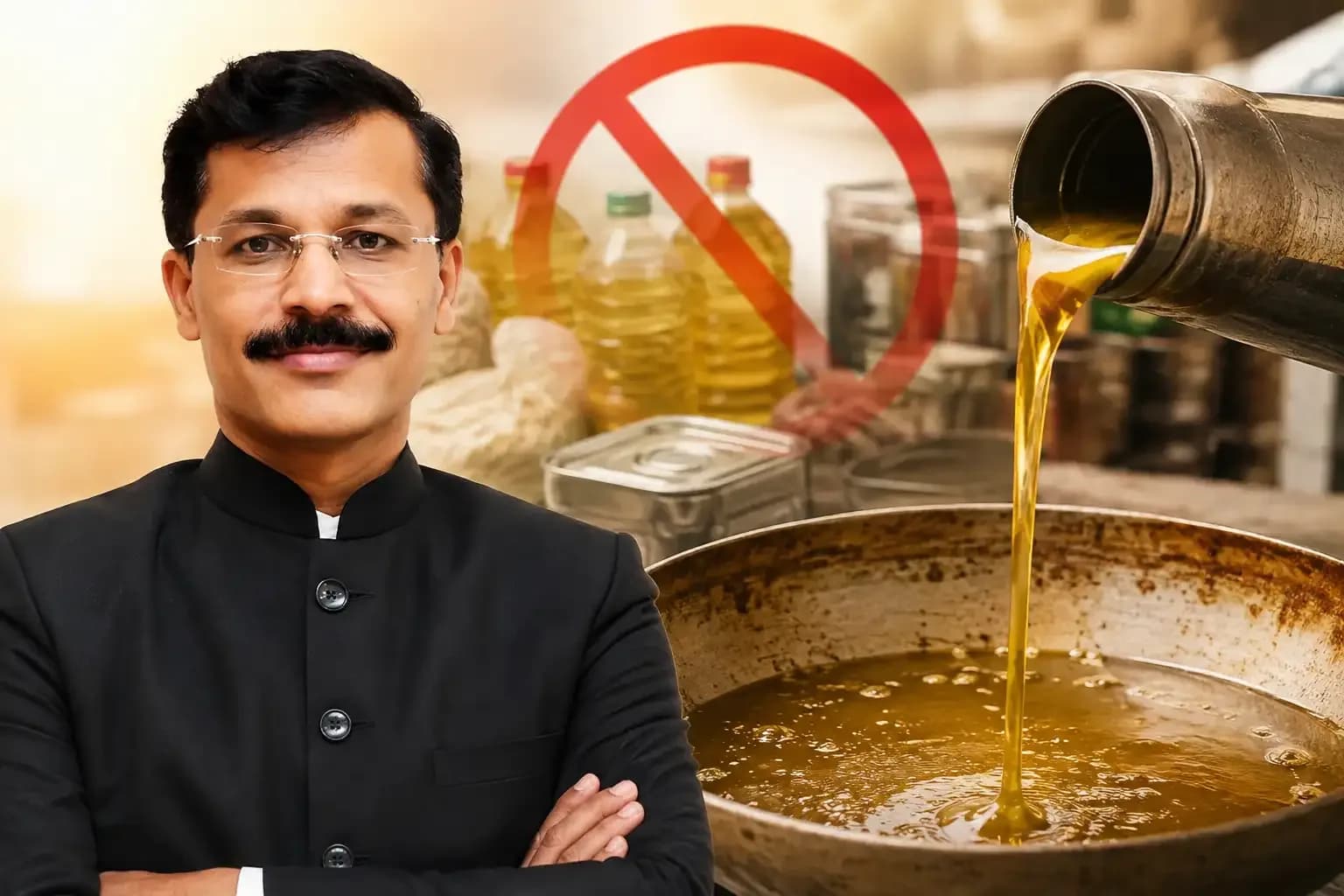
The Maharashtra Food and Drug Administration (FDA) has ordered an immediate statewide ban on the sale of loose or unpackaged edible oil, stepping up its crackdown on adulteration, unsafe packaging and the repeated reuse of cooking oil.
The directive was announced by Maharashtra FDA Commissioner Tukaram Mundhe on Thursday as edible oil becomes the latest major focus of the state's ongoing “Safe Food, Safe Maharashtra” food-safety campaign. The new compliance and enforcement order covers the edible-oil sector from manufacturing and processing to distribution, retail, hotels, eateries and online sellers.
Loose Edible Oil Sale Prohibited Across Maharashtra
Under the new order, edible oil can no longer be sold in loose or unpackaged form. Oil intended for sale must be supplied in sealed, tamper-evident and properly labelled packaging.
Mundhe has also urged consumers not to purchase loose or unsealed oil, warning that such products often lack basic information about their source and date of manufacture. The absence of traceability can make it difficult for authorities to identify the source of contaminated or adulterated oil if a food-poisoning incident occurs.
The FDA's action is significant because loose edible oil remains widely available through parts of the unorganised market. The new order is intended to push the sector towards greater traceability and accountability.
Order Covers the Entire Edible Oil Supply Chain
The compliance order is not restricted to retailers.
According to the FDA, responsibility will extend across the supply chain, including:
Oil expeller and manufacturing units
Refiners and processors
Packers and repackers
Wholesalers and distributors
Retailers and shops
Hotels and restaurants
Food businesses using frying oil
Online sellers and e-commerce platforms
Manufacturers and distributors supplying oil in loose form can face enforcement action, while retailers are expected to reject consignments that are unsealed, tampered with or otherwise non-compliant.
FDA Finds Adulteration, Unauthorised Blending and Relabelling
The crackdown follows inspections that uncovered what the FDA described as persistent violations in the edible-oil sector.
Among the problems identified were businesses operating without valid licences or under incorrect categories, adulteration of declared oils with cheaper undeclared oils, unauthorised blending, relabelling and the repackaging of oil nearing its expiry date.
The FDA has also flagged the use of non-food-grade packaging and misleading descriptions of edible oil.
Mundhe specifically highlighted mustard oil, saying that 100% pure mustard oil cannot be blended with other oils and sold as pure mustard oil.
1,247 Samples Tested; 77 Substandard and 13 Unsafe
The scale of the problem is reflected in Maharashtra FDA's testing data for 2025-26.
The department analysed 1,247 edible-oil samples across Maharashtra. Of these:
1,142 samples conformed to prescribed standards
77 samples were found to be substandard
13 samples were classified as unsafe
15 samples were misbranded
The FDA also reported that action was taken involving approximately 3,20,781 kg of stock valued at about ₹5.31 crore.
The figures have prompted the regulator to intensify surveillance and enforcement across the sector.
Repeatedly Reused Cooking Oil Comes Under Major Scrutiny
Loose oil is only one part of the new crackdown. The FDA has also put the repeated reuse of frying oil firmly under the scanner.
Mundhe said instances had come to light where cooking oil was repeatedly reused in food establishments. There are also concerns that discarded cooking oil can be collected and subsequently re-enter the food chain.
Under the food-safety framework, used cooking oil with Total Polar Compounds (TPC) above 25% cannot be used for cooking. The FDA has directed food businesses to ensure that such oil is removed from the food chain and handed over to authorised collectors under the Repurpose Used Cooking Oil (RUCO) system.
The concern is particularly relevant to restaurants, hotels, snack shops and other businesses where oil is repeatedly heated for frying.
Repeated heating changes the chemical composition of oil and increases TPC levels. The FDA therefore wants food businesses to monitor their frying oil and prevent oil that has crossed the prescribed limit from being used again.
Reused and Rusted Oil Containers Also Targeted
The FDA has also tightened scrutiny of the containers used to store and sell edible oil.
Businesses have been warned against refilling edible oil into old, rusted, cracked or unsuitable containers. The reuse of tins that previously contained mineral oil, lubricants, paints or chemicals is particularly prohibited because of the risk of contamination.
The FDA has also raised concerns about businesses reusing old packaging and relabelling products, practices that can make it difficult to establish the actual source, age and quality of the oil.
Serious Penalties for Food-Safety Violations
Mundhe has warned that violations will not be treated as routine regulatory lapses.
Depending on the nature and consequences of a violation, offences under the Food Safety and Standards Act, 2006 can attract substantial fines and imprisonment. Reports on Thursday's announcement cited penalties that can extend to ₹10 lakh in serious cases, while offences involving unsafe food causing death can carry imprisonment of at least seven years and potentially life imprisonment, along with a minimum fine of ₹10 lakh under the applicable provisions.
The FDA has also warned that misleading advertisements related to edible oil can attract penalties of up to ₹10 lakh.
What Consumers Should Check Before Buying Edible Oil
The FDA has advised consumers to move away from loose oil and purchase only properly packaged products.
Consumers should check:
Whether the package is properly sealed
The manufacturer's name and details
FSSAI licence information
Batch or lot number
Manufacturing or packing date
“Best Before” date
Product label and ingredients
Whether the packaging appears new and undamaged
Whether the seller provides a bill or invoice
Consumers have also been advised to avoid oil sold in old, rusted or reused cans.
For multi-source edible oils, buyers should examine the declared composition and relevant certification details rather than relying on promotional claims such as “super refined” or “double refined.”
Why the Maharashtra Move Matters
The order marks a significant tightening of oversight in a sector that directly affects almost every household and a large part of India's food-service industry.
For consumers, the shift means greater emphasis on packaging, labelling and traceability. For manufacturers and distributors, it increases the importance of maintaining proper licences, documentation and supply-chain records. For restaurants and hotels, the rules around the handling, monitoring and disposal of used cooking oil will require closer compliance.
The FDA's approach also reflects a broader shift in Maharashtra's food-safety enforcement: rather than focusing only on individual adulterated products, the regulator is increasingly examining the entire chain through which food is manufactured, packaged, transported, sold and consumed.
A Broader Food-Safety Crackdown Underway
The edible-oil order is the latest move in Mundhe's wider Safe Food, Safe Maharashtra campaign.
The FDA has recently intensified inspections of hotels, restaurants, canteens, quick-commerce facilities and other food businesses, with the department increasingly focusing on licensing, hygiene, storage, food handling and compliance with food-safety regulations.
With edible oil now identified as a major enforcement priority, manufacturers, traders, retailers and food-service operators across Maharashtra are likely to face closer scrutiny in the coming weeks.
For consumers, the message from the FDA is straightforward: do not buy loose or unsealed edible oil, and choose properly packaged and labelled products with clear traceability.