
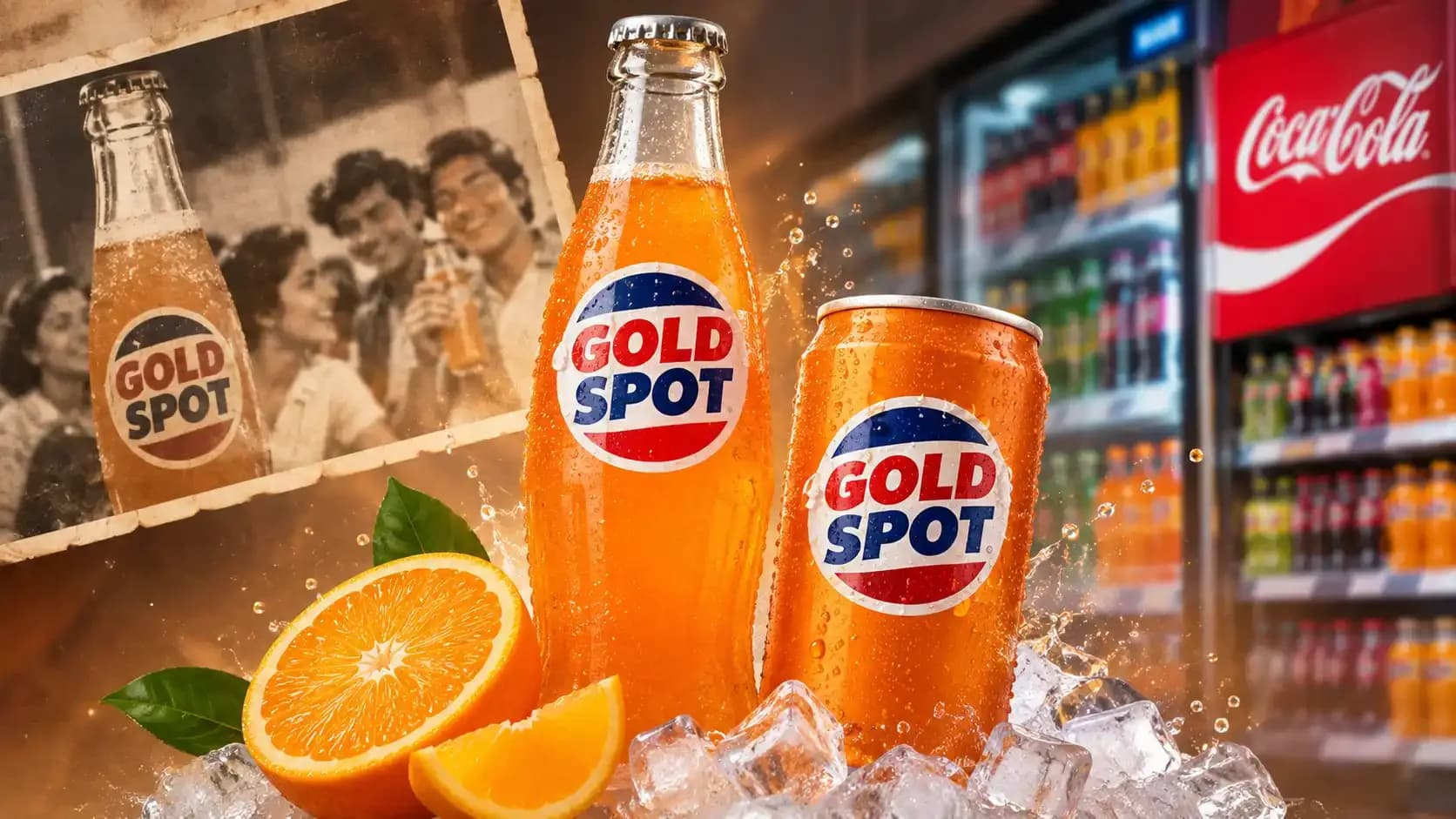
Coca-Cola is preparing to bring back Gold Spot, one of India's most recognisable legacy soft drink brands, after a gap of 26 years. The iconic orange-flavoured carbonated beverage, which disappeared from retail shelves in 2000, is reportedly set for a return with a low-sugar or no-sugar formulation.
According to a report by The Economic Times dated November 23, 2026, the beverage could return to retail shelves as early as the following week. The reported relaunch signals Coca-Cola's renewed interest in leveraging established Indian brands while responding to changing consumer preferences and increasing competition in the country's soft drinks market.
The proposed comeback is particularly significant because Gold Spot was discontinued after Coca-Cola acquired several beverage brands from Parle in 1993. At the time, the company decided to focus on Fanta, which already had a strong presence in the orange-flavoured carbonated drinks category.
From Parle's Iconic Brand to Coca-Cola's Portfolio
Gold Spot was introduced by Parle in 1952 and became one of India's popular orange-flavoured soft drinks. Known for its distinctive taste, bright orange identity and nostalgic appeal, the brand developed a strong consumer following over several decades.
Parle's beverage portfolio expanded significantly with brands such as Thums Up, Limca and Maaza. When Coca-Cola re-entered India in 1993, it acquired several of Parle's established beverage brands, including Gold Spot, Thums Up, Limca, Maaza, Citra and Rim Zim.
However, Coca-Cola eventually discontinued Gold Spot in 2000, choosing to concentrate its marketing and distribution efforts on Fanta in the orange soft drink segment.
The proposed revival would bring back a brand that has remained familiar to generations of Indian consumers despite its prolonged absence from the market.
Low-Sugar Formulation Could Define Gold Spot's New Positioning
One of the most significant aspects of the reported comeback is the proposed change in formulation.
Rather than simply bringing back the original beverage, Coca-Cola is reportedly exploring a low-sugar or no-sugar version of Gold Spot. This could help the company position the brand differently from Fanta while responding to increasing interest in reduced-sugar beverage options.
The development also reflects a broader shift within the packaged beverage industry, where companies are increasingly exploring alternative formulations to address changing consumer expectations.
However, Coca-Cola has not publicly established the product's exact sugar content, sweetener composition, nutritional profile or final formulation. Details regarding packaging, pricing and bottle sizes also remain unconfirmed.
Reliance's Campa Intensifies Competition in India's Soft Drinks Market
The reported revival comes at a time when competition in India's carbonated soft drinks market is becoming increasingly aggressive.
Reliance Consumer Products has been expanding Campa's presence through competitive pricing, distribution expansion and a growing beverage portfolio. Since its relaunch in 2023, Campa has emerged as a significant challenger to established players such as Coca-Cola and PepsiCo.
According to figures cited by The Economic Times, Campa recorded more than ₹4,700 crore in gross sales in FY26, based on information shared by Reliance. The brand has also established a stronger presence in several regional markets.
The growing popularity of smaller beverage players has added pressure on established companies to strengthen their portfolios and distribution strategies.
NielsenIQ data cited in the report indicated that the combined market share of smaller soft drink players, led by Campa and Lahori Zeera, increased from approximately 7% in January-September 2024 to 15% during the corresponding period in 2025.
For Coca-Cola, reviving Gold Spot could provide another opportunity to strengthen its presence in India's increasingly competitive beverage market.
Gold Spot's Return Could Complement Fanta
The revival also raises questions about Coca-Cola's brand portfolio strategy.
Fanta remains one of the company's established products in India's orange-flavoured carbonated soft drinks category. Reintroducing Gold Spot with a different formulation and consumer proposition could allow Coca-Cola to address additional market segments without relying exclusively on its existing brands.
The company could potentially use Gold Spot's historical recognition to attract consumers familiar with the original beverage while introducing its revised formulation to younger audiences.
Coca-Cola also has an established bottling and distribution ecosystem in India, which could support the brand's re-entry into retail markets if the relaunch proceeds as reported.
MS Dhoni's Gold Spot Appearance Fuels Comeback Speculation
The reported comeback has also attracted attention following photographs of former Indian cricket captain MS Dhoni and his wife, Sakshi Dhoni, with Gold Spot cans circulating on social media.
The photographs have triggered speculation about a possible promotional campaign associated with the brand's return.
However, there has been no confirmed announcement establishing MS Dhoni as Gold Spot's brand ambassador. His involvement in the product's marketing strategy therefore remains unclear.
The development has nevertheless generated considerable nostalgia and curiosity among consumers who remember the original beverage.
A Strategic Return for an Iconic Indian Beverage Brand
Gold Spot's proposed return is more than a nostalgic product revival. It reflects the changing dynamics of India's soft drinks industry, where established multinational companies are facing growing competition from domestic players and adapting their portfolios to evolving consumer preferences.
For Coca-Cola, bringing back Gold Spot could offer an opportunity to revive an established brand, explore the reduced-sugar beverage segment and strengthen its competitive position against emerging challengers.
Whether the brand can recreate its earlier popularity will depend on its taste, pricing, distribution and ability to establish a distinct identity alongside Fanta.
After disappearing from Indian retail shelves in 2000, Gold Spot could soon get another opportunity to win over consumers. This time, however, its success will depend not just on nostalgia, but on how effectively Coca-Cola adapts the iconic orange drink to India's changing beverage market.