
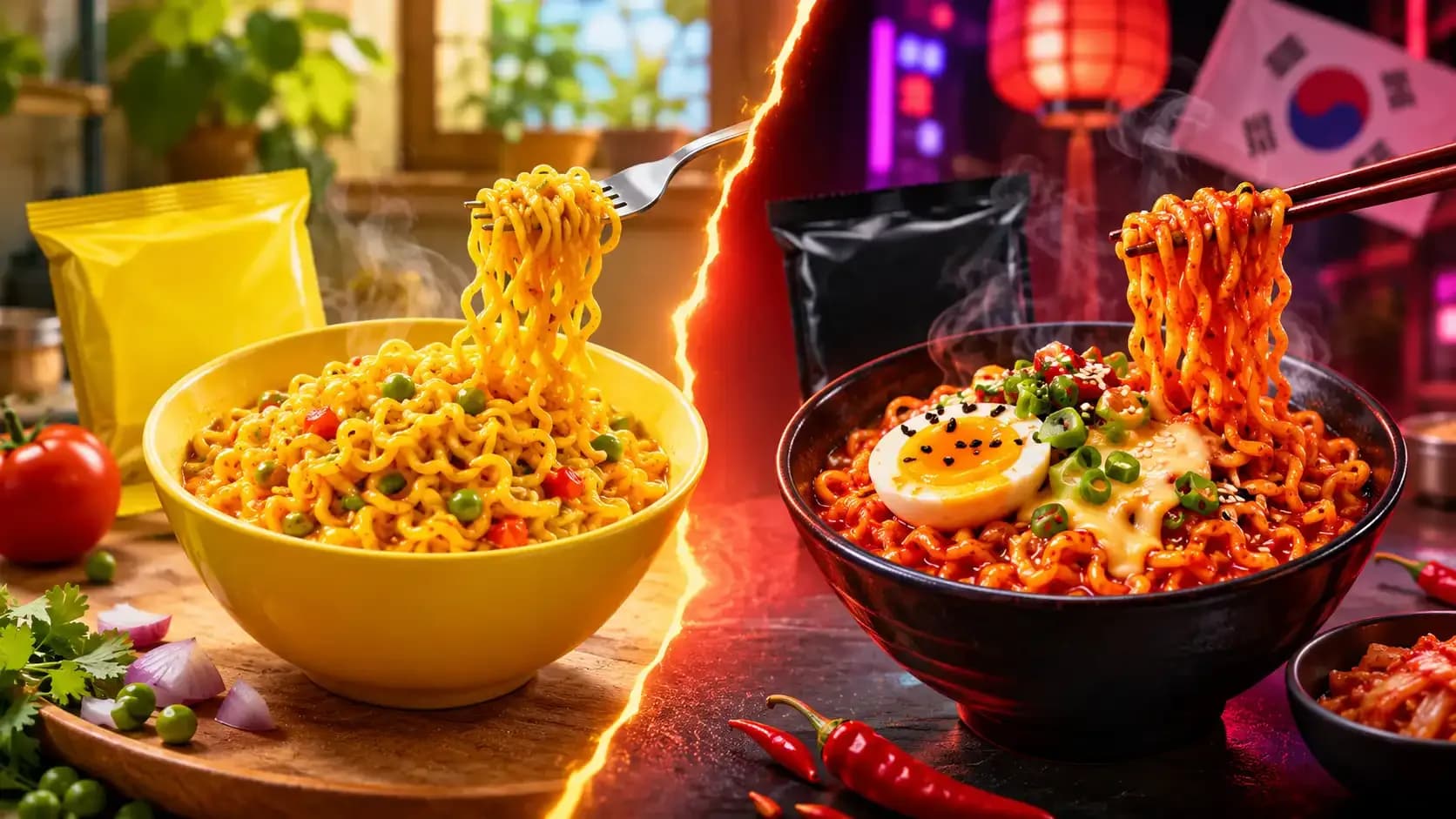
Maggi Built India's Love for Instant Noodles. Now Korean Ramen Is Selling Indians a New Experience.
For millions of Indians, instant noodles have always meant one thing: Maggi.
A packet of Maggi, some boiling water, its familiar masala and a couple of minutes were enough to satisfy an evening craving, make a quick meal or rescue a hungry college student. For decades, Nestlé's Maggi has enjoyed a place in Indian kitchens that few packaged-food brands can replicate.
But something interesting is happening in India's noodle market.
A growing number of young consumers are reaching for something different. Instead of the familiar yellow Maggi packet, they are experimenting with fiery Korean noodles, adding cheese and eggs, sharing their food experiences on Instagram and taking part in the viral spicy noodle challenges.
Brands such as Samyang and Nongshim are introducing Indian consumers to a different kind of instant-noodle experience.
And this is no longer just a social media trend. It is becoming a business opportunity.
The question is no longer simply whether Korean ramen can compete with Maggi. It is whether India's relationship with instant noodles is changing.
India's ₹8,000-crore noodle market has a new challenger
India's instant-noodles market is estimated at approximately ₹8,000 crore, making it an important category within the country's packaged-food industry.
According to NielsenIQ data reported by Moneycontrol, the overall instant-noodles category recorded value growth of 9.3%, while Korean noodles registered 16.7% value growth over two years.
Korean noodles still account for approximately 2% of the overall instant-noodles market. However, their growth rate suggests that international flavours are finding an increasingly receptive audience.
The online market tells an even more interesting story.
India's online instant-noodles market is estimated at approximately ₹675 crore, with Korean noodles accounting for nearly 20% of sales by value.
This difference is important.
Korean ramen is not yet challenging Maggi across India's entire household market. However, it is building a disproportionately strong position among digitally active, urban and experimental consumers.
For international noodle manufacturers, that could be an attractive starting point.
Why are Indian consumers falling in love with Korean ramen?
The popularity of Korean ramen cannot be explained by taste alone. It is connected to a broader change in how younger Indians discover and consume food.
1. The K-culture effect
Korean entertainment has created a cultural connection with Indian audiences.
K-pop, Korean dramas, films and social media have introduced millions of viewers to Korean food, including ramyun, kimchi and spicy noodles.
When consumers see their favourite Korean actors and creators enjoying a particular food, curiosity often translates into product trials.
Samyang's Buldak range has particularly benefited from this trend, with its extremely spicy flavours becoming popular in online food challenges.
For many young consumers, trying Korean ramen is not just about eating noodles. It is also about experiencing a part of Korean food culture.
2. From everyday convenience to premium indulgence
Maggi traditionally built its appeal around affordability, familiarity and convenience.
Korean ramen is selling something slightly different.
Consumers are buying thicker noodles, distinctive sauces, intense spice and flavours that are not traditionally associated with Indian instant noodles.
They are also experimenting with cheese, eggs, vegetables, chicken and other toppings to create restaurant-style bowls at home.
This changes the consumption occasion.
Maggi may be the quick evening snack, while Korean ramen becomes a weekend indulgence or something consumers order when they want to try something different.
3. Gen Z wants to experiment
Younger consumers are increasingly exposed to international food trends through Instagram, YouTube and food creators.
Food is no longer just about hunger. It is also about discovery, presentation and experience.
A bowl of Korean ramen with cheese, a boiled egg and spicy sauce is visually appealing, easy to prepare and highly shareable on social media.
That gives Korean noodle brands an advantage in generating attention without relying entirely on traditional advertising.
Maggi isn't losing its throne just yet
Despite the growing interest in Korean ramen, declaring Maggi's decline would be premature.
In fact, recent data suggests that Maggi continues to strengthen its household presence.
An Economic Times report published in November 2026, citing a Nestlé presentation, noted that approximately 37% of urban Indian households purchased Maggi monthly, compared with 24% in 2016.
That is an important indicator of the brand's continued relevance.
Maggi's biggest advantage remains its distribution network, brand familiarity, affordability and ability to reach consumers across income groups and geographies.
A Korean ramen packet positioned at a premium price cannot automatically replace a product that has become an everyday purchase for millions of families.
The two products are increasingly serving different consumer needs.
However, Nestlé is not ignoring the changing preferences.
In November 2023, Maggi introduced Korean BBQ noodles in vegetarian and chicken variants, bringing Korean-inspired flavours into its established product portfolio.
The strategy is relatively straightforward: rather than allow the entire premium flavour opportunity to international brands, Maggi can use its existing distribution and brand recognition to participate in the trend.
The competition is bigger than Maggi vs Samyang
The Korean ramen trend is also attracting established Indian and international food companies.
Samyang: Its Buldak range has become one of the most recognisable Korean spicy-noodle products, benefiting from social media and the global popularity of Korean food.
Nongshim: The South Korean company is expanding its presence in India through products such as Shin Ramyun and new distribution partnerships.
ITC's YiPPee!: The company has been exploring international flavour profiles, including Gochujang, Tom Yum and Yaki Udon-inspired offerings.
Nissin: The Japanese food company already has a presence in India's instant-noodles category and is positioned to participate in the growing demand for premium Asian noodle formats.
Wow! Momo: The Indian food company is also exploring the opportunity through Korean-inspired noodles and packaged-food offerings.
This competition suggests that the opportunity is not limited to importing Korean products. Indian companies can also develop products inspired by international flavours and adapt them to local preferences.
Quick commerce is becoming the new battleground
Perhaps the biggest business development in this category is not happening inside the kitchen. It is happening on smartphone screens.
For decades, Maggi benefited from India's traditional retail network. Its presence in kirana stores helped make it accessible across cities, towns and smaller markets.
Korean ramen brands are taking a somewhat different route.
They are using quick-commerce platforms, premium supermarkets and online marketplaces to reach consumers who are actively looking for international food products.
A notable example is Nongshim's distribution partnership with Blinkit in 2026 to introduce its Shin Ramyun Kimchi Stir Fry range in India.
The launch focused on major urban markets, including Delhi and Mumbai.
Moneycontrol also reported that Korean noodles had achieved significant growth on quick-commerce platforms, with growth exceeding 40%.
This is a significant shift in the way international packaged-food brands can enter India.
Instead of first building an extensive nationwide retail network, a company can identify high-demand urban markets, introduce selected products through quick commerce and gradually expand its distribution.
For emerging international food brands, this reduces the initial barriers to market entry.
The opportunity is moving beyond metro cities
One of the more interesting developments is that Korean-inspired food is finding customers beyond India's traditional premium urban consumer base.
A June 2026 Mint report highlighted the growth of Indian businesses operating in this category.
Gimi Michi, an Indian Korean-food startup, raised $1 million in seed funding. The company reported monthly net sales exceeding ₹1 crore, with nearly half its sales coming from Tier-II and Tier-III cities.
Meanwhile, Wow! Momo reportedly generated around ₹1 crore in monthly sales from its Korean instant-noodles range, while its overall noodle business contributed approximately ₹2 crore per month.
These are company-reported figures, but they provide an indication of the commercial potential emerging around Korean-inspired packaged food.
The bigger takeaway is that Korean flavours are no longer restricted to a small group of metropolitan consumers.
Indian food companies are beginning to see an opportunity in taking these flavours to a wider audience.
From instant noodles to ramen bars: A new food-service opportunity
What happens when consumers don't just want to buy Korean noodles but also want the experience of preparing and eating them?
That is where self-service ramen bars enter the picture.
Imagine a small outlet where customers select their preferred noodle packet, choose toppings, cook their ramen at a dedicated station and enjoy a customised bowl.
It combines packaged-food retail with the experience of a quick-service restaurant.
This model is beginning to attract attention in India.
Nongshim has explored self-service ramyun bars through its partnership with Reliance Retail's Freshpik.
Mint also reported that Chennai-based Myeon Hub estimated an investment of approximately ₹20 lakh for setting up a self-service ramen bar.
For food entrepreneurs, the model offers an interesting proposition.
Unlike a conventional restaurant, the menu can be built around packaged noodles, standardised toppings and relatively simple preparation processes.
Potential advantages include lower kitchen complexity, controlled inventory and opportunities to sell additional toppings and beverages.
However, the economics still depend on location, rent, footfall, product costs, staffing and repeat purchases.
The bigger opportunity is that the Korean ramen trend could create business models beyond packaged-food manufacturing.
It could support specialised food outlets, distribution businesses, retail experiences and even new franchise concepts.
Can Korean ramen become an everyday Indian food?
This is where the industry faces its biggest challenge.
Getting consumers to try a product is one thing. Getting them to purchase it regularly is another.
Korean ramen brands need to overcome several barriers.
Price sensitivity: Premium imported noodles may attract curious consumers, but frequent purchases depend on affordability.
Taste localisation: Extremely spicy products may generate attention, but brands need flavours that encourage repeat consumption.
Vegetarian preferences: India has a large vegetarian consumer base, creating opportunities for products with clearly communicated vegetarian ingredients and suitable flavour profiles.
Import costs: Imported products face currency, logistics and distribution costs. Local manufacturing or sourcing could become increasingly important as demand grows.
Health perception: Sodium levels and nutritional expectations may influence how frequently consumers purchase instant noodles.
Ultimately, the category's future will depend on whether Korean ramen can move beyond novelty and become a regular part of Indian consumers' food habits.
What the numbers say about the future
The broader instant-noodles category is also expected to benefit from changing consumption patterns.
According to Mordor Intelligence estimates reported by the Economic Times in November 2026:
India's instant-noodles market is projected to reach approximately $3.74 billion by 2032.
Korean-style spicy noodles are projected to grow at a CAGR of 12.97% between 2027 and 2032.
Online instant-noodles retail is projected to grow at a CAGR of 14.26%.
Cup and bowl noodle formats are projected to grow at a CAGR of 14.01%.
These are market forecasts, not guaranteed outcomes. However, they highlight the opportunities emerging in premium flavours, online distribution and convenient meal formats.
For packaged-food companies, the next phase of competition may not simply be about selling more noodle packets. It may be about developing new consumption occasions and building stronger relationships with younger consumers.
The bigger question: Is Maggi's biggest competitor changing?
Maggi built its dominance by making instant noodles affordable, convenient and familiar.
Korean ramen is introducing a different proposition: premium flavours, cultural relevance, experimentation and food experiences.
The two can coexist, and there is currently no convincing evidence that Korean ramen is replacing Maggi in India's overall market.
But the competitive landscape is changing.
Nestlé is experimenting with Korean-inspired products. ITC is expanding its international flavour portfolio. Korean manufacturers are investing in distribution. Indian startups are building businesses around Korean food, while retailers and entrepreneurs are exploring ramen-based experiences.
For consumers, this means more choices.
For manufacturers, it means a new premium opportunity.
And for food entrepreneurs, it means an emerging category that could create opportunities across packaged food, retail, quick commerce and QSRs.
Maggi may still own the everyday noodle occasion. But Korean ramen is helping create a new one.
And that could be the beginning of a much bigger change in India's packaged-food market.