
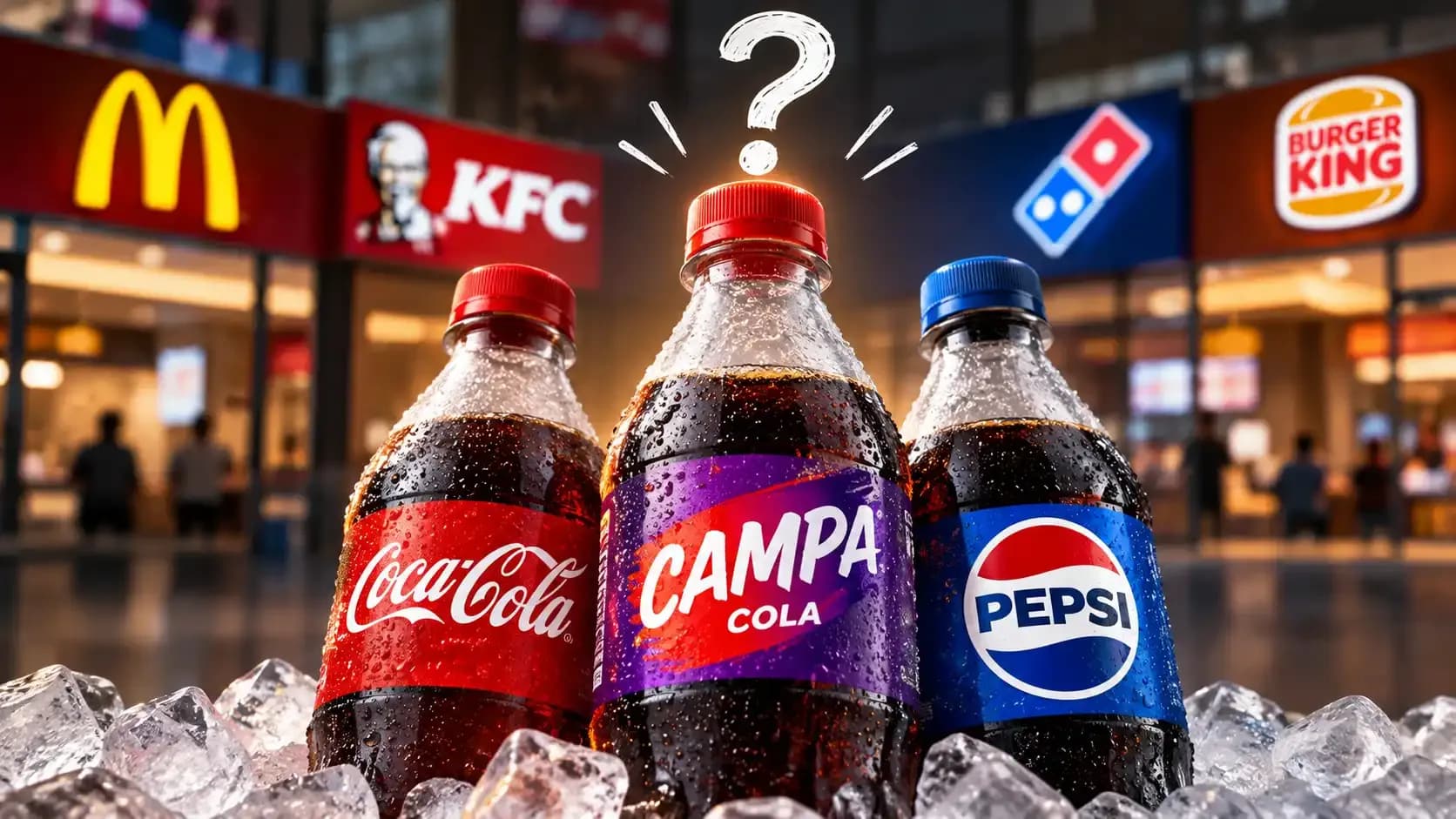
Reliance's Campa has crossed ₹4,700 crore in annual gross sales, challenged established beverage players and expanded its manufacturing and distribution network. Yet a closer look at India's organised restaurant industry reveals a significant gap: some of the country's biggest quick-service restaurant chains continue to operate with Coca-Cola and PepsiCo as their beverage partners. Is Campa missing a major growth opportunity?
India's beverage market is witnessing a competitive shift that would have been difficult to imagine a few years ago.
For decades, Coca-Cola and PepsiCo have dominated India's organised carbonated soft-drink industry. Their brands have become deeply integrated into the country's retail ecosystem, restaurants, cinemas, food courts, hotels and quick-service restaurants.
Then came Reliance Industries.
Also read: PepsiCo Retains KFC Partnership in India and 7 Other Markets Despite Losing US Deal to Coca-Cola
Through Reliance Consumer Products Limited (RCPL), the company revived Campa Cola, a familiar Indian beverage brand that had largely disappeared from the mainstream market.
What followed was an aggressive expansion strategy involving competitive pricing, manufacturing investments, distribution incentives, retail partnerships and high-profile marketing campaigns.
Campa is no longer simply a nostalgic brand making a comeback.
According to Reliance's FY26 disclosures, Campa generated more than ₹4,700 crore in gross sales, becoming India's fourth-largest carbonated soft-drink brand, with a double-digit market share in key markets.
Also read: Taco Bell Renews PepsiCo Deal Through 2036 After KFC Switches to Coca-Cola
Also read: Campa Goes Global: Reliance Takes India’s ₹4,700-Crore Cola Brand to Australia
But despite this growth, there is one important question that deserves greater attention.
Why are some of India's largest restaurant chains still associated with Coca-Cola and PepsiCo rather than Campa?
Walk into a KFC, McDonald's, Pizza Hut, Domino's or Wow! Momo outlet, and the established beverage partnerships remain visible.
This raises an important strategic question: Has Campa successfully challenged the beverage giants in retail but yet to make a meaningful breakthrough in India's organised food-service industry?
India's ₹60,000-crore carbonated drinks opportunity
To understand the importance of this question, it is necessary to examine the size of the market.
According to industry estimates reported by Impact Magazine in September 2026, India's carbonated soft-drink market was valued at approximately ₹60,000 crore in 2025, with annual consumption estimated at around 2.4 billion cases.
The competitive landscape is changing.
Industry estimates reported by NDTV Profit in July 2026 put Coca-Cola's share of India's carbonated beverage market at approximately 40–42%, followed by PepsiCo at 28–30%. Campa was estimated to have captured around 7–8%.
These are industry estimates rather than independently audited market-share figures, and market shares can differ depending on whether they are measured by volume or value.
Nevertheless, the numbers illustrate how quickly Campa has emerged as a serious challenger.
A separate report by Business Standard, citing industry estimates, noted that smaller players including Campa and Lahori Zeera had nearly doubled their combined market share to approximately 15% during January–September 2025, compared with around 7% in the previous year.
The traditional Coca-Cola–PepsiCo dominance is facing its strongest competitive challenge in years.
But there is another market that could become equally important for Campa.
India's QSR industry: The next big battlefield
India's organised food-service industry is expanding rapidly, creating new opportunities for beverage manufacturers.
According to the food-service market estimates published by the India Brand Equity Foundation (IBEF), citing Redseer Consulting, India's overall food-service market reached approximately ₹7.95 lakh crore (US$90 billion) in FY26.
It is projected to reach ₹14.28 lakh crore (US$150 billion) by FY31.
Organised food-service brands already account for an estimated 45–50% of this market.
The QSR opportunity is also substantial.
Restaurant Brands Asia's FY2024–25 annual report, which discusses the Indian QSR market, puts the organised QSR segment at approximately ₹64,900 crore in FY24. It projects the market to reach approximately ₹1.48 lakh crore by FY29, representing an estimated compound annual growth rate of 17.9%.
These figures are not the same market: the ₹60,000-crore figure refers to carbonated soft drinks, the ₹7.95-lakh-crore figure covers the broader food-service industry, and the QSR figures cover the organised quick-service restaurant segment.
For a beverage company, the opportunity is clear.
Every new restaurant, food court, cinema outlet, airport restaurant and delivery-focused food business creates another potential consumption point.
Yet Campa's presence in this institutional channel has not become as prominent as its retail expansion.
The QSR partnerships that Campa needs to challenge
The existing beverage relationships of major restaurant operators explain why entering this market is not straightforward.
1. McDonald's and Coca-Cola
McDonald's has maintained a long-standing association with Coca-Cola.
In July 2023, McDonald's India North and East collaborated with Coca-Cola India to introduce a customised beverage platform featuring Coca-Cola X Masala and Sprite X Chili Guava.
This was more than a regular beverage supply arrangement. It demonstrated how a beverage company and restaurant operator could work together on menu innovation and locally relevant consumer experiences.
The distinction is important: beverage partnerships can become part of a restaurant's product strategy, rather than simply a procurement decision.
2. KFC and PepsiCo
KFC represents one of the clearest examples of how difficult it can be for a challenger to enter an established QSR account.
On November 6, 2026, PepsiCo announced the renewal of its beverage partnership with KFC across eight international markets, including India.
The agreement covers India, Australia, the UK, Spain, Germany, France, the Netherlands and Belgium.
The companies also plan to collaborate on locally relevant beverage selections, menu offerings and innovation aimed at younger consumers.
This is a significant development for Campa because it confirms that PepsiCo's relationship with KFC in India is continuing.
3. Domino's and Coca-Cola
Domino's provides an interesting example of how commercial relationships in the beverage industry can change.
Jubilant FoodWorks, which operates Domino's in India, had partnered with PepsiCo in 2018.
However, in December 2024, Jubilant FoodWorks announced a memorandum of understanding with Coca-Cola India for the procurement and marketing of sparkling beverages and certain other products.
The development followed the Jubilant Bhartia Group's agreement to acquire a 40% stake in Hindustan Coca-Cola Beverages, Coca-Cola's Indian bottling business.
This is particularly interesting because it demonstrates that beverage partnerships can be influenced by larger corporate relationships and strategic business interests.
4. Wow! Momo and Coca-Cola
Coca-Cola India also announced a partnership with Wow! Momo Foods, covering Wow! Momo, Wow! China and Wow! Chicken.
The partnership announcement highlighted a network of more than 800 restaurants and included the positioning of combinations such as Coke and momos.
This demonstrates how beverage companies are looking beyond traditional burger and pizza chains to establish themselves across India's growing QSR ecosystem.
5. Burger King
Burger King is another major restaurant operator worth examining. However, its current India-specific beverage supply and exclusivity arrangements are not sufficiently established in the public material reviewed for this article.
It would therefore be inaccurate to claim a confirmed nationwide Coca-Cola or PepsiCo exclusivity agreement without further verification.
The broader picture, however, is clear: established beverage companies have developed substantial commercial relationships across India's organised food-service industry.
Why Campa cannot win simply by offering cheaper cola
This is perhaps the most important part of the story.
Campa's retail strategy has been built around competitive pricing and aggressive distribution.
A lower-priced bottle can attract consumers, encourage trial and help a new brand gain shelf space.
But the economics of a QSR partnership are considerably more complicated.
A restaurant chain does not necessarily choose its beverage supplier based on the lowest purchase price.
It evaluates the complete commercial proposition.
This may include:
Procurement pricing and volume-linked commercial incentives.
Promotional funding and joint advertising.
Exclusive beverage arrangements.
Product innovation and customised beverages.
Refrigeration, dispensing and equipment support.
Distribution reliability and stock replenishment.
Consumer marketing and brand-building programmes.
For Coca-Cola and PepsiCo, a major restaurant chain is not simply a customer.
It is also a large consumer engagement platform.
Their brands are visible at the exact moment consumers are making food and beverage purchase decisions.
Campa needs to build a similarly attractive institutional proposition.
The distribution challenge: Three million outlets do not automatically mean QSR dominance
Reliance has a substantial distribution advantage.
According to FY26 disclosures reported by Moneycontrol, RCPL operates 12 manufacturing plants and services approximately three million outlets through a network of more than 5,000 distributors.
These figures demonstrate the scale of Reliance's FMCG ambitions.
However, general retail distribution and national QSR distribution are two different businesses.
A grocery store may purchase products through a distributor and replenish its inventory based on local demand.
A large restaurant chain requires a more structured supply arrangement.
Its requirements include:
Consistent supply across multiple cities.
Standardised packaging and product specifications.
Predictable replenishment during peak consumption periods.
Reliable service across individual outlets.
Equipment and refrigeration support where required.
Dedicated institutional account management.
For a QSR operating hundreds or thousands of outlets, a supply disruption can affect menu availability and customer experience.
Campa must demonstrate that it can meet these requirements consistently.
Its growing manufacturing network is an advantage, but the ability to service a large national restaurant account must be demonstrated separately.
The real competitive advantage of Coca-Cola and PepsiCo
One reason established beverage companies remain strong in the QSR channel is their ability to offer more than their flagship cola.
Coca-Cola brings a broad portfolio that includes Sprite, Thums Up, Fanta, Limca and other beverage products.
PepsiCo brings brands such as Pepsi, Mountain Dew, 7UP and Mirinda, alongside other products depending on the market and agreement.
This allows restaurant operators to offer a broader selection instead of relying on one cola brand.
It also gives beverage companies opportunities to create customised products and promotional campaigns.
Campa has an expanding beverage portfolio, but it needs to establish whether its product range, operational capabilities and commercial incentives can match the requirements of large institutional buyers.
The competition is not just between three cola labels.
It is between three different business propositions.
The opportunity Reliance should not ignore
Reliance has already demonstrated its ability to build distribution, attract consumer attention and challenge established brands.
The next opportunity could be to build a dedicated institutional beverage business.
Instead of focusing exclusively on winning accounts such as McDonald's or KFC, Campa could pursue several other opportunities.
Regional QSR chains: India's growing regional burger, pizza, momo, biryani and fried-chicken businesses could provide a relatively accessible entry point.
Independent restaurant groups: Multi-outlet restaurant operators may be more open to experimenting with alternative beverage partnerships.
Multiplexes and food courts: Cinema halls and shopping-centre food courts provide concentrated beverage consumption opportunities.
Highways and travel infrastructure: Highway restaurants, railway food courts, airports and bus terminals offer opportunities to build an out-of-home presence.
Hotels and institutional catering: Hotels, corporate cafeterias, colleges and large catering operators represent additional institutional channels.
Campa could also explore customised restaurant-exclusive beverage combinations, meal bundles and co-branded campaigns.
These partnerships would allow the company to build institutional credibility before pursuing some of the most difficult national QSR contracts.
The unanswered question: Has Campa actually approached the big QSR chains?
There is an important distinction between the absence of a publicly visible partnership and an actual rejection.
There is no reliable public disclosure establishing that Reliance formally approached every major QSR chain discussed in this article and was rejected.
Nor is there sufficient publicly available information to establish that all these restaurant chains have refused to consider Campa.
Existing supply agreements, commercial terms, exclusivity clauses and renewal timelines may influence their choices.
Reliance's institutional sales strategy also remains an area that deserves further investigation.
This is precisely where the company should be asked to explain its ambitions.
Is Campa actively negotiating with large restaurant chains? Does RCPL have a dedicated HoReCa and institutional sales division? Is it offering customised pricing and marketing support to restaurant operators? Does it intend to build a separate out-of-home distribution network?
These questions matter because the next stage of growth may depend as much on institutional partnerships as it does on retail distribution.
The next chapter of India's cola war
Campa has already achieved something significant.
It has revived an Indian beverage brand, challenged two powerful multinational competitors and changed the conversation around pricing and competition in the country's carbonated drinks market.
But winning the retail shelf is not the same as winning the restaurant table.
Coca-Cola and PepsiCo have spent decades developing commercial relationships, distribution infrastructure and brand integration across the food-service industry.
Reliance has the financial strength, retail ecosystem and manufacturing ambition to compete.
What remains to be seen is how effectively it can translate these advantages into large institutional partnerships.
India's food-service market is projected to reach US$150 billion by FY31. The opportunity is too large for a serious beverage challenger to ignore.
Campa does not necessarily need McDonald's, KFC or Domino's to validate its success. But building a meaningful presence in the organised restaurant industry would represent a major milestone in its evolution.
The real test for Campa is no longer just how many bottles it can sell through India's kirana stores. It is whether it can become a beverage brand that India's biggest restaurants actively want on their menus.
Because in India's cola war, winning the consumer's refrigerator is one battle.
Winning the restaurant table could be the next one.