
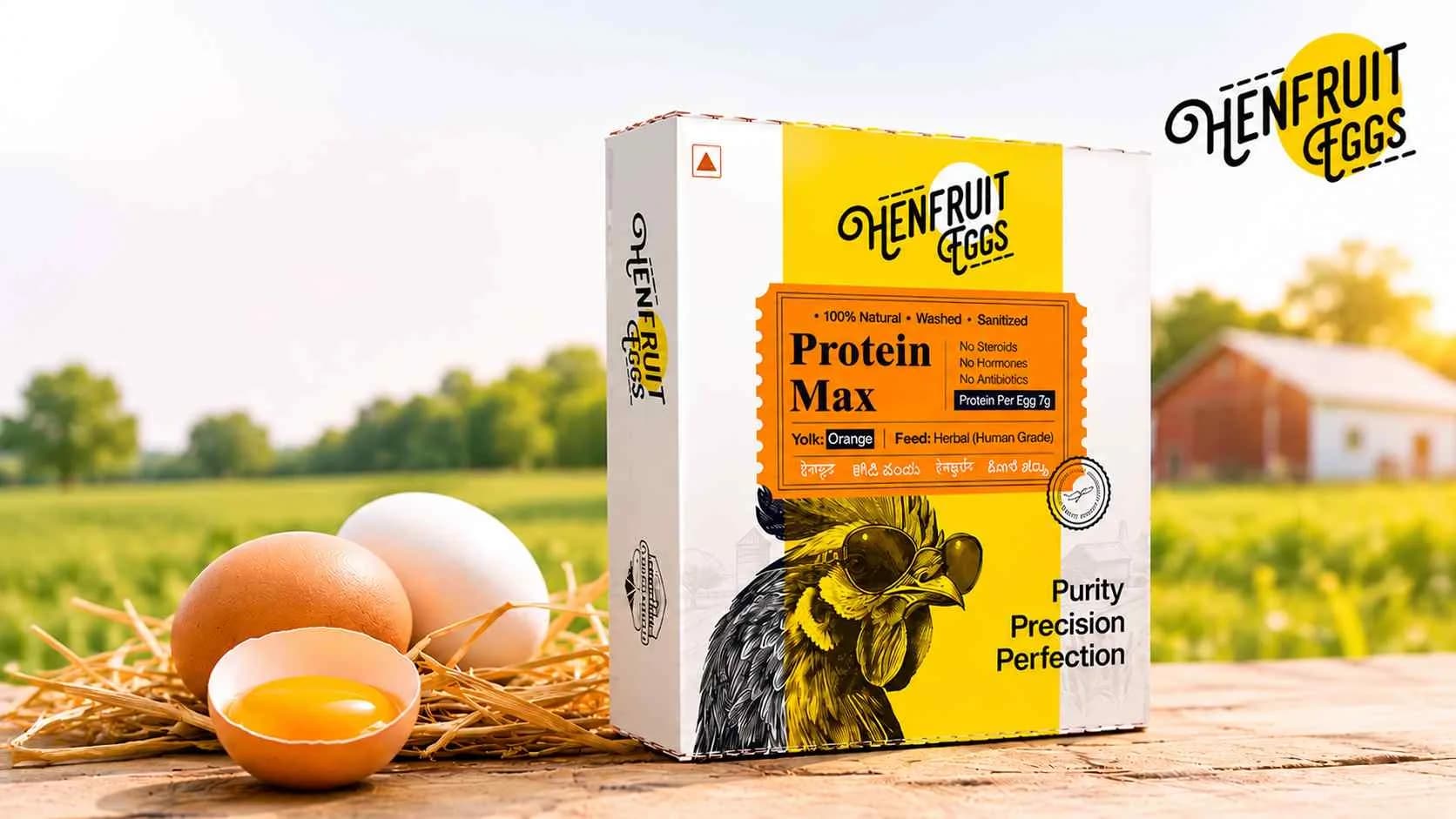
Indian branded egg company Henfruit has raised $15 million (approximately ₹140 crore) in its first external funding round, marking a significant milestone in its journey as a bootstrapped food business.
The Series A funding round saw participation from Lok Capital, DSG Consumer Partners and RPSG Capital Ventures. The company plans to use the fresh capital to strengthen its operational infrastructure, expand its supply chain, increase production capacity and build its brand presence across more Indian markets.
Founded in 2014 by Tarun Gupta, Henfruit has spent more than a decade building its business without institutional equity funding. The latest investment comes as the company looks to accelerate its expansion in India's branded egg market, where consumer interest in quality, food safety and traceability is creating opportunities for organised food businesses.
From a Bootstrapped Startup to a Large-Scale Egg Business
Henfruit's growth reflects the gradual transformation of eggs from a largely unbranded commodity into a packaged consumer food category.
The company currently operates across 15 cities and processes more than four crore eggs every month. It employs over 300 people and has reportedly expanded its business scale by approximately 10 times over the past three years.
Unlike traditional egg distribution, which largely depends on local traders and fragmented supply chains, Henfruit focuses on building a more organised procurement, processing and distribution network.
Its business model combines sourcing, quality checks, automated processing, packaging and distribution to deliver branded eggs to consumers through multiple retail channels.
Henfruit Targets Revenue of Over ₹350 Crore in FY27
The company's financial growth has been another important factor behind its expansion plans.
Henfruit reportedly generated revenue of approximately ₹136.8 crore in FY25, which increased to around ₹210 crore in FY26. The company is targeting revenue of more than ₹350 crore in FY27.
This represents a projected increase of approximately 67% over its reported FY26 revenue.
The revenue trajectory highlights the growing commercial opportunity in India's organised egg market. However, the FY27 figure is a company target rather than achieved revenue, and detailed profitability figures have not been publicly disclosed.
Strengthening Distribution Through Quick Commerce and Retail
Henfruit has built a multi-channel distribution strategy to reach consumers across different purchasing platforms.
Its products are available through quick-commerce platforms such as Blinkit, Zepto and Swiggy Instamart, alongside online grocery and e-commerce channels including BigBasket, Amazon India and Flipkart.
The company also sells through its own website and is working to expand its physical market presence.
Quick commerce has become an increasingly important distribution channel for everyday food products. Categories such as eggs, milk, bread and other frequently purchased essentials are benefiting from consumers' preference for convenient, on-demand deliveries.
For Henfruit, expanding its presence across these platforms could help increase product visibility, improve consumer access and strengthen repeat purchases.
Focus on Quality, Testing and Traceability
Food safety and quality assurance are central to Henfruit's brand positioning.
The company says its eggs undergo regular quality testing through in-house laboratory facilities as well as independent third-party laboratories. It also promotes access to testing reports through its website.
Its processing operations include automated cleaning, sanitisation and grading. The company also emphasises traceability across its supply chain, aiming to provide consumers with greater visibility into the sourcing and handling of its products.
Henfruit offers different egg variants, including standard white eggs, higher-protein options and cage-free products.
The brand also promotes antibiotic-free and hormone-free positioning as part of its product offering.
As consumers become more conscious about food quality and sourcing, these attributes could help organised egg brands differentiate themselves from conventional loose-egg suppliers.
Where Will the Fresh Funding Be Deployed?
The $15 million investment is expected to support Henfruit's next phase of expansion.
The company's priorities include strengthening backend infrastructure, increasing production capabilities, improving procurement networks and expanding its distribution footprint.
It is also looking to establish collection centres in new geographies to improve sourcing efficiency and build a stronger supply chain.
Markets such as Mumbai, Bengaluru, Hyderabad and Pune are among the geographies identified for further expansion.
The investment will also support marketing initiatives as Henfruit looks to establish stronger consumer recognition in a category where purchasing decisions have traditionally been driven more by price and availability than by brand preference.
Building an efficient supply chain will be particularly important as the company expands. Eggs are perishable products, and maintaining consistent quality requires coordination between farms, collection centres, processing facilities, storage and last-mile distribution.
Competition in India's Branded Egg Market
Henfruit is entering its next growth phase in a market where other organised players are also building consumer-focused egg businesses.
Eggoz Nutrition is one of the prominent competitors in India's branded egg segment. The company has raised institutional funding and has been expanding its presence through packaged egg products and quality-focused positioning.
The broader market opportunity lies in bringing greater organisation to a category that remains heavily dependent on fragmented production and distribution networks.
While traditional suppliers continue to dominate a large portion of the market, branded players are attempting to build consumer trust through standardised packaging, quality checks, product differentiation and improved availability.
The growing adoption of quick commerce could further accelerate this transition by making packaged eggs more accessible to urban households.
Investors See Opportunity in India's Organised Food Market
The participation of Lok Capital, DSG Consumer Partners and RPSG Capital Ventures highlights investor interest in businesses operating within everyday consumer food categories.
Unlike discretionary products, eggs are a frequently purchased household essential. This creates opportunities for brands that can establish consistent supply, distribution efficiency and consumer trust.
The investment also reflects the potential of businesses that have spent years building their operating infrastructure before approaching institutional investors for growth capital.
For Henfruit, the challenge now will be to translate its existing operational scale into a wider national presence while maintaining product quality and supply-chain efficiency.
What Henfruit's Funding Means for India's Food Industry
Henfruit's $15 million funding round comes at a time when India's food and FMCG sector is witnessing growing interest in organised, branded and quality-focused everyday food products.
The transformation of categories such as dairy, packaged staples and fresh food demonstrates how consumer brands can create value by introducing consistency, quality assurance and convenience into traditionally fragmented markets.
Eggs could be another category where this transition gathers momentum.
With its first external funding round, Henfruit is positioning itself to capture a larger share of this opportunity. Its ability to expand distribution, maintain operational efficiency and build consumer trust will determine how successfully it can compete in India's evolving branded egg market.
The latest investment is therefore not just a funding milestone for Henfruit but also another indication of growing investor interest in India's organised food economy.