
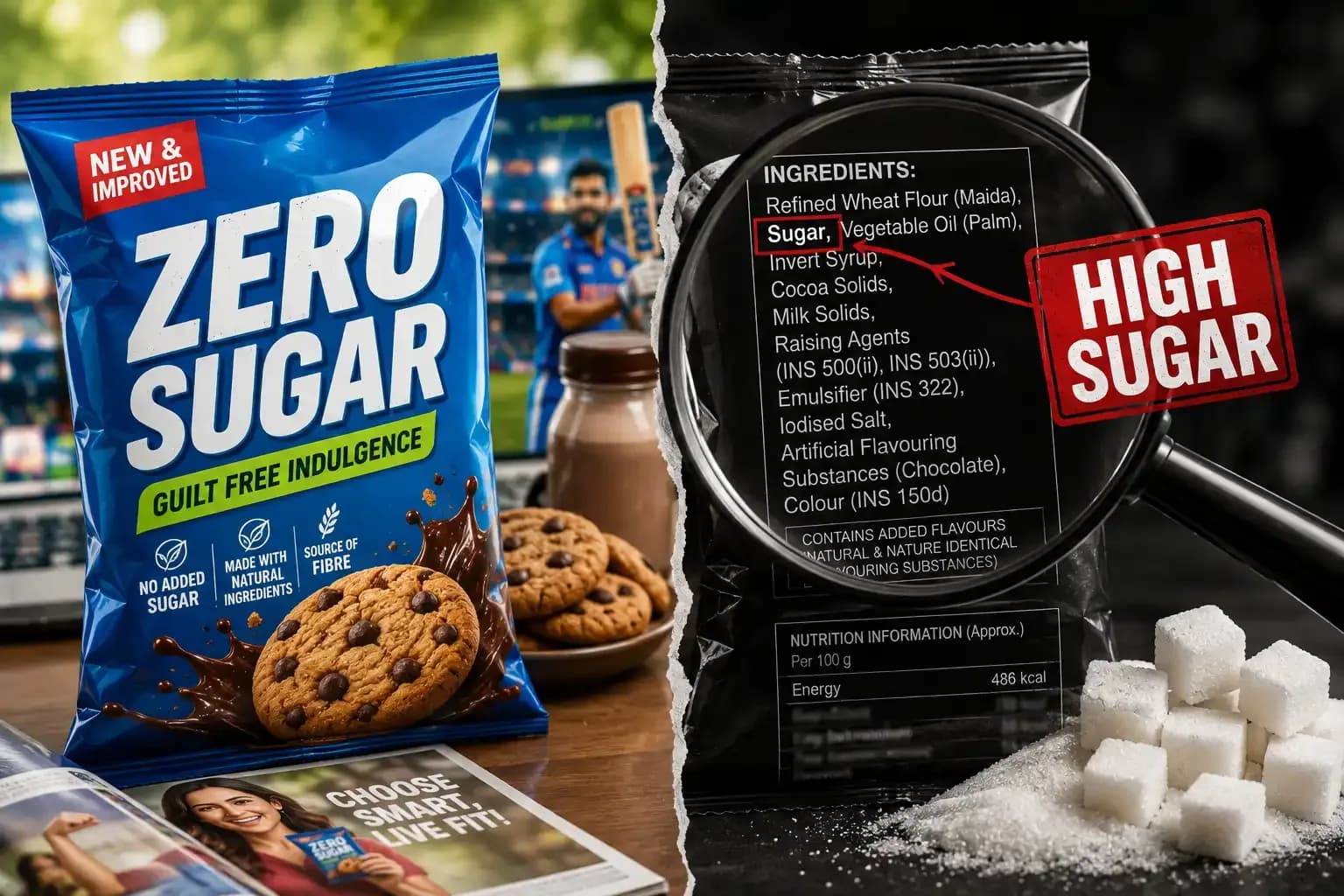
India’s packaged-food companies spend hundreds and, in some cases, thousands of crores every year marketing their products. Yet the country has spent years debating whether consumers should be given a simple front-of-pack warning when a product is high in sugar, sodium or saturated fat. With the Supreme Court now pressing FSSAI and the Centre to act, the question is becoming increasingly difficult to avoid: is the delay the result of scientific disagreement and bureaucracy—or has industry influence played a role?
A packet of packaged food can tell consumers a lot in just a few words.
ZERO SUGAR.
HIGH PROTEIN.
SOURCE OF FIBRE.
NO ADDED SUGAR.
WHOLEGRAIN.
These claims are designed to capture attention.
And companies spend enormous sums making sure consumers notice them.
But imagine the same front of the packet carrying another set of words:
HIGH SUGAR.
HIGH SODIUM.
HIGH SATURATED FAT.
That is the kind of front-of-pack warning India has been debating for years.
The question now is not whether India's food industry should be allowed to advertise its products. It should.
The question is whether consumers should receive potentially important nutritional information with the same clarity and prominence as the marketing message.
After years of consultations, expert committees and competing proposals, the issue has now reached the Supreme Court.
And the Court is asking why India is still waiting.
The business of selling food is already worth thousands of crores
India's packaged-food market is no longer a niche segment.
An industry report estimated India's packaged-food market at around ₹11.17 lakh crore in FY2025, up from approximately ₹10.20 lakh crore in FY2024. The market has been projected to reach nearly ₹18.77 lakh crore by FY2030.
Market estimates based on Euromonitor data have also placed India's packaged-food retail sales at more than US$100 billion.
Within that market, categories such as savoury snacks, biscuits, confectionery, beverages and ready-to-eat products represent enormous consumer businesses.
And behind these products is an equally large advertising industry.
The largest food and FMCG companies do not merely manufacture products. They manufacture consumer perception.
That perception is built through television advertising, digital campaigns, celebrity endorsements, sports sponsorships, social media, influencers, retail promotions and increasingly aggressive quick-commerce marketing.
The numbers are revealing.
Advertising budgets behind the brands
According to company disclosures, Hindustan Unilever spent approximately ₹6,028 crore on advertising and promotion in FY2024-25.
Britannia Industries reported consolidated advertising and sales-promotion expenditure of approximately ₹560 crore during FY2024-25.
Nestlé India's advertising and sales-promotion expenditure was approximately ₹966 crore during FY2024-25.
ITC's reported advertising and sales-promotion expenditure was around ₹1,320 crore during FY2024-25.
These figures should not be interpreted as evidence that these companies opposed front-of-pack warnings.
They do not.
But they establish something important.
Consumer attention is big business.
And the front of a packet is one of the most valuable pieces of consumer communication a food company controls.
That is why the debate over what appears there matters.
The three words that could change the package
The principle behind front-of-pack labelling is simple.
Instead of forcing consumers to turn the package over, find the nutrition table, identify serving size, calculate nutrient quantities and compare them with recommended intake, the front of the package provides an immediate interpretation.
For example:
HIGH SUGAR
or
HIGH SODIUM
or
HIGH SATURATED FAT
The objective isn't to ban the product.
It isn't to stop consumers from buying it.
It is to make the nutritional risk visible before the consumer makes the purchase.
And this is where India's regulatory debate has become complicated.
India has been debating this for years
India's front-of-pack labelling discussion goes back more than a decade.
FSSAI began examining ways to address foods high in fat, sugar and salt years ago. By 2018, the government was discussing revised food-labelling regulations that included front-of-pack nutritional information.
The 2018 proposal contemplated information on nutrients including energy, fat, added sugar and salt, with colour coding for products exceeding specified thresholds.
The issue continued into 2019, when FSSAI proposed further changes involving colour-coded nutritional information.
But the rules were not finalised.
Instead, the country entered another cycle of consultation.
Then came a fundamentally different proposal.
2022: India considers stars instead of warnings
In 2022, FSSAI moved towards the Indian Nutrition Rating, or INR.
The concept was straightforward:
Instead of telling consumers that a product was high in sugar or sodium, the package would receive a rating ranging from ½ star to 5 stars.
The rating would be calculated using an algorithm that considered negative nutritional factors such as:
energy;
total sugar;
saturated fat;
sodium;
while also giving positive consideration to factors such as:
protein;
fibre;
fruits;
vegetables;
nuts;
legumes.
The intention was to give consumers an overall picture of nutritional quality.
But public-health organisations raised a fundamental objection.
A star rating tells consumers whether a product is relatively better.
A warning label tells consumers what may be wrong with it.
Those are not necessarily the same thing.
The "health halo" problem
Consider two hypothetical products.
Product A contains a substantial amount of sugar but also contains protein and fibre.
Product B contains less sugar but fewer positive nutritional components.
Under an overall scoring system, Product A could potentially receive a respectable rating.
Under a warning system, however, the consumer could simply see:
HIGH SUGAR.
The warning does not attempt to calculate whether the product is "healthy overall."
It simply identifies a nutrient of concern.
Public-health advocates argue that this distinction is crucial because consumers should not be encouraged to interpret an overall rating as a health endorsement.
That concern has become one of the central arguments in India's FOPL debate.
What does the Indian evidence say?
This is where the debate moves beyond lobbying and into science.
A randomized field experiment involving 2,869 Indian adults across six states compared different front-of-pack labelling systems.
The results were striking.
Without a front-of-pack label, only 39.1% of participants correctly identified all products high in nutrients of concern.
With warning labels, the figure increased to 60.8%.
Traffic-light labels produced 54.8%.
A Guideline Daily Amount system produced 55%.
The Health Star Rating produced 45%.
In other words, warning labels produced the largest improvement in consumers' ability to identify products high in nutrients of concern.
There is an important qualification.
The study did not establish that warning labels automatically stop consumers from purchasing unhealthy products.
But it did show that warning labels made the information substantially easier to understand.
And that is exactly what a front-of-pack system is supposed to accomplish.
Another Indian survey found overwhelming support for warnings
A separate study involving consumers across 14 Indian states found that approximately 93% of respondents preferred warning labels.
The study also found that:
91.3% consumed packaged food or beverages;
95% were aware of food-package labelling;
88.6% considered labelling information helpful;
55.4% considered packaged foods healthy.
The findings suggested that consumers were not necessarily asking for more complicated nutrition information.
They were asking for information they could understand quickly.
Then came the 14,000 comments
In 2022, FSSAI's draft front-of-pack framework generated more than 14,000 comments from stakeholders.
The submissions reportedly came from:
food companies;
industry associations;
consumer organisations;
public-health organisations;
individuals;
other stakeholders.
FSSAI subsequently constituted an Expert Committee in February 2023 to examine the responses.
The committee held several meetings and reviewed the competing arguments.
But the process continued.
And continued.
And continued.
Two years of expert review
The expert committee process itself became lengthy.
The committee was constituted in February 2023, while its recommendations emerged only after an extended review.
This is where a legitimate question about bureaucracy enters the story.
How long should a regulator take to decide what consumers should see on a food packet?
Three months?
One year?
Two years?
A decade?
There is no simple answer.
Food regulation is complicated.
But there is a point at which consultation risks becoming a substitute for decision-making.
And India's FOPL debate appears to have reached that point.
Industry involvement is impossible to ignore
The food industry has every right to participate in regulatory consultations.
A new labelling rule can affect:
packaging;
manufacturing;
product formulation;
marketing;
consumer perception;
advertising;
product portfolios;
costs.
But the scale and duration of industry participation make it an important part of the investigation.
During the 2022 consultation process, industry associations reportedly backed the Health Star Rating approach, while consumer organisations pushed for warning labels.
Then, in 2025, the Ministry of Food Processing Industries reportedly received 430 representations from food-industry stakeholders raising concerns about the proposed framework.
Again, this does not prove regulatory capture.
But it demonstrates sustained industry involvement in shaping the policy.
The question is whether that involvement merely informed the regulator—or materially changed the direction and pace of regulation.
That question remains unanswered.
The latest proposal moves away from a simple warning
Instead of a large, prominent warning saying:
HIGH SUGAR
the latest regulatory approach has focused on making certain nutritional information more prominent and presenting it alongside recommended daily intake figures.
The daily limits being discussed include approximately:
25g added sugar
10g saturated fat
5g salt
The approach is based on India's nutritional guidance.
From a regulatory perspective, the logic is understandable.
Give consumers accurate numbers.
Let them decide.
But public-health advocates have a different question:
Should consumers have to do the maths?
A consumer buying a biscuit packet at a supermarket may spend seconds looking at the package.
The regulator is asking that consumer to interpret grams, serving sizes and recommended daily intake.
A warning label reduces that cognitive burden to two or three words.
That is the fundamental disagreement.
The "zero sugar" paradox
This is where the debate around marketing becomes particularly interesting.
The words ZERO SUGAR are immediately understandable.
A consumer does not need a calculator.
A consumer does not need to understand RDA percentages.
The message is clear.
The same is true for claims such as:
HIGH PROTEIN
SOURCE OF FIBRE
NO ADDED SUGAR
These messages are designed to communicate quickly.
But imagine a regulatory requirement that says:
If a product exceeds a scientifically determined threshold for sugar, it must display HIGH SUGAR prominently on the front.
The information would be equally clear.
The question is whether the consumer should receive both sides of the nutritional picture.
Not:
"Buy this."
Not:
"Don't buy this."
Simply:
"Know this before you buy."
This is not an argument against marketing
Food companies have the right to market their products.
They can advertise taste.
They can advertise convenience.
They can advertise protein.
They can advertise price.
They can advertise lifestyle.
They can use celebrities.
They can sponsor sporting events.
They can build emotional brands.
The issue is whether the regulator should require material nutritional information to be equally visible.
Because if one side of the communication is professionally engineered to capture attention, while the other is buried inside a nutrition table, the consumer does not receive symmetrical information.
The Supreme Court has now entered the battle
The issue reached the Supreme Court through a public-interest litigation seeking mandatory warning labels for products high in sugar, salt and saturated fat.
The Court has repeatedly questioned the pace of FSSAI's regulatory process.
In February 2026, the Court expressed dissatisfaction with the progress made by the regulator and specifically considered the possibility of front-of-pack warnings identifying high levels of sugar, sodium and saturated fat.
Then came the August hearing.
On August 13, 2026, the Supreme Court gave the Centre and FSSAI two weeks to place their final decision before the Court.
The Court indicated that if the government failed to act, it could issue directions itself.
The Court also questioned whether pressure from corporate interests was influencing the regulator.
That is an allegation.
It is not yet a judicial finding that industry caused the delay.
But it is a question now formally hanging over the regulatory process.
And it is a question that deserves an evidence-based answer.
The industry's argument is not without merit
A serious investigation must also examine the other side.
Food manufacturers argue that India's food ecosystem is different from countries where warning labels have been introduced.
India has a huge diversity of:
traditional foods;
regional snacks;
small manufacturers;
MSMEs;
packaged versions of traditional products.
A threshold designed without considering Indian dietary patterns could create unintended consequences.
Industry also has legitimate concerns about:
reformulation costs;
packaging changes;
compliance;
product classification;
impact on smaller manufacturers;
scientific thresholds.
These arguments cannot simply be dismissed as lobbying.
They need evidence.
And that is exactly what the regulator should publish.
The question is: where is the evidence?
If warning labels would harm small businesses, show the numbers.
If they would increase food prices, show the modelling.
If Indian consumers understand RDA information better than warning labels, publish the evidence.
If the Health Star Rating works better for India, publish the independent research.
If warning thresholds would unfairly classify traditional foods, show the product-level analysis.
And if industry lobbying had no influence on the policy, make the stakeholder submissions and meeting records public.
Transparency can answer almost every question being asked.
What should FSSAI publish?
At minimum, the regulator should make public:
The 14,000+ stakeholder submissions
Who submitted them?
What did they recommend?
How many supported warnings?
How many supported stars?
How many opposed interpretive labels?
It should also publish:
Expert Committee minutes
Attendance records
Conflict-of-interest declarations
Industry representations
The 430 submissions reportedly made in 2025
Meeting records between regulators and food companies
The scientific evidence used to determine thresholds
The final INR algorithm
The expected impact on commonly sold products
Without that information, the public is being asked to trust a regulatory process that has already taken years.
The data story could be even bigger
There is another investigation hiding inside this one.
Take India's biggest packaged-food categories.
Analyse hundreds of products.
For every product, record:
retail price;
serving size;
sugar per 100g;
sugar per serving;
sodium;
saturated fat;
calories;
protein;
fibre;
front-of-pack claims;
advertising claims;
proposed INR score;
whether it would receive a warning under a nutrient-specific model.
Then compare the results.
The question would be simple:
How many products marketed with positive nutritional or lifestyle messaging would qualify for a front-of-pack warning under an objective nutrient threshold?
That is a question data can answer.
Look at the multinational comparison
There is another important international benchmark.
Chile introduced mandatory front-of-pack warning labels in 2016.
Other countries subsequently adopted similar systems, including Peru, Mexico, Uruguay, Argentina and Colombia, among others.
The international experience has generated evidence that warning labels can improve consumers' ability to identify products high in critical nutrients and can encourage reformulation. WHO and PAHO have documented the growing use of interpretive front-of-pack systems internationally.
The question for India is therefore not whether the world has ever tried this.
It has.
The question is:
Why is India still debating the basic architecture of the system?
The bigger public-health question
India is facing a growing burden of obesity, diabetes, hypertension and other non-communicable diseases.
The country's own dietary guidelines warn against excessive consumption of foods high in fats, sugars and salt.
That makes food information more than a packaging issue.
It is a public-health intervention.
But regulation must also be proportionate, evidence-based and workable.
That is why the debate needs to move beyond slogans.
Bureaucracy, science or industry pressure?
There are now three competing explanations for India's delay.
1. Bureaucracy
FSSAI has spent years consulting experts, analysing thousands of comments and attempting to create a scientifically defensible regulatory framework.
2. Scientific disagreement
There are legitimate disagreements over:
thresholds;
algorithms;
warning labels;
star ratings;
Indian dietary patterns;
serving sizes;
consumer behaviour.
3. Industry influence
The industry has participated extensively in consultations and submitted substantial representations against aspects of the proposed framework.
The available evidence does not yet prove that industry pressure caused the delay.
But the Supreme Court has now questioned whether corporate pressure is influencing the process.
That makes the question impossible to ignore.
The real battle is not over three words
At first glance, the FOPL debate looks like a fight over packaging.
It isn't.
It is a fight over who controls the first message a consumer sees.
A food company wants that first message to be:
Taste.
Energy.
Protein.
Convenience.
Happiness.
Zero sugar.
A public-health regulator may want it to be:
Know what you're eating.
And if a product crosses a scientifically established threshold, that message could be as simple as:
HIGH SUGAR.
The final question for India
Food companies spend enormous amounts of money persuading consumers to buy their products.
There is nothing inherently wrong with that.
Advertising is part of business.
But consumers also have a right to information.
If the government believes a product contains a level of sugar, sodium or saturated fat that deserves attention, why should the consumer have to search for that information?
Why shouldn't the information be visible where the marketing is visible?
Why should "ZERO SUGAR" be allowed to communicate instantly while "HIGH SUGAR" remains a regulatory argument?
And perhaps most importantly:
If India can take years to decide whether three words should appear on the front of a food packet, what does that say about the balance between corporate interests, regulatory caution and public health?
The Supreme Court has now given the government a deadline.
The next chapter of India's food-labelling story may no longer be written by another committee.
It may be written in a courtroom.
And the three words at the centre of the battle are remarkably simple: