

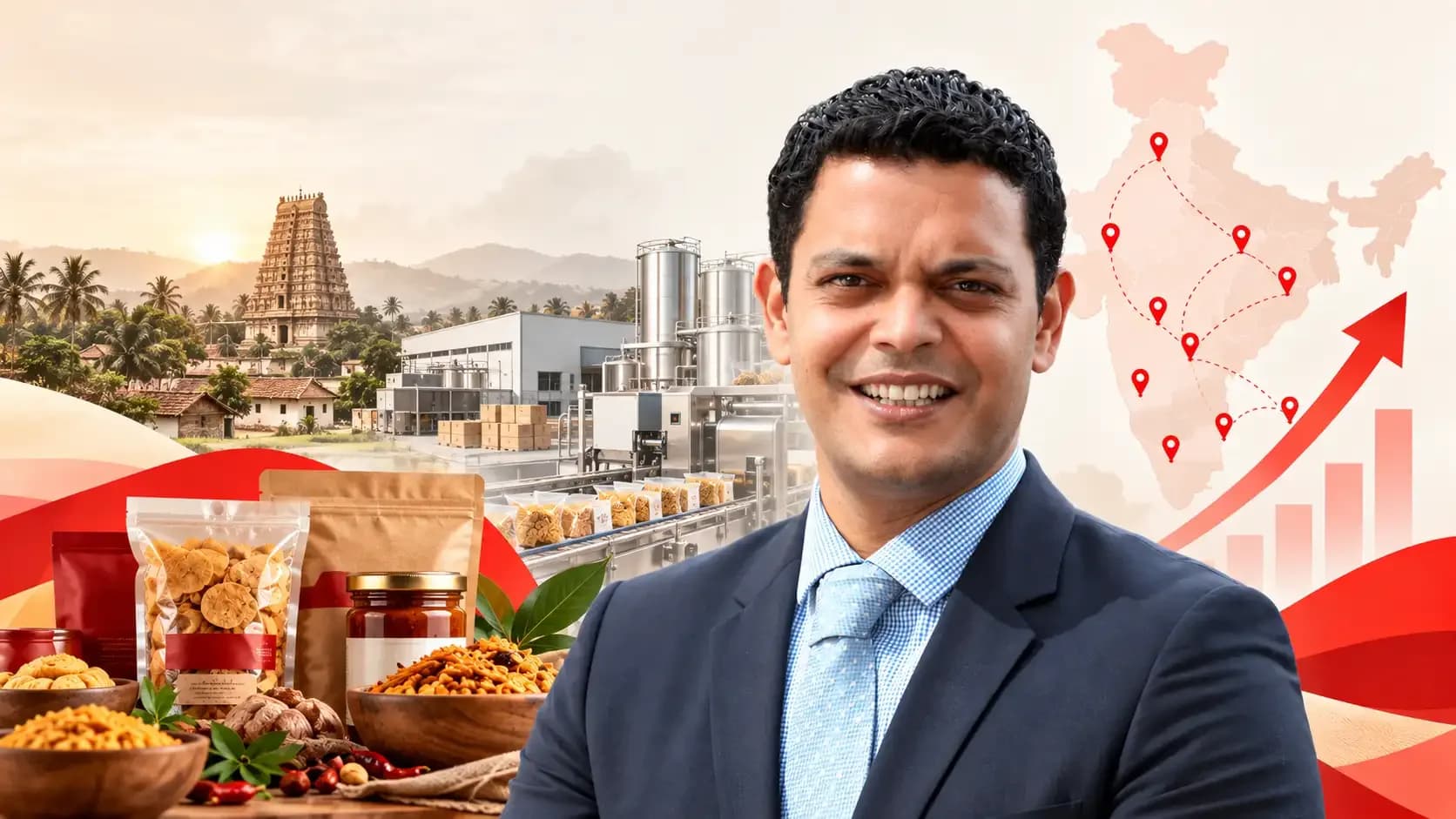
India’s packaged-food industry has spent years chasing the next national brand. Arovia Consumer is taking a different route: instead of building another food brand from the ground up, it wants to find brands that have already won their local markets — and take them beyond their home turf.
The consumer platform, founded by former Soulfull founder Prashant Parameswaran, has secured a ₹100 crore capital commitment from Fireside Ventures to pursue acquisitions in India’s regional packaged-food market.
The strategy puts a different question at the centre of India’s FMCG story: what happens when the country’s thousands of successful regional food businesses get access to national-scale capital, distribution and operating expertise?
From building brands to buying proven ones
Arovia is not following the conventional startup playbook of launching a product, spending heavily on consumer acquisition and gradually building distribution.
Its approach starts much further down the road.
The company is looking for established, predominantly family-owned and regional packaged-food businesses that already have a strong consumer base, distribution infrastructure and local supply chains. The reported focus is on companies with annual revenue of ₹100 crore or more that are profitable or cash-flow positive.
Arovia plans to acquire significant stakes in such businesses and then work with their existing promoters to expand the brands into new geographies, channels and product categories.
That distinction is important.
The opportunity Arovia sees is not necessarily a lack of good food brands in India. It is the gap between being a strong regional business and becoming a national consumer company.
The regional brand opportunity
India's food market is unusually fragmented.
Consumer preferences change dramatically from one state to another, creating room for brands that understand local tastes, ingredients and consumption habits better than a national player might.
A packaged-food company can therefore build a meaningful business in one geography without ever achieving national distribution.
For decades, many of these businesses have remained promoter-led, growing through local distributors and traditional retail rather than venture capital or institutional investment.
Arovia's thesis is that some of these companies may already have the hardest part of the business figured out: people want the product.
What they may lack is the capital and infrastructure required to replicate that success elsewhere.
Eight markets on Arovia’s radar
Arovia is currently scouting businesses across several regional markets, including:
Kochi
Pune
Coimbatore
Madurai
Mysuru
Mangalore
Surat
Indore
The locations span several distinct food and consumer ecosystems rather than concentrating on a single region.
That gives an indication of the breadth of the opportunity Arovia is pursuing.
Kerala and Karnataka offer deep pools of regional food businesses, while cities such as Pune, Surat and Indore sit within larger commercial ecosystems with established manufacturing and distribution networks.
The target is not a distressed-business rescue
Arovia's reported acquisition criteria are notable because the platform isn't positioning itself around distressed assets.
The company is looking for businesses that have already demonstrated commercial traction.
The reported profile includes companies with:
₹100 crore-plus revenue
Positive cash flow or profitability
Established regional consumer loyalty
Existing distribution networks
Local supply chains
Strong founder or family ownership
That makes the strategy closer to buy-and-build than a turnaround exercise.
The ambition is to take something that already works and provide the resources required to make it work at a much larger scale.
What happens to the families behind these businesses?
For India's family-owned FMCG sector, this could be one of the most significant aspects of the model.
Arovia's strategy does not necessarily require founders to walk away immediately after a transaction.
Depending on the business, existing promoters could remain involved in operating or strategic roles while Arovia provides capital and scaling support. Reported plans also indicate that some promoters could eventually exit over a period of roughly three to five years.
This potentially creates a bridge between two generations of Indian consumer businesses.
The family retains the knowledge, relationships and understanding of the brand.
The institutional investor-backed platform brings capital, professional management and expansion capabilities.
The bigger opportunity may be beyond individual acquisitions
Arovia's strategy becomes more interesting if it manages to build a sizeable portfolio.
Consider a hypothetical portfolio containing a Kerala snack company, a Maharashtra packaged-food business, a Karnataka traditional-food brand and a Gujarat-based consumer company.
Each brand could retain its individual identity while the parent platform potentially creates efficiencies in areas such as:
Procurement → Manufacturing → Warehousing → Distribution → Technology → Marketing
That is where a collection of regional brands could potentially become more valuable together than separately.
Arovia has indicated that procurement, manufacturing and supply-chain synergies could form part of this portfolio strategy.
The concept is not simply to own several food brands.
It is to create infrastructure that allows those brands to scale faster.
Why Prashant Parameswaran’s background matters
The founder's previous experience makes the strategy particularly relevant to the food sector.
Parameswaran was associated with Soulfull, the millet-focused food company he co-founded in 2013.
Tata Consumer Products acquired 100% of Soulfull's parent company, Kottaram Agro Foods, in 2021.
That journey gave Parameswaran experience on the other side of the transaction — building a consumer food business and subsequently becoming part of a larger FMCG platform.
Arovia now approaches the market from the acquisition side.
The model is therefore built around an experience that looks something like:
Build a regional consumer proposition → establish distribution → prove demand → scale → integrate with a larger platform.
Arovia is effectively trying to make the latter part of that journey repeatable across multiple businesses.
Fireside's role
For Fireside Ventures, the investment also extends its longstanding focus on Indian consumer businesses.
The venture capital firm closed its fourth fund at ₹2,265 crore in 2025, taking its assets under management to around ₹5,300 crore.
Its portfolio has included consumer companies across categories ranging from food and beverages to personal care, lifestyle and direct-to-consumer products.
Arovia gives Fireside exposure to a somewhat different consumer model: rather than placing capital into one emerging brand, it is backing a platform designed to acquire several businesses.
₹100 crore is the starting point, not necessarily the endgame
Another detail is worth clarifying.
The ₹100 crore should not simply be viewed as a conventional startup funding round where the entire amount immediately sits on Arovia's balance sheet for operating expenses.
The reported structure is a capital commitment from Fireside Ventures, with capital expected to be deployed as acquisition opportunities are completed.
Arovia is initially targeting roughly two to four regional packaged-food businesses.
As the portfolio develops, the platform could potentially raise additional capital for further acquisitions.
The eventual size of the business will therefore depend less on the initial ₹100 crore headline and more on how effectively Arovia converts that capital into a portfolio of scalable consumer companies.
The first acquisition will reveal the real strategy
For now, Arovia has not publicly disclosed the names of its acquisition targets.
That makes its first transaction particularly important.
The first deal will answer several questions:
How large are the companies Arovia is actually pursuing?
How much ownership does it want?
How much control will existing promoters retain?
Which food categories does it consider most attractive?
How quickly can a regional brand move into another state?
And perhaps most importantly:
Can the acquisition model produce faster and more efficient growth than building a new FMCG brand from scratch?
India's consumer economy has produced two very visible types of companies in recent years.
There are the large legacy FMCG companies with national distribution, and there are venture-backed D2C brands attempting to build national recognition digitally.
Arovia is betting on the space between them.
Thousands of regional businesses have already spent years building products, distribution networks and consumer trust. Their challenge has often been geographical scale rather than product validation.
If Arovia can successfully identify those businesses and provide the capital and infrastructure needed to expand them, the model could turn regional food companies into a new source of national FMCG growth.
For now, however, the thesis remains to be tested.
The first acquisition — and what Arovia does with it afterwards — will be the clearest indicator of whether India's regional food-brand opportunity can be turned into a scalable acquisition platform.