

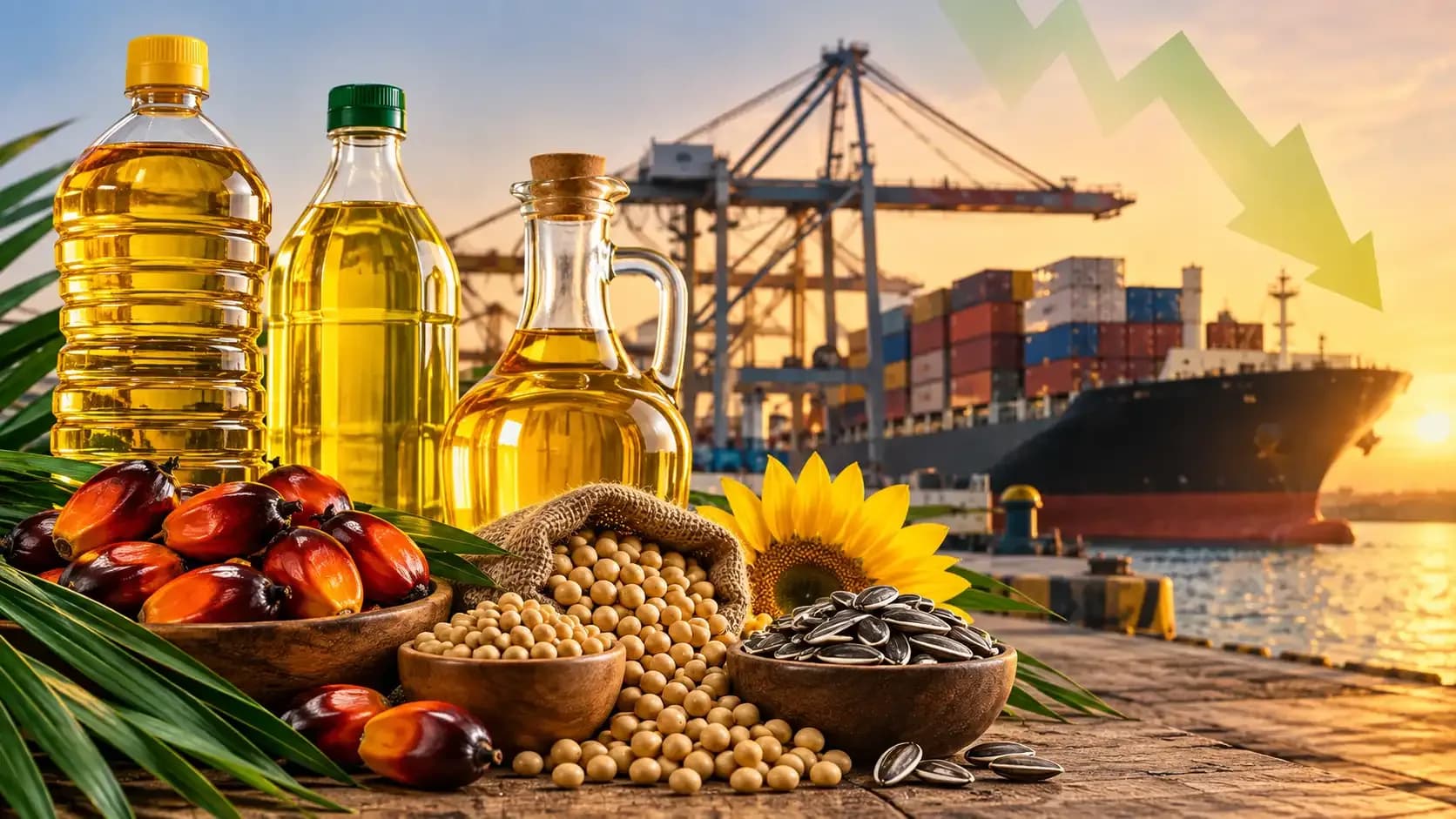
India has cut import duties on major edible oils in a move aimed at bringing down cooking oil prices and easing food inflation ahead of the festive season.
The government has reduced the Basic Customs Duty (BCD) on imported crude palm oil, crude soybean oil and crude sunflower oil, while also lowering duties on their refined counterparts.
The biggest change comes for crude sunflower oil, where the basic customs duty has been reduced from 10% to zero.
For consumers, the move could eventually translate into cheaper cooking oil. But for India's food and FMCG industry, the implications go much deeper — from restaurant margins and packaged snacks to domestic refiners, importers and oilseed farmers.
What has India changed in edible oil import duty?
The new customs duty structure came into effect on September 24, 2026, following a government notification issued on September 23.
Here is what has changed:
Oil | Earlier Basic Customs Duty | New Basic Customs Duty |
|---|---|---|
Crude sunflower oil | 10% | 0% |
Crude soybean oil | 10% | 5% |
Crude palm oil | 10% | 5% |
Refined sunflower oil | 32.5% | 22.5% |
Refined soybean oil | 32.5% | 27.5% |
Refined palm oil | 32.5% | 27.5% |
In other words, the government has made imported crude edible oils cheaper, with sunflower oil receiving the largest reduction.
The move is intended to lower the landed cost of edible oils and ultimately provide relief to consumers.
Why has the government cut edible oil import duty?
The decision comes at a time when global edible-oil prices remain elevated and India's food inflation has been under pressure.
India is one of the world's largest consumers of edible oils, but domestic production is not sufficient to meet demand. As a result, the country relies heavily on imports of palm, soybean and sunflower oil.
That dependence makes Indian cooking-oil prices vulnerable to movements in:
Global palm oil prices
Soybean oil prices
Sunflower oil prices
International crude oil markets
Freight costs
The rupee-dollar exchange rate
Geopolitical disruptions
When global edible-oil prices rise, Indian consumers can feel the impact relatively quickly.
The latest duty cut is therefore aimed at creating some breathing room in the domestic market.
Cooking oil prices: Will consumers actually pay less?
This is the question millions of Indian households will be asking.
The short answer is: the duty cut creates room for prices to fall, but it does not guarantee an immediate equivalent reduction in retail prices.
Why?
Because the journey from an imported crude oil shipment to a bottle on a supermarket shelf involves several stages.
International market → Importer → Refinery → Packaging → Distributor → Retailer → Consumer
Companies may also have existing inventories that were imported under the earlier duty structure.
As new, lower-cost shipments enter the country, however, the reduction in import costs should create downward pressure on wholesale and retail prices, assuming other costs remain broadly stable.
The government has also asked edible-oil companies to pass on the benefit of the duty reduction to consumers and revise their Price to Distributor (PTD) and Maximum Retail Price (MRP) accordingly.
That makes the next few weeks particularly important for consumers.
Why crude sunflower oil is the biggest beneficiary
Among the three major crude edible oils covered by the announcement, sunflower oil has received the sharpest duty reduction.
Its Basic Customs Duty has gone from:
10% → 0%
That effectively eliminates the BCD on crude sunflower oil imports.
The duty on refined sunflower oil has also been reduced from 32.5% to 22.5%.
Sunflower oil is widely consumed in several Indian markets, particularly in parts of southern and western India, making the change potentially significant for both household and commercial consumption.
Why India wants companies to import crude oil instead of refined oil
There is an important policy signal hidden in the new duty structure.
The government has maintained a substantial duty differential between crude and refined edible oils.
The differential currently stands at 19.25 percentage points.
This encourages companies to import crude edible oil and refine it within India rather than importing finished refined oil.
That matters because domestic refining creates additional economic activity through:
Refinery utilisation
Transportation
Storage
Packaging
Distribution
Domestic value addition
So the policy is not simply about making imported edible oil cheaper.
It is also about keeping India's domestic edible-oil refining industry competitive.
India's dependence on imported edible oil
The scale of India's dependence on imports explains why customs duty is such an important policy tool.
India imported around 16.07 million tonnes of major vegetable oils during 2024-25.
Of that:
Around 7.52 million tonnes were palm oil
Around 4.82 million tonnes were soybean oil
Around 2.89 million tonnes were sunflower oil
Palm oil remains India's largest imported edible oil.
India primarily sources palm oil from Indonesia and Malaysia, while soybean oil imports are heavily linked to South American producers such as Argentina and Brazil.
Sunflower oil supplies have historically been significantly connected to the Black Sea region.
This means Indian cooking-oil prices are closely connected to developments far beyond India's borders.
What does the duty cut mean for FMCG companies?
The impact could extend well beyond the kitchen.
Edible oil is a major input for several categories of India's packaged-food industry.
Companies producing:
Chips
Namkeen
Biscuits and snacks
Fried foods
Ready-to-eat products
Instant foods
Processed foods
could potentially see some relief in input costs if lower import duties translate into lower domestic edible-oil prices.
However, the eventual impact on consumer prices will depend on each company's procurement costs, inventory levels, pricing strategy and other input costs.
For FMCG companies, cheaper edible oil could therefore create an opportunity to either improve margins or offset increases elsewhere in the cost structure.
Restaurants, QSRs and sweet makers could also benefit
The timing of the decision is particularly relevant for India's food-service industry.
The country is heading into a period of strong festive consumption, when demand rises for sweets, snacks, fried foods and restaurant meals.
For restaurants, QSRs, caterers and sweet manufacturers, edible oil is an important operating expense.
Lower oil prices could therefore provide some relief to businesses that use large quantities of cooking oil.
The impact could be especially relevant during periods of high-volume production, when even a relatively small reduction in per-litre input costs can become meaningful at scale.
But there is another side: Indian farmers
Cheaper imported edible oil is good news for consumers, but it creates a policy challenge for India's oilseed farmers.
India has been trying to increase domestic oilseed production and reduce its dependence on imports.
If imported oils become significantly cheaper, domestic oilseed prices could face pressure.
That creates a difficult balance for policymakers:
Consumers want affordable cooking oil.
Farmers need remunerative prices for oilseeds.
Refiners need access to competitively priced raw materials.
The government wants to reduce India's import dependence.
The latest duty cut prioritises near-term price relief, but the impact on domestic oilseed economics will be something to watch.
Could the move increase India's edible-oil import bill?
Potentially, yes.
India's dependence on imported edible oil means lower import duties can encourage higher imports.
Industry estimates have indicated that India's vegetable-oil import bill could rise to around ₹1.75 lakh crore during the current marketing year ending October, influenced by higher import volumes, global prices and currency movements.
This highlights a broader structural problem.
India can use import duties to manage domestic prices in the short term, but it cannot completely insulate consumers from global edible-oil markets while the country remains heavily dependent on imports.
Global prices remain the wildcard
There is another factor that could determine how much consumers ultimately benefit.
If international palm, soybean or sunflower oil prices rise sharply, some or all of the benefit created by India's lower import duties could be absorbed by higher commodity prices.
Currency movements could have a similar effect.
A weaker rupee makes imported commodities more expensive in India, even if the customs duty is lower.
So the actual retail price of cooking oil over the coming months will depend on a combination of tax policy, global commodity prices, currency movements and domestic margins.
What happens next?
The next stage will be closely watched by consumers and the food industry.
The key question is no longer whether India has reduced the import duty — that has already happened.
The bigger question is:
How much of the duty cut will actually reach the consumer?
Retail prices of leading edible-oil brands will provide the clearest answer.
At the same time, industry watchers will be tracking:
Edible-oil import volumes
Global palm and soybean prices
Sunflower oil prices
Domestic oilseed prices
FMCG input costs
Restaurant and QSR margins
Refinery utilisation
Retail cooking-oil prices
India's latest edible oil import duty cut is an attempt to tackle a problem that affects almost every part of the food economy.
For households, the hope is simple: lower cooking-oil prices.
For restaurants and food manufacturers, it could mean some relief on input costs.
For domestic refiners, the continued duty advantage for crude oil supports domestic processing.
For farmers, however, cheaper imports could create fresh pressure on domestic oilseed prices.
And for policymakers, the bigger challenge remains unchanged: how does India reduce its dependence on imported edible oil while keeping cooking oil affordable for more than a billion consumers?
For now, the government has chosen to use the import-duty route to provide some relief.
The real test will be visible not in the customs notification, but in the price of the next bottle of cooking oil consumers pick up from a store.