

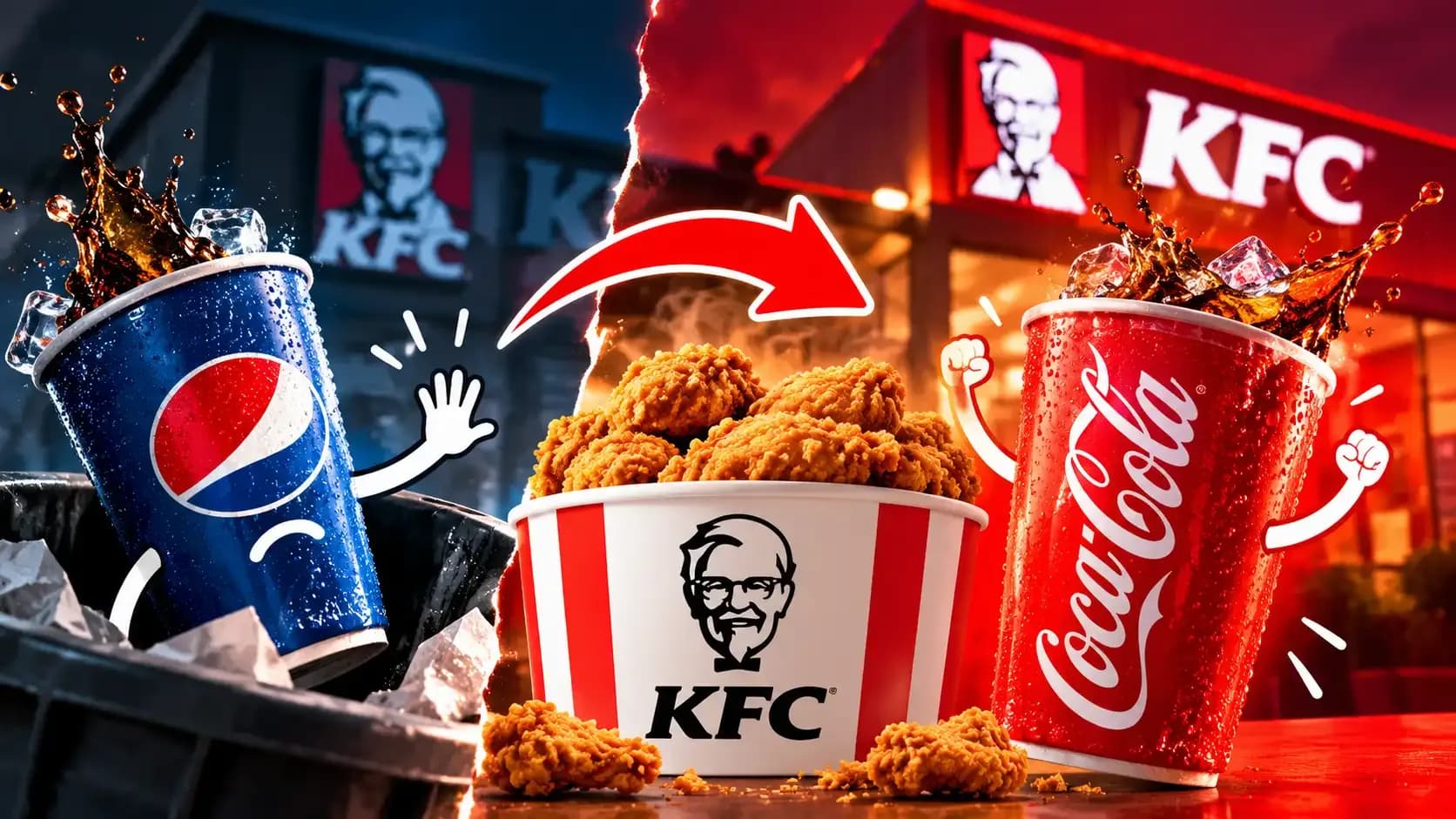
Imagine ordering your favourite KFC fried chicken meal and reaching for a Pepsi, only to find Coca-Cola in its place. That change is coming to KFC restaurants across the United States, and it marks the end of one of the fast-food industry's longest-running beverage partnerships.
KFC has announced a new partnership with The Coca-Cola Company, replacing PepsiCo as its beverage supplier in the US. The transition will begin in January 2027, with Coca-Cola products expected to reach all US KFC restaurants by spring 2027.
The announcement, made on October 15, 2026, ends a relationship that dates back approximately four decades. It also gives Coca-Cola a significant new restaurant partner while handing PepsiCo an unwelcome setback in an increasingly competitive beverage market.
And here's the catch: this is not a worldwide switch. The announcement concerns KFC's US restaurants, while PepsiCo's beverage agreements with KFC's international operations and Taco Bell are continuing.
The Big Switch: What Exactly Has Changed?
According to the announcement, KFC US is bringing Coca-Cola products into its beverage offering as part of its broader effort to refresh the restaurant experience and strengthen its business.
Here are the key details:
Announcement date: October 15, 2026.
New beverage partner: The Coca-Cola Company.
Outgoing partner: PepsiCo.
Rollout begins: January 2027.
Expected completion: Spring 2027.
Restaurants affected: Approximately 3,700-plus US locations.
Financial terms: The companies have not disclosed the value of the agreement.
Coca-Cola products are expected to be introduced across KFC's US restaurant network as part of the new partnership, with the transition scheduled for completion by spring 2027.
Why Is KFC Making the Switch?
KFC has presented the partnership as part of its wider effort to modernise its menu, strengthen its restaurants and create a more relevant experience for today's customers.
The new arrangement gives KFC access to Coca-Cola's extensive beverage portfolio, product innovation capabilities and established food-service operations.
However, neither company has publicly disclosed the commercial terms or identified a single financial factor as the reason for the switch. It would therefore be premature to claim that pricing, poor sales or a dispute directly caused the decision.
The move is nevertheless strategically significant: beverage partnerships are about more than which cola appears on a menu. They can influence restaurant operations, product development, marketing campaigns and the overall customer experience.
The Twist: Pepsi Once Owned KFC
Here's the historical detail that makes this story even more interesting.
PepsiCo acquired KFC in 1986 as part of its expansion into the restaurant business.
PepsiCo later spun off its restaurant operations in 1997, creating the corporate structure that eventually became Yum! Brands, which owns KFC, Taco Bell and Pizza Hut.
Even after the separation, PepsiCo remained a beverage partner to Yum! Brands' restaurant businesses for decades.
That history makes the latest announcement more than an ordinary supplier change. Two companies whose business relationship dates back to common ownership are now moving in different directions in the US market.
Is This a Major Blow for PepsiCo?
The KFC decision comes at a challenging time for PepsiCo's North American business.
The company has been dealing with sluggish demand, higher costs and a slower-than-expected recovery in sales growth and profit margins. Its snack business is also facing pressure from consumers concerned about high prices and increasingly interested in healthier options.
Losing a restaurant account as prominent as KFC adds to those challenges, although the financial impact cannot be determined from the publicly available information.
KFC's large US restaurant network makes the change commercially significant. Losing access to beverage sales across those locations could affect PepsiCo's restaurant-channel presence and create an unfavourable perception of its competitive position.
Still, it would be inaccurate to suggest that KFC's decision alone determines PepsiCo's financial outlook. The company's wider beverages and snacks businesses, pricing strategy, distribution network and other restaurant partnerships remain important.
Coke Wins KFC US, but Pepsi Is Not Out of the Picture
The headline may sound like PepsiCo has lost KFC altogether, but the actual situation is more nuanced.
PepsiCo's agreements covering KFC's international restaurants and Taco Bell are continuing. The Taco Bell agreement has also been reported as a long-term arrangement.
This means the change is limited to KFC's US beverage partnership. It does not represent a complete global breakup between PepsiCo and Yum! Brands.
PepsiCo also maintains beverage partnerships with other restaurant chains, including Subway and Jersey Mike's Subs, while continuing to operate across multiple food-service channels.
The distinction matters because international markets operate under different commercial arrangements. A change in the United States should not automatically be interpreted as a change at KFC restaurants in India or elsewhere.
Why Coca-Cola Could Benefit From This Deal
For Coca-Cola, the agreement offers an opportunity to expand its presence in one of America's most recognisable fried-chicken restaurant chains.
KFC's combination of chicken meals, sides, sauces and beverages provides a platform for Coca-Cola to reach customers through a large, established restaurant network.
The partnership also gives both companies an opportunity to collaborate on beverage innovation and restaurant-level execution.
Coca-Cola already has long-standing beverage relationships with major restaurant chains. Adding KFC US to its portfolio strengthens its presence across the quick-service restaurant sector.
However, the companies have not disclosed the deal's financial value, so it is too early to quantify the additional revenue or market-share gains Coca-Cola might achieve.
What Does This Mean for the Fast-Food Industry?
The KFC announcement highlights how restaurant beverage contracts can become important strategic decisions rather than routine purchasing arrangements.
As restaurant brands compete for customers, they are looking beyond their core food menus to improve the overall dining experience, refresh product offerings and generate additional sales opportunities.
For beverage companies, winning or losing a major restaurant account can influence visibility, distribution and the perception of their competitive strength.
The KFC switch also puts the long-running Coca-Cola-versus-Pepsi rivalry back in the spotlight. But it does not establish that Coca-Cola has won the entire cola war. PepsiCo retains significant restaurant partnerships, and the ultimate commercial impact will depend on performance across multiple channels and markets.
For KFC, the real test will be whether the new partnership helps deliver a better customer experience and supports its broader business strategy.
Will KFC India Also Replace Pepsi With Coca-Cola?
There is no announced global switch covering KFC India in this announcement.
The change specifically concerns KFC US, while PepsiCo's beverage arrangements covering KFC's international restaurants are continuing.
Therefore, customers in India should not assume that Pepsi will disappear from KFC menus here simply because the US business is changing suppliers.
Any future change in India would require separate confirmation from the relevant businesses.
KFC's move from PepsiCo to Coca-Cola marks the end of a nearly 40-year beverage relationship in the United States and gives Coca-Cola a major new restaurant partner.
For PepsiCo, it is an unwelcome development amid broader challenges in North America, but the impact should be viewed in context: its international KFC arrangements and Taco Bell partnership remain in place.
The transition is scheduled to begin in January 2027, with Coca-Cola expected across KFC's US restaurants by spring 2027. With the financial terms still undisclosed, the full commercial implications remain to be seen.
One thing is certain: a simple change in the drink served alongside fried chicken has turned into a significant story about brand loyalty, restaurant strategy and the battle for a place on consumers' tables.
What would you choose with your KFC bucket — Pepsi or Coca-Cola?