
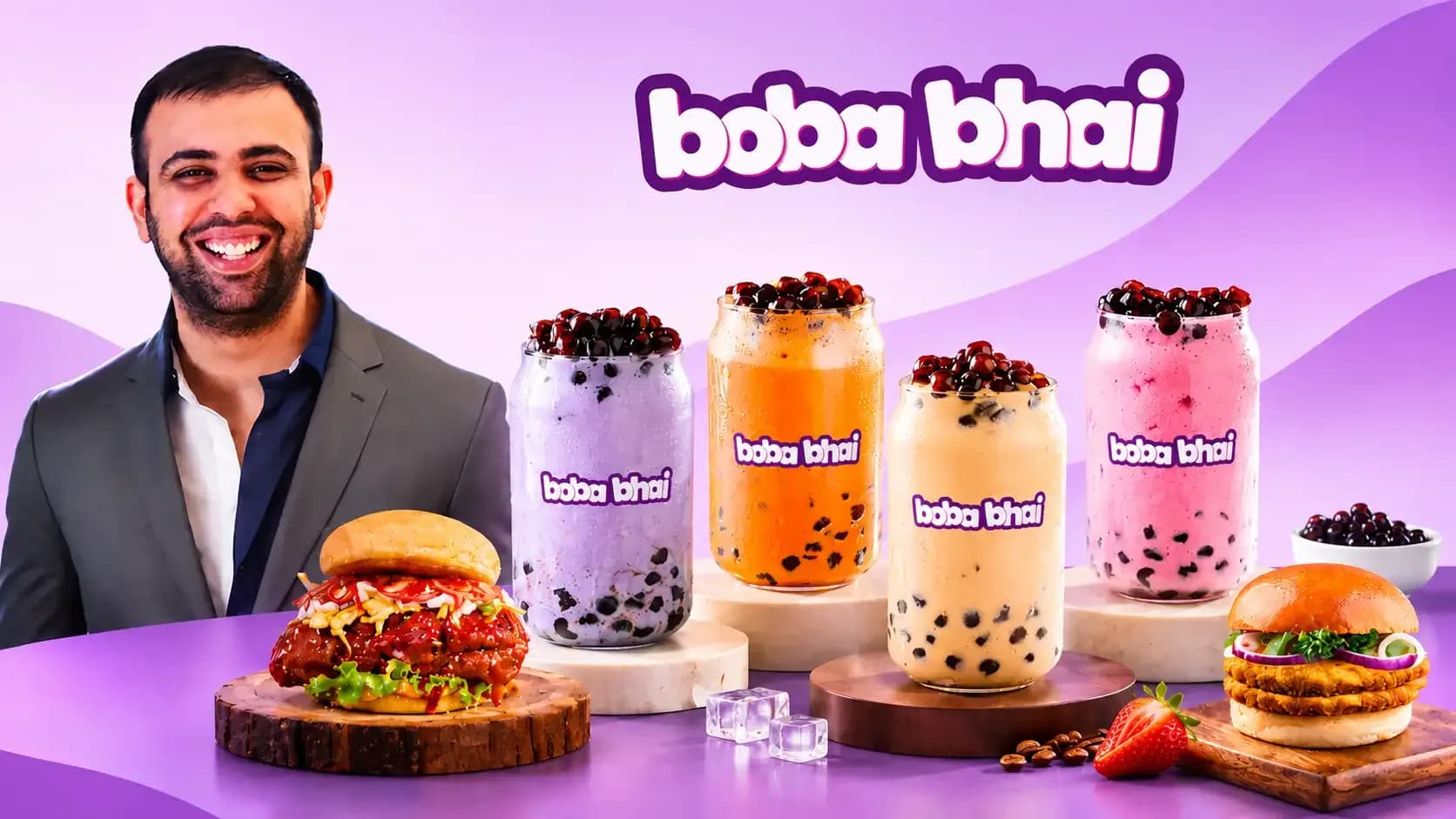
Indian bubble tea and quick-service restaurant brand Boba Bhai reported a significant increase in revenue during the financial year ended March 31, 2026, with its operating revenue rising approximately 139% year-on-year to ₹68 crore, compared with ₹28.44 crore in FY25.
However, the company's rapid expansion came with a substantial increase in expenses. Its net loss widened to ₹21.8 crore in FY26, compared with ₹9.96 crore in the previous financial year, reflecting the costs associated with building and scaling its business operations.
According to publicly reported financial statement figures, Boba Bhai recorded total income of approximately ₹69 crore during FY26, while its total expenses stood at around ₹90.4 crore.
The performance highlights the contrasting realities of the company's growth journey: strong consumer demand and increasing business scale on one side, and the challenge of achieving sustainable profitability on the other.
Revenue Growth Driven by Food and Beverage Expansion
Boba Bhai's revenue growth reflects its evolution from a bubble tea-focused brand into a broader food and beverage business.
While its original positioning centred on bubble tea and Asian-inspired beverages, the company has gradually expanded its menu to include Korean-inspired food offerings, burgers and other quick-service restaurant products.
Food and beverage sales contributed approximately ₹67.26 crore to its FY26 operating revenue, while scrap sales accounted for around ₹28 lakh.
In a separate founder interview published by Inc42, Dhruv Kohli indicated that food and beverages contributed approximately equally to the company's FY26 revenue. This reflects the brand's efforts to build a broader product portfolio rather than depend exclusively on bubble tea sales.
The expansion into food also gives the company an opportunity to increase average order values and attract customers across different consumption occasions.
Rising Operating Costs Put Pressure on Profitability
Despite the strong increase in revenue, Boba Bhai's expense structure remains a significant challenge.
The company's reported expenses increased considerably during FY26, with employee benefits, raw material consumption, advertising and promotional activities, and platform commissions contributing to its cost base.
Employee benefit expenses reportedly increased by approximately 210.3% year-on-year to ₹13.5 crore. This increase reflects the additional workforce and operational requirements associated with business expansion.
Advertising and promotional expenditure rose approximately 139.9% to ₹13 crore, indicating continued investment in customer acquisition and brand visibility.
Commission expenses increased approximately 155.9% to ₹11.44 crore. For a business operating across physical outlets and online food delivery channels, commissions represent an important cost consideration, particularly when a significant portion of orders comes through third-party platforms.
Raw material consumption also increased approximately 138.5% to ₹25 crore, broadly reflecting the higher volume of food and beverage sales.
These figures underline the operational complexity of scaling a consumer-facing food business, where revenue growth must be accompanied by tighter control over procurement, staffing, distribution and customer acquisition costs.
Store Expansion and Unit Economics Remain Central to the Business
Boba Bhai has been expanding its physical presence alongside its cloud-kitchen operations.
In an April 2026 interview with ETRetail, founder Dhruv Kohli discussed the company's network of more than 100 stores across eight cities, with its operating model split between QSR outlets and cloud kitchens.
The founder also indicated that individual outlets were generating store-level profitability of approximately 18–20%, with reported break-even periods of two to three months.
The estimated investment required to establish an outlet was placed between ₹14 lakh and ₹22 lakh.
These management-reported figures suggest that individual locations can achieve profitability relatively quickly. However, store-level profitability should be distinguished from overall company profitability, which also includes central management, corporate overheads, marketing, technology, depreciation and other expenses.
The distinction is important in understanding why a business can have profitable outlets while continuing to report substantial consolidated losses.
₹40 Crore Funding to Support the Next Phase of Growth
In March 2026, Boba Bhai raised ₹40 crore in a funding round led by existing investors, including 8i Ventures, Titan Capital Winners Fund and Global Growth Capital. BIG Capital and other angel investors also participated.
The funding is expected to support the company's expansion plans, product development, operational infrastructure and leadership capabilities.
For a rapidly expanding QSR business, access to capital is important because opening new outlets requires investment in locations, equipment, staff, inventory and supply-chain infrastructure.
However, the effectiveness of this funding will ultimately depend on how efficiently the company converts its expansion investments into sustainable revenue and cash generation.
Boba Bhai Targets ₹200 Crore Revenue and 250–300 Stores
Looking ahead, Boba Bhai has outlined ambitious expansion plans.
In an April 2026 interview with ETRetail, the company indicated its ambition to reach 250–300 stores and generate more than ₹200 crore in revenue during FY27.
Achieving the revenue target would require growth of approximately 194% over its reported FY26 operating revenue of ₹68 crore.
The company is also looking to strengthen its quick-commerce and e-commerce presence, while increasing the contribution of its QSR format.
In addition, its plans include investments in manufacturing infrastructure to support a larger store network and improve operational scalability.
The expansion strategy reflects a broader ambition to establish Boba Bhai as a multi-category food and beverage brand rather than remain limited to the bubble tea segment.
Boba Bhai's FY26 performance presents an interesting case in India's emerging QSR market.
A 139% increase in operating revenue demonstrates the company's ability to expand its business and attract consumer demand. Its growing store network, diversified menu and investor backing provide a foundation for further expansion.
However, the increase in net losses highlights the financial challenges associated with rapid scaling.
The company's next phase will require more than new store openings. Improving outlet-level contribution, managing employee costs, reducing dependence on expensive customer acquisition channels and generating stronger operating cash flows will be essential.
For investors and the wider food-service industry, the key metric to watch will not simply be how quickly Boba Bhai expands, but how efficiently it can turn that expansion into sustainable profitability.
Its FY27 target of ₹200 crore in revenue could mark an important milestone. Whether the company can achieve that growth while narrowing its losses will determine the strength of its long-term business model.