

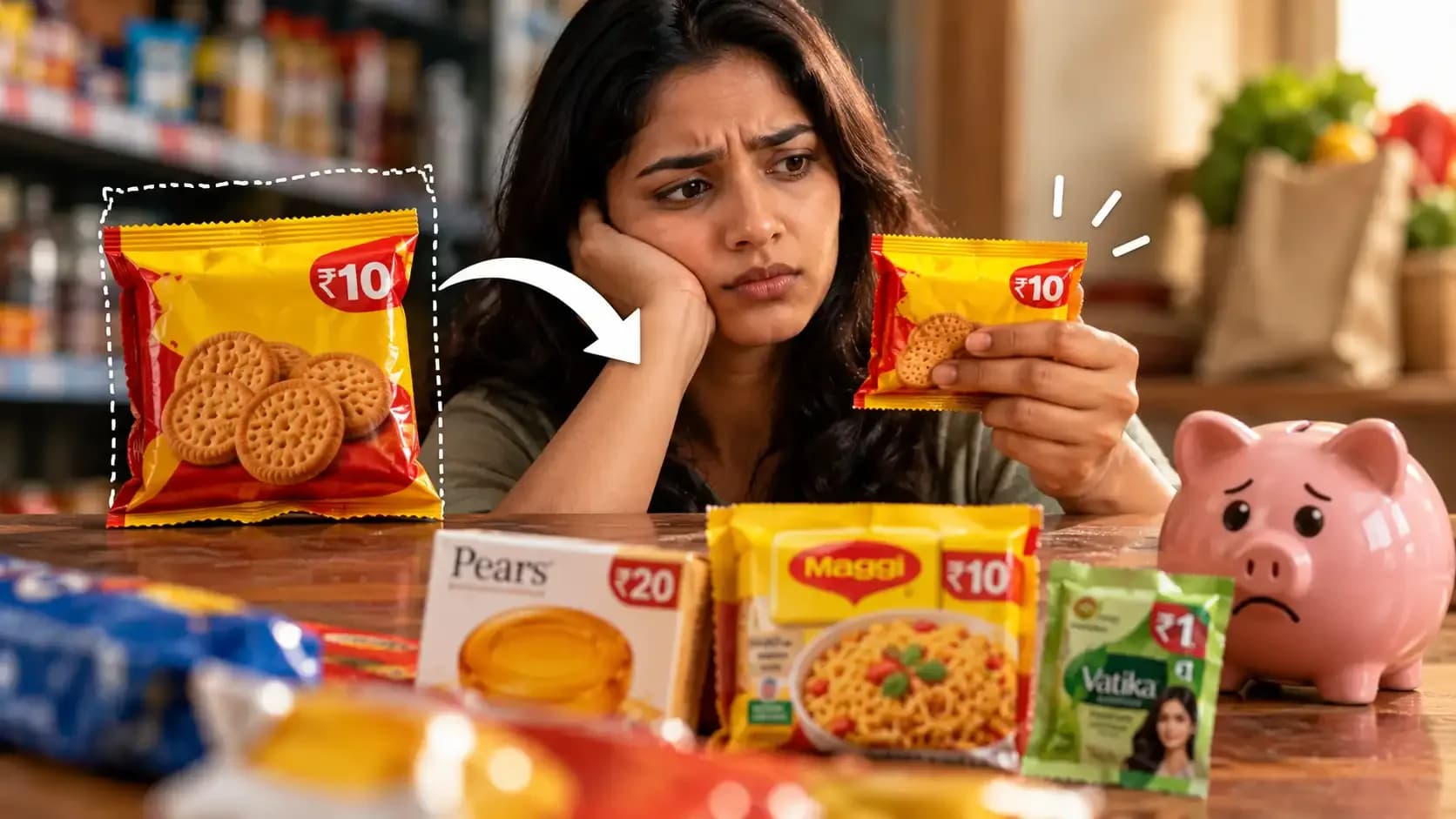
For millions of Indian consumers, ₹10 is not just a price. It is a habit.
It is the price of a biscuit packet picked up at a kirana store, a snack bought on the way home, a shampoo sachet, a detergent bar or a small personal-care product. The number is familiar, predictable and, for many households, psychologically easier to accept than ₹11 or ₹12.
But there is a catch.
The ₹10 price may stay exactly where it is while the quantity inside the packet gets smaller.
That phenomenon — commonly known as shrinkflation — is once again becoming a significant strategy across India's fast-moving consumer goods (FMCG) industry as companies navigate rising input costs while trying to protect price-sensitive consumers.
Recent industry reporting indicates that FMCG companies are considering or implementing grammage reductions, particularly across smaller ₹5–₹25 packs. The All India Consumer Products Distributors Federation has said reductions of around 2–5% are being seen in some smaller packs, while larger packs can face more substantial changes.
For consumers, however, the important number is not always the MRP.
It is the price per gram or millilitre.
And that number can tell a very different story.
When ₹10 Doesn't Really Mean the Same ₹10
Consider a simple example.
A product previously sold for ₹10 at 100 grams cost the consumer:
₹0.10 per gram.
If the MRP remains ₹10 but the quantity falls to 90 grams, the effective price becomes:
₹0.111 per gram.
The consumer is still handing over the same ₹10.
But the effective price of the product has increased by approximately 11.1% per gram.
That is the central issue with shrinkflation.
There may be no increase in the printed MRP. There may be no dramatic price announcement. But the economics of the purchase have changed.
Pears and Vatika: A Current Example of the Strategy
Recent reporting has highlighted two examples that illustrate how the strategy works.
A Pears soap pack reportedly moved from 60 grams to 57 grams while retaining a ₹20 price point.
That represents a 5% reduction in quantity.
Because the consumer is still paying ₹20, the effective price per gram rises by approximately 5.3%.
The calculation is straightforward:
Earlier: ₹20 ÷ 60g = ₹0.333/g
Now: ₹20 ÷ 57g = ₹0.351/g
The same ₹20 therefore buys less product.
A similar example has been reported for a Dabur Vatika hair-oil sachet, where the quantity moved from approximately 4 ml to 3.8 ml while retaining the ₹1 price point.
Again, the MRP has not changed.
But the effective price per millilitre has risen by about 5.3%.
These examples matter because they demonstrate the logic behind shrinkflation: preserve the familiar price point while adjusting the quantity.
This Isn't a New FMCG Play
Shrinkflation is not a phenomenon that suddenly appeared in 2026.
Indian FMCG companies have used grammage changes for years, particularly during periods of commodity inflation.
Some of the most frequently cited historical examples include Parle-G, Maggi, Vim and Haldiram's.
A ₹10 Parle-G pack cited in earlier industry reporting moved from around 140 grams to 110 grams.
That represents a quantity reduction of approximately 21.4%.
But because the consumer continued paying ₹10, the effective price per gram increased by roughly 27.3%.
Another widely cited example involved Haldiram's Aloo Bhujia. A ₹10 pack reportedly moved from 55 grams to 42 grams.
That is a reduction of nearly 24% in quantity.
The effective price per gram therefore rose by approximately 31%.
Similarly, historical reporting documented reductions in products such as Maggi noodles and Vim bars.
A Maggi ₹10 pack that moved from approximately 70 grams to 60 grams effectively represented a 16.7% increase in price per gram, even though the MRP remained unchanged.
A Vim bar cited in earlier reporting moved from 155 grams to 135 grams, translating into an effective price-per-gram increase of roughly 14.8%.
These are historical examples, not evidence that every one of these products is currently sold at those exact grammages. But they demonstrate how powerful the mechanism can be.
Why FMCG Companies Prefer Smaller Packs
To understand shrinkflation, it is important to understand India's unusual relationship with price points.
In many developed markets, companies can increase prices relatively directly.
A product costing $2 can become $2.10.
In India, moving from ₹10 to ₹11 can be considerably more complicated.
The ₹5, ₹10 and ₹20 price points have become deeply embedded in everyday FMCG purchasing behaviour.
For a consumer buying a ₹10 product, a jump to ₹12 represents a visible 20% increase.
Reducing the quantity inside the ₹10 pack is less obvious.
This is particularly important in lower-income and price-sensitive consumer segments.
Industry data has previously shown the enormous importance of low-unit packs to India's FMCG industry. Historical reporting has indicated that small-value packs account for substantial portions of sales for companies including Britannia, Parle Products and Hindustan Unilever.
In other words, companies are not simply selling shampoo, biscuits, detergent or snacks.
They are also selling affordable entry points.
The Consumer Is Buying Affordability — But Potentially Paying More Per Unit
There is an important contradiction at the heart of the shrinkflation debate.
From the consumer's perspective:
₹10 today is still ₹10.
That matters, particularly when household budgets are under pressure.
From the company's perspective, however, the cost of producing the product may have increased because of:
Commodity prices
Packaging costs
Transportation
Energy
Labour
Logistics
Currency movements
Agricultural raw materials
Increasing the MRP may push consumers toward cheaper alternatives.
Reducing grammage allows the company to retain the familiar price point while protecting its margins.
So the company can argue:
"We are keeping the product affordable."
The consumer can reasonably respond:
"But I'm getting less for the same money."
Both statements can be true.
And that is what makes shrinkflation more complicated than a simple story about companies increasing prices.
India's Small-Pack Economy Is Getting Bigger
The significance of shrinkflation becomes clearer when viewed alongside India's growing preference for small packs.
Industry reports have indicated that small packs account for a substantial share of FMCG volumes across categories including biscuits, soaps, detergents, shampoos and staples.
Recent reporting has put the contribution of ₹5 and ₹10 packs at particularly significant levels for several large FMCG companies.
For consumers with limited disposable income, buying a ₹10 packet can be easier than spending ₹100 on a larger pack, even if the larger pack offers better value per gram.
This creates an interesting economic paradox.
Consumers are buying smaller packs because they want to control how much they spend at one time.
Companies are making smaller packs because they want to control the price consumers see.
The same product architecture serves both sides — but for different reasons.
The Inflation Problem Behind the Packet
The timing of the current discussion is important.
India's consumer economy continues to face pressure from food and commodity inflation.
Official August 2026 data showed India's headline CPI inflation at 4.82% year-on-year, while food inflation was considerably higher at 5.95%.
For FMCG manufacturers, the pressure does not come from consumer inflation alone.
Companies also have to manage the cost of raw materials and packaging.
Sugar, edible oils, coffee, cocoa, packaging materials, freight and energy can all influence the cost structure of consumer products.
When input costs rise faster than companies can comfortably pass through in the form of higher MRPs, grammage becomes another lever.
That is where shrinkflation enters the equation.
But Is It Really a Hidden Price Increase?
This is where the debate becomes more interesting.
Calling every grammage reduction a "hidden price hike" oversimplifies the economics.
Companies do not necessarily have unlimited pricing power.
If a biscuit packet moves from ₹10 to ₹12, the consumer may simply switch brands.
If a shampoo sachet moves from ₹1 to ₹1.20, the increase may be difficult to implement through the retail system.
But reducing the quantity from 4 ml to 3.8 ml allows the company to maintain the ₹1 price point.
For a company facing higher costs, this may be less about increasing profits and more about sharing the inflation burden between the company and the consumer without disrupting demand.
That distinction matters.
The real question is not whether companies are allowed to change grammage.
They are.
The question is whether consumers notice the change and understand what it means for the actual price they are paying per unit.
The ₹10 Illusion
There is a psychological element to all of this.
Consumers often remember prices.
They may not remember grammage.
Ask someone how much their favourite biscuit packet costs and they may immediately say:
₹10.
Ask them how many grams are inside and the answer may not be as immediate.
That difference gives price points enormous power.
A consumer sees:
₹10 → ₹10
and assumes:
No price increase.
But the more meaningful comparison may actually be:
₹0.071/g → ₹0.091/g
or whatever the specific product's historical and current unit economics show.
This is why the price-per-100g metric may be more useful to consumers than the MRP alone.
The GST Twist
There is another interesting dimension to India's recent FMCG pricing story.
Following GST rationalisation, some FMCG companies increased the grammage of certain products while retaining existing price points.
For example, previous reporting cited changes in Parle-G packs where the number of biscuits in some low-priced packs increased following tax changes.
That creates an important question for consumers:
If tax savings or cost reductions allow a company to increase grammage while maintaining the MRP, consumers can receive more product.
But when input costs rise again, grammage can move in the opposite direction.
This means the quantity inside a familiar ₹10 or ₹20 pack can become an important indicator of how companies are absorbing — or passing on — changes in their cost structures.
What Happens When Commodity Prices Fall?
This may ultimately be the most important question in the shrinkflation debate.
Suppose a company changes a pack from:
100g → 90g at ₹10
because input costs have risen.
What happens when those costs later fall?
Does the packet return to:
100g at ₹10?
Or does the company maintain:
90g at ₹10?
There is no universal answer across the FMCG industry.
But the question deserves greater scrutiny because once consumers become accustomed to a particular pack size, a grammage reduction can become the new normal.
For journalists and consumers, this creates a useful metric to track:
Not just price inflation, but quantity inflation — or shrinkflation.
How Much Are Consumers Actually Losing?
The easiest way to understand shrinkflation is to calculate the difference.
Suppose a consumer buys ₹10 worth of a product every week.
At the original quantity, they might receive 100g.
Over 52 weeks:
100g × 52 = 5.2 kg
If the same ₹10 pack falls to 90g:
90g × 52 = 4.68 kg
The consumer has received:
520 grams less product over one year
without spending a single rupee less.
Now multiply that across multiple products.
Biscuits.
Snacks.
Soap.
Detergent.
Shampoo.
Tea.
Coffee.
Spreads.
Staples.
The individual reduction may look insignificant.
Across a household's entire FMCG basket, it can become meaningful.
What Consumers Should Look At
The simplest way for consumers to protect themselves is to stop comparing only the MRP.
Instead, compare:
Price per 100 grams
or
Price per 100 ml
For example:
Product A: ₹20 / 100g = ₹20 per 100g
Product B: ₹18 / 75g = ₹24 per 100g
Product B looks cheaper because its MRP is ₹18.
But it is actually more expensive per unit.
This is why larger packs can sometimes provide better value — although consumers should check the actual unit price rather than assuming that a bigger pack is automatically cheaper.
The Bigger Business Story
Shrinkflation tells us something larger about India's FMCG industry.
Companies are caught between three competing forces:
Consumers want affordability.
Investors want margins.
Input costs remain volatile.
Raising prices solves one problem but can damage volumes.
Keeping prices unchanged protects volumes but can squeeze margins.
Reducing grammage offers a third option.
It preserves the psychological price point while changing the economics underneath it.
That makes the humble ₹10 packet an unusually useful window into the health of India's consumer economy.
So, Is Your ₹10 Packet Really Still ₹10?
Technically, yes.
Economically, not necessarily.
If the MRP remains ₹10 but the quantity falls, the consumer is paying a higher price for every gram or millilitre.
That does not automatically mean the company is acting unfairly. Companies face legitimate cost pressures, and keeping a low price point can help maintain access to everyday products.
But consumers deserve to understand the distinction.
Because inflation does not always arrive with a new price tag.
Sometimes, it arrives with a little less inside the same packet.
And the next time you pick up a ₹10 FMCG product, the more important question may not be:
"Has the price gone up?"
It may be: