

India's fasting-food aisle is getting a makeover. What was once largely associated with home-cooked meals during Navratri, Shravan and other religious occasions is increasingly appearing in branded packets on supermarket shelves and quick-commerce apps.
From roasted makhana and rock-salt potato chips to sabudana mixtures, banana chips, fasting flours and ready-to-cook products, food companies are building a more organised market around traditional eating habits. The shift is bringing together established packaged-food manufacturers, specialist snack brands and regional businesses looking to take familiar products to a wider audience.
The opportunity is already visible in the makhana business. According to MarkNtel Advisors, India's makhana market was valued at an estimated $1.46 billion in 2025 and is projected to reach $2.23 billion by 2030, implying a compound annual growth rate (CAGR) of 8.8%.
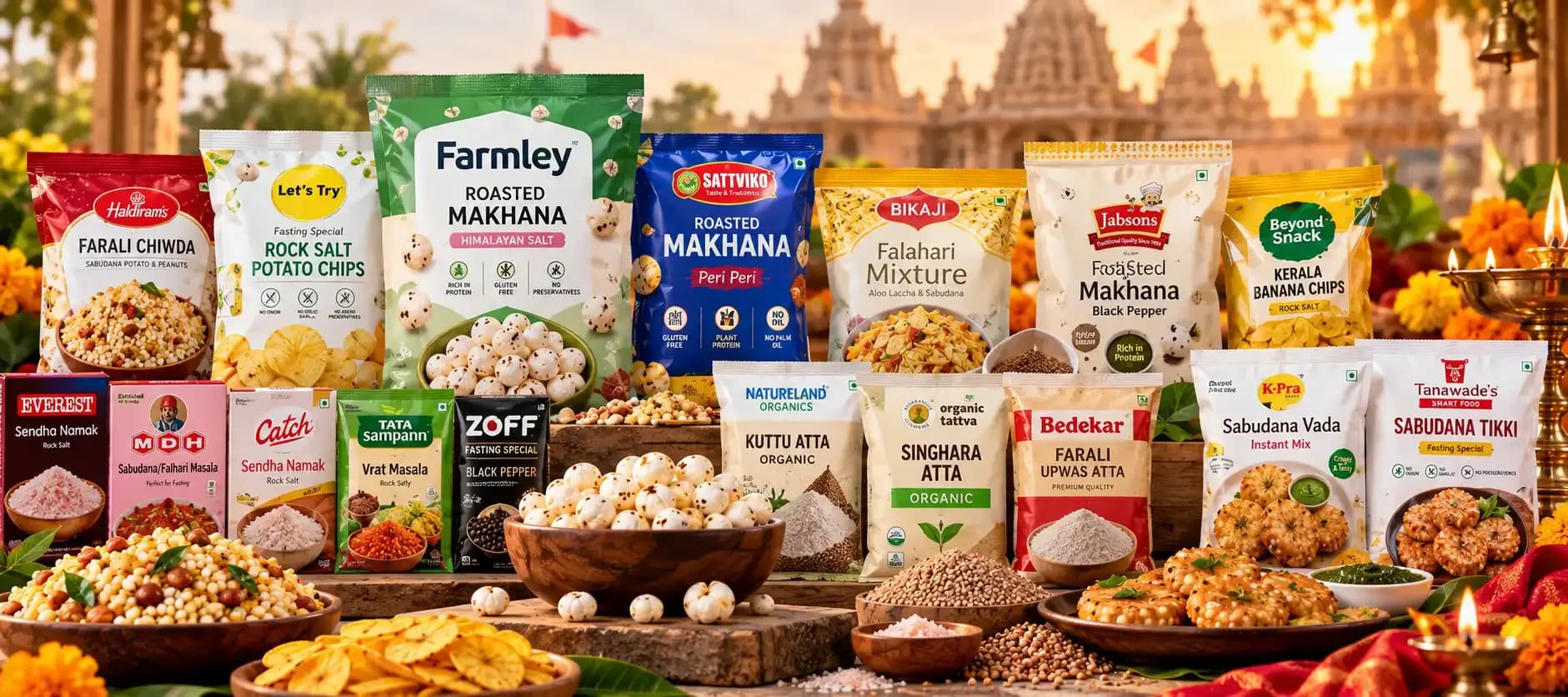
But makhana is only one part of the story. An industry infographic mapping India's vrat-food brands highlights a wider ecosystem spanning snacks, staples, condiments, ready-to-cook foods and multi-category packaged products.
The bigger question for the food industry is whether brands can turn a traditionally occasion-led category into a year-round consumer business.
India's makhana market could reach $2.23 billion by 2030
Makhana has moved well beyond its traditional association with fasting meals. Once sold largely as an agricultural commodity or consumed in relatively simple preparations, fox nuts are now marketed as roasted, flavoured and premium packaged snacks.
MarkNtel Advisors estimates India's makhana market at $1.46 billion in 2025, rising to $2.23 billion by 2030.
That represents an increase of approximately $770 million, or 52.7%, over five years.
India makhana market | Estimate |
|---|---|
Market size in 2025 | $1.46 billion |
Projected market size in 2030 | $2.23 billion |
Forecast CAGR | 8.8% |
Increase in projected market value | $770 million |
Five-year increase over the 2025 baseline | 52.7% |
Source: MarkNtel Advisors. These are commercial research estimates and forecasts, not audited industry revenue figures.
The report identifies raw makhana, roasted makhana, flavoured makhana and makhana powder among the product segments. It estimates that roasted makhana accounts for approximately 67% of the market. This segment share is a research-firm estimate rather than an official government statistic.
The product mix offers an important indication of where commercialisation is taking place. Roasted and flavoured variants give companies an opportunity to sell convenience, taste and packaging alongside the underlying ingredient.
However, the $2.23 billion forecast applies to the makhana market as defined by the research firm. It should not be interpreted as the value of India's entire vrat-food industry, for which a comparable, independently established market-size estimate was not identified.
Government data reveals the scale of India's makhana supply chain
The commercial opportunity is supported by a substantial agricultural base.
In a sector backgrounder published on August 19, 2026, the Government of India's Press Information Bureau reported that India produced 63,910 metric tonnes of makhana in 2024–25. The second advance estimates for 2025–26 placed production at 80,590 metric tonnes.
Bihar accounted for an estimated 60,000 metric tonnes in 2025–26, making it the country's dominant production centre.
Production indicator | Government-reported figure |
|---|---|
India's production, 2024–25 | 63,910 tonnes |
India's production, 2025–26 second advance estimate | 80,590 tonnes |
Bihar's production, 2025–26 estimate | 60,000 tonnes |
Bihar's share of estimated national production | Approximately 74.4% |
Domestic market growth, 2021–22 to 2024–25 | 17–18% annually |
The latest production estimate is approximately 26.1% higher than the 2024–25 figure. That comparison indicates a significant increase in estimated output, although it does not establish how much of the additional production will translate into packaged retail sales.
The government backgrounder also reported that the domestic makhana market expanded by 17–18% annually between 2021–22 and 2024–25. It projected the domestic market to reach ₹11,000–12,000 crore by 2029–30.
These figures differ materially from MarkNtel Advisors' dollar-denominated market forecast. The estimates should be reported separately because their market definitions and valuation methodologies may differ.
The government has also highlighted a sharp rise in average makhana prices. Its backgrounder cited an average price of around ₹500 per kilogram during 2020–22, compared with nearly ₹1,250 per kilogram in 2025.
The comparison suggests that rising demand and price realisation have become important features of the sector. However, these figures do not mean that every farmer, processor or packaged-food brand has experienced the same increase in earnings.
Source: Press Information Bureau, Government of India, August 2026.
Bihar's makhana industry is moving towards value addition
Bihar's importance to the makhana business extends beyond cultivation. The state's production concentration gives it a central role in processing, sourcing and the development of branded products.
Districts including Purnia, Katihar, Darbhanga, Madhubani, Saharsa and Supaul are associated with makhana cultivation and processing. Mithila Makhana also has a Geographical Indication tag, offering a means of identifying products associated with the region when the relevant GI requirements are met.
The next stage of value creation could involve improved processing, grading, quality control, packaging and the development of products designed for domestic retail and export markets.
The government constituted the National Makhana Board in September 2025 and approved a Central Sector Scheme for the Development of Makhana with an outlay of ₹476.03 crore for 2025–26 to 2030–31.
The scheme is intended to support areas including research, improved cultivation practices, farmer training, processing, branding and market access.
For packaged-food companies, improvements in the supply chain could help address quality and sourcing requirements. For farmers, the commercial benefits will depend on whether greater value addition and improved market access lead to better returns at the farm level.
The distinction matters because a larger packaged-food market does not automatically guarantee higher incomes for the producers supplying its raw materials.
The market is larger than makhana: Five segments are emerging
The industry infographic offers a useful snapshot of how brands are approaching the broader vrat-food opportunity. Rather than treating fasting foods as one homogeneous category, it separates the ecosystem into several product groups.
1. Packaged vrat snacks
Makhana, potato wafers, banana chips, sabudana mixtures, nuts and sweets form the most visible part of the category.
Companies can compete through flavours, pack sizes, pricing, convenience and brand positioning. Specialist snack businesses can focus on fasting-specific products, while established manufacturers can use their existing distribution networks to reach consumers.
The infographic includes names such as Farmley, Let's Try, Sattviko, Bikaji, Haldiram's, Beyond Snack, Jabsons and True Elements.
Their inclusion demonstrates the range of businesses associated with traditional and fasting-friendly snacks. It does not establish their market shares or indicate that every product in their portfolios is suitable for fasting.
2. Ready-to-cook fasting foods
Products that reduce preparation time represent another potential growth area.
Traditional fasting meals can require ingredient preparation and cooking. Ready-to-cook formats offer a convenience proposition for consumers who want to prepare familiar dishes with less effort.
The infographic identifies K.Pra and Tanawade's Smart Foods in this segment.
The broader opportunity is to make traditional food preparation easier without losing the familiarity of the original dish. Actual commercial success will depend on product quality, shelf life, availability and consumer willingness to pay.
3. Vrat flours and staples
Buckwheat flour, water chestnut flour, amaranth and sabudana remain important ingredients in many fasting traditions.
This segment allows companies to serve consumers who prefer home-cooked meals rather than ready-to-eat snacks.
Brands including Natureland Organics, Organic Tattva, Bedekar and Dinesh Flour Mill appear in the infographic's staples or flour categories. Their presence should not be taken as confirmation that all products sold by these companies are intended for fasting.
4. Condiments and seasonings
Spices, salts and other cooking ingredients can also participate in the fasting-food ecosystem.
The graphic includes Everest, Tata Sampann, Catch, Zoff and MDH. These are broader food and seasoning businesses, rather than brands exclusively dedicated to vrat products.
The opportunity in this segment is more specific: products must match the requirements of the intended consumer and the particular fasting tradition being served.
5. Multi-category traditional-food brands
Established snack and sweets businesses can participate in fasting occasions through relevant products within larger portfolios.
Haldiram's and Bikaji are examples of companies operating across wider packaged-snack categories. Their inclusion in the broader ecosystem illustrates how traditional snacks can be marketed for multiple occasions.
For established companies, the opportunity may lie in extending existing distribution and brand recognition into additional consumption occasions. For smaller businesses, the challenge is to develop a distinctive proposition without the same scale of distribution.
The infographic is a category map, not a market-share chart. It does not provide company revenues, product-level sales or evidence that the businesses shown are growing at the same rate.
Quick commerce is making fasting foods more visible
The changing retail presentation of vrat products offers a concrete example of how the category is developing.
Blinkit's online collection for vrat snacks listed products including:
Farmley Prasadam Makhana, 200 grams, at ₹389.
Whole Farm Makhana, 100 grams, at ₹142.
Let's Try Rock Salt Potato Chips, 52 grams, at ₹37.
Let's Try Sabudana Falhari Mixture, 192 grams, at ₹117.
Tata Sampann High Protein Makhana, 200 grams, at ₹356.
These prices were displayed in the platform listing updated on September 16, 2026. They are examples of listed prices at a particular point in time, not industry-wide averages or verified transaction prices.
The range illustrates the different ways brands compete within the same shopping occasion. Consumers can choose between relatively inexpensive potato chips, packaged mixtures, premium makhana and larger packs.
Quick commerce may help consumers discover specialised products without visiting a dedicated store. It can also give brands another route to reach consumers during periods of heightened demand.
But visibility is not the same as profitability. Platform charges, promotions, fulfilment costs, discounts and repeat-purchase rates all influence the economics of selling through these channels.
Makhana exports reached ₹192.96 crore in FY2025–26
India's makhana opportunity also extends beyond domestic retail.
The government reported that India exported 7,264.89 metric tonnes of makhana products in FY2025–26, with an export value of ₹192.96 crore.
The United States, Canada and the United Arab Emirates together accounted for 77% of reported export volume.
Export market | Share of India's makhana exports | Reported average export price |
|---|---|---|
United States | 40% | $19.50/kg |
Canada | 20% | $15.80/kg |
United Arab Emirates | 17% | $13.30/kg |
United Kingdom | 10% | $20.00/kg |
Germany | Smaller market | $26.00/kg |
Australia | Smaller market | $21.00/kg |
Source: Government of India, Press Information Bureau, August 19, 2026. Average prices are reported figures and may vary according to product type, processing, quality and commercial terms.
The export data presents two distinct opportunities.
The first is to strengthen established markets where Indian products already have a presence. The second is to explore markets where the government reports higher average unit-price realisations.
However, higher average export prices do not automatically translate into higher profit margins. Product specifications, processing, freight, compliance and other commercial costs must be considered before comparing market attractiveness.
India also introduced a separate Harmonized System of Nomenclature code for popped makhana and other makhana products in 2025. The government said this would help improve product-specific export data, which had previously been obscured by broader classifications.
Better trade data can help companies assess demand and identify markets, but individual exporters still need to validate customer demand and the economics of each destination.
Can traditional fasting foods become a year-round business?
The biggest commercial question is not whether fasting foods sell during Navratri or Shravan. Those occasions already provide established reasons for consumers to purchase relevant products.
The more important question is whether brands can build demand outside these periods.
Makhana offers one possible route because it can be marketed in different formats, including roasted and flavoured snacks. Other products may have different opportunities: fasting flours can serve home cooking, while packaged mixtures and ready-to-cook foods can address convenience needs during specific occasions.
The distinction between traditional demand and everyday demand must remain clear. A product being available throughout the year does not prove that consumers buy it regularly throughout the year.
For manufacturers, demonstrating year-round demand would require evidence such as monthly sales, repeat-purchase rates, customer retention and changes in sales outside major fasting periods.
Without those figures, it would be premature to conclude that the entire vrat-food category has already become a mainstream, year-round FMCG market.
What could determine the next phase of growth?
Several factors are likely to influence which businesses succeed.
Reliable sourcing: Makhana prices and quality can vary. Companies need supply arrangements that support consistent products without exposing margins to excessive volatility.
Product differentiation: Similar flavours and packaging can make it difficult for brands to stand out. Product quality, provenance, distinctive formulations and consumer trust may become increasingly important.
Distribution economics: Supermarkets, online marketplaces and quick-commerce platforms can improve access, but each channel has its own costs and competitive pressures.
Consumer trust: Fasting rules vary across communities and households. Clear ingredient information and accurate product claims are important for brands serving this market.
Value addition: Processing, packaging and branding can create additional commercial opportunities, but the benefits must be assessed across the supply chain rather than only at the retail stage.
These factors will shape the market differently across snacks, staples, flours and convenience foods. A company selling raw ingredients faces different commercial conditions from a brand selling premium roasted makhana.
India's vrat-food market is becoming more visible as traditional products enter organised retail, branded packaging and online shopping collections. Makhana provides the clearest numerical illustration of the opportunity, with a commercial research forecast projecting the market to grow from $1.46 billion in 2025 to $2.23 billion by 2030.
Government data adds another dimension: production is rising, Bihar remains the dominant source, exports reached ₹192.96 crore in FY2025–26, and public investment is being directed towards the sector.
But the wider packaged vrat-food market remains less clearly measured. The available evidence does not establish its total value, the market shares of the brands shown in the infographic, or whether demand has shifted decisively from seasonal occasions to everyday consumption.
For food companies, the opportunity is to turn traditional products into accessible, differentiated and commercially sustainable offerings. For farmers and processors, the challenge is to ensure that the expansion of branded products creates value further up the supply chain.
The next stage of the story will depend on evidence of repeat demand, stronger processing capabilities, export development and the ability of brands to compete beyond festival-led sales.
Sources consulted: Press Information Bureau, Government of India; MarkNtel Advisors; online product listings from Blinkit. Figures are attributed to their respective publishers, and the makhana market forecast should not be confused with the total size of India's vrat-food market.