


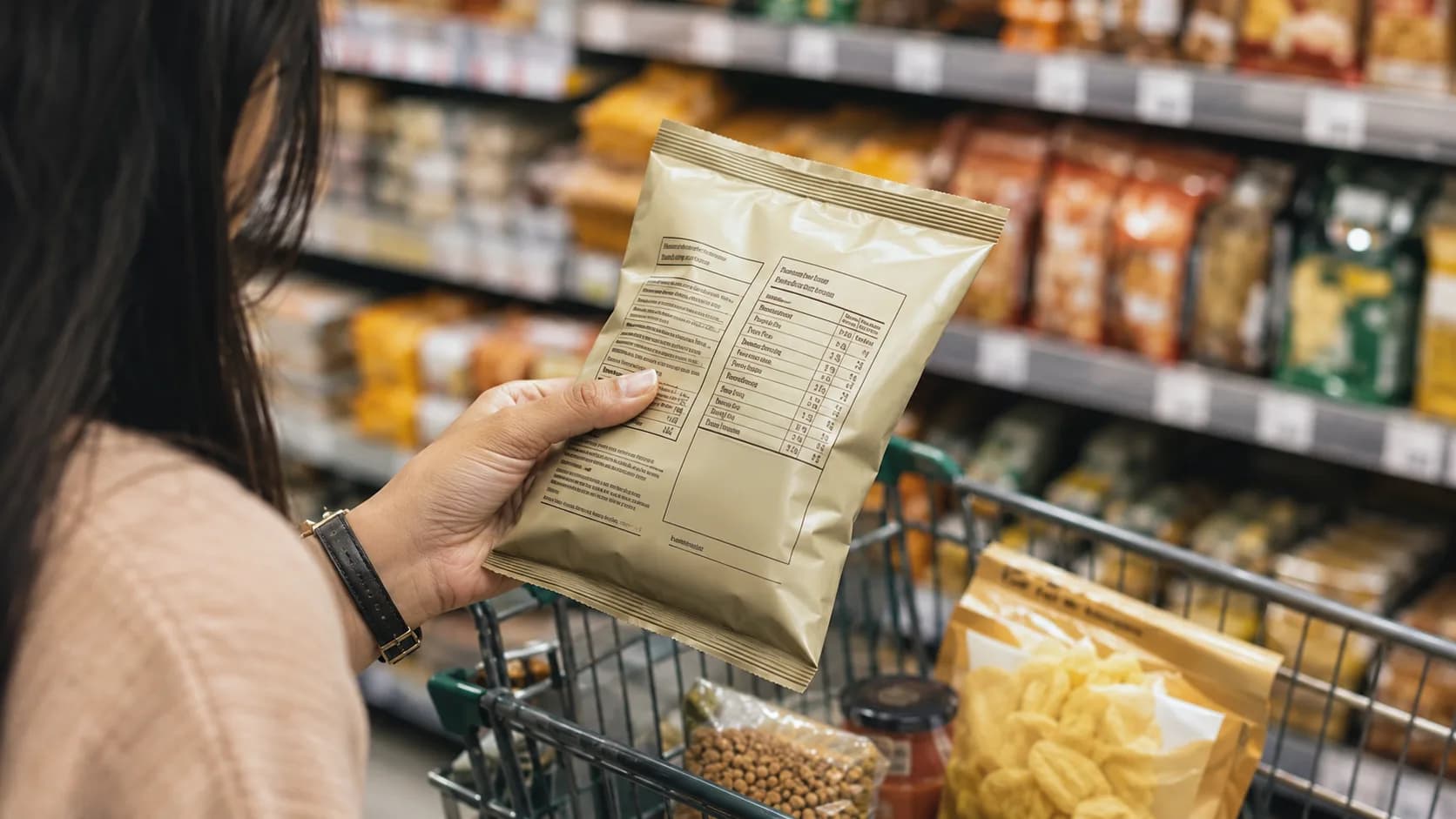
Pick up a packet of biscuits in any Indian supermarket and flip it over. Buried in a grid of numbers is a line that says "Total Sugars," another that says "Sodium" printed in a font built for a nutritionist, not a shopper with ten seconds to decide.
The front of the pack, meanwhile, says "baked, not fried." It says "0% trans fat." It says nothing about whether this specific biscuit crosses the line India's own scientists consider high in sugar or saturated fat.
That gap is now the subject of a sharp exchange inside India's highest court. On August 13, a bench of Justices J.B. Pardiwala and K. Vinod Chandran criticised the Food Safety and Standards Authority of India (FSSAI) over its reluctance to introduce front-of-pack warning labels on packaged foods high in sugar, salt and saturated fat and questioned whether the regulator was bowing to industry pressure. The bench made clear that if FSSAI wouldn't act, the court would. It gave the regulator two more weeks to submit a final decision.
Nobody in this case disputes that Indian food packaging needs to say more. The fight is over what "more" should look like: a warning, or a worksheet.
THE COURT HAS RUN OUT OF PATIENCE
This dispute has simmered for over a decade, but it sharpened in February 2026, when the same bench directed FSSAI to revert within four weeks and endorsed warning symbols for products high in sodium, sugar or saturated fat alongside a positive logo for healthier ones. The court called FSSAI's compliance affidavit unsatisfactory and said the exercise so far had produced nothing meaningful.
FSSAI missed that deadline. By March, the petitioners a Kerala-based non-profit, 3S and Our Health Society were telling the court the regulator was bending to industry pressure and asked for a hard cut-off.
On August 3, FSSAI filed a new affidavit proposing a table of recommended daily limits for sugar, saturated fat and salt, printed alongside a product's nutrient content and serving size, instead of warning symbols. The petitioner called this a disregard of the court's February order. The August 13 hearing was the court's response: two weeks, or the bench writes the rule itself.
WARNING SYMBOL vs. NUMBER TABLE
A warning label is a small, high-contrast symbol often a black octagon or stop sign that flags at a glance when a product crosses a threshold for sugar, sodium or saturated fat. It doesn't explain anything. It interrupts.
FSSAI's plan works differently. It would tell a shopper the recommended daily limit is 25g of sugar, 10g of saturated fat and 5g of salt, based on the 2024 ICMR-NIN Dietary Guidelines then leave it to them to check the product's own numbers against that limit and do the math.
The petitioner's advocate, Rajiv Shankar Dvivedi, called this a three-step task find the number, recall the limit, calculate that defeats the entire point of a front-of-pack label, which exists to shortcut exactly that process. FSSAI's counsel, Additional Solicitor General Brijender Chahar, argued a blunt warning oversimplifies a country with distinct dietary habits, including higher reliance on fried and spicy food, and that global warning-label models can't be copy-pasted onto India. The bench wasn't convinced, saying the country owed its citizens especially children the same protection, regardless of local eating habits.
WHY INDIA HAS TAKEN SO LONG
This isn't India's first attempt and the first one collapsed the same way this one might. In September 2022, FSSAI floated the "Indian Nutrition Rating," a health-star system that could award stars to a high-sugar product if it scored well elsewhere. Nutrition researchers tore into it as a system that could mislead more than it clarified, and it was quietly shelved.
That star-rating idea wasn't a guess. In 2021, under then-CEO Arun Singhal, FSSAI paid the Indian Institute of Management Ahmedabad over Rs 2.4 crore to test how Indian consumers responded to different label formats star ratings, warning labels, traffic lights, number tables. That study is now central to the petitioner's newest filing, which claims its findings actually undercut FSSAI's current proposal.
In July 2024, FSSAI took a smaller step: bolder, bigger-font sugar, salt and saturated-fat numbers on the back of the pack. A readability fix not a front-of-pack warning. By February 2026, the court had run out of patience with incremental fixes and asked FSSAI to consider warning symbols outright. That's the order it now stands accused of dodging.
AN AGENCY ARGUING AGAINST ITS OWN EVIDENCE?
FSSAI's stated position is that a daily-limit table informs without alarming and it points to a March 2026 stakeholder consultation where most industry participants opposed warning labels.
But the petitioner's sharpest claim is that FSSAI's own 2021 IIMA study contradicts that. Per the petitioner's account, correct identification of an unhealthy product came in at 55% for a number table like FSSAI's proposal, 45% for a star rating and just 39.1% with no label at all. The petitioner argues this shows a plain numerical table performs worse than a warning label, and that FSSAI's affidavit left out this comparison, along with input from 29 public-health and consumer groups that backed warning labels during the same consultation.
Worth being precise: none of this is law yet. There is no mandatory front-of-pack warning or interpretive label in India today only the 2024 rule for bolder back-of-pack numbers. The daily-limit table, the warning symbols the court has floated, and every claim above remain contested, mid-litigation.
WHAT INDUSTRY ARGUES AND WHAT SCIENCE SAYS
Industry's case, made through Senior Advocate Maninder Singh for manufacturer interests, is about proportion: a blanket warning symbol risks treating a marginally-over-threshold product the same as a genuinely excessive one, and reformulating to avoid a warning carries real cost harder for small manufacturers than large ones. The bench acknowledged the commercial concern but held that warning labels simply let buyers decide for themselves, and that manufacturers don't get the deciding vote in a public-health question. No individual company has gone on record opposing warning labels in this case; the industry position has come through counsel and trade bodies, not named manufacturers.
The public-health case rests on scale. Per the 2024 ICMR-NIN guidelines, 56.4% of India's total disease burden is linked to unhealthy diets, with high-sugar, high-salt, high-fat foods tied to elevated obesity, diabetes, hypertension and cardiovascular risk a pattern, not a claim that any single product causes any single disease.
CAN INDIANS EVEN READ THE LABEL?
This is the real question behind the courtroom arguments. A 2025 scoping review of Indian nutrition-labelling studies found nearly half of Indian consumers ignore front-of-pack labels while shopping though it also found structured nutrition education, as seen in Canada and Mexico, sharply improves label use once it exists. Most Indian studies on this skew urban, meaning less is known about how the country's rural and small-town majority actually reads any of these formats. Separately, ICMR-NIN researchers testing formats with Indian consumers found real differences in comprehension by design proof that format isn't cosmetic, it's functional. The "will Indians understand this" question raised in court isn't rhetorical. It's answerable and partial answers already exist in India's own research.
WHAT OTHER COUNTRIES LEARNED
Chile is the case most worth watching, because its 2016 law used exactly the black-octagon format India's petitioners want. Phased in through 2020, it required "high in" warnings on sugar, sodium, saturated fat and calories. The share of Chilean products needing a warning label fell from 71% before the law to 53% after its strictest phase driven largely by reformulation. A separate study found a real drop in purchases of high-in beverages after the law took effect.
Mexico offers an even closer parallel: it started with a voluntary numbers-based label similar in spirit to FSSAI's current proposal before switching to mandatory "high-in" warning octagons. A 2018 five-country comparison found Mexican consumers had the highest front-of-pack label awareness among the countries studied, and linked that to the switch away from a numbers-first system. It's close to a live experiment for the exact choice India is weighing now: a country tried the numbers approach, found it underused, and moved to warnings instead.
Neither example proves a warning label is automatically right for India diets, literacy and retail habits differ. But both offer something India still lacks: years of real evidence on which format actually changes what people buy.
WHAT CHANGES FOR YOUR SHOPPING BASKET
If the court's preferred approach wins, a shopper picking up instant noodles, a sweetened drink or a bag of chips sees a symbol not a paragraph telling them if that product is high in sugar, salt or saturated fat. No arithmetic required.
If FSSAI's proposal wins instead, the same shopper sees a table: nutrient content per 100g, serving size, and daily limits. Working out whether the product is "high" in anything still falls to them essentially the same task the back-of-pack panel already allows, just moved to the front in a bigger font.
Either way, nothing changes yet. There is no live mandatory front-of-pack rule today only a court-ordered deadline and a regulator running out of room to delay.
WHAT HAPPENS NEXT
FSSAI's next filing is due in the final week of August 2026. The court has made clear this isn't open-ended: if the regulator doesn't produce a workable framework, the bench is prepared to write the rule itself. Given that FSSAI has already missed one deadline in this case the four-week window set in February, blown past by July there's real uncertainty about whether it meets this one either. What's different now is that a court that has twice expressed open frustration has put a short, specific clock on what happens next.
Stand at the shelf again. The back panel still has its grid of numbers. The front still makes its quieter claims baked, not fried; zero trans fat none of which answer the only question that matters in the five seconds before the packet goes in the basket: is this one of the ones high in what your body doesn't need more of? Whether India finally answers that with a symbol or a spreadsheet isn't a technical detail anymore. It's a decision the country's highest court has said it will make itself, if the regulator won't.