

For most Indians, Ferrero Rocher doesn't get bought. It arrives in a golden box, at Diwali, from a relative who wants you to know they spent something. That association was built deliberately over nearly twenty years, and it worked.
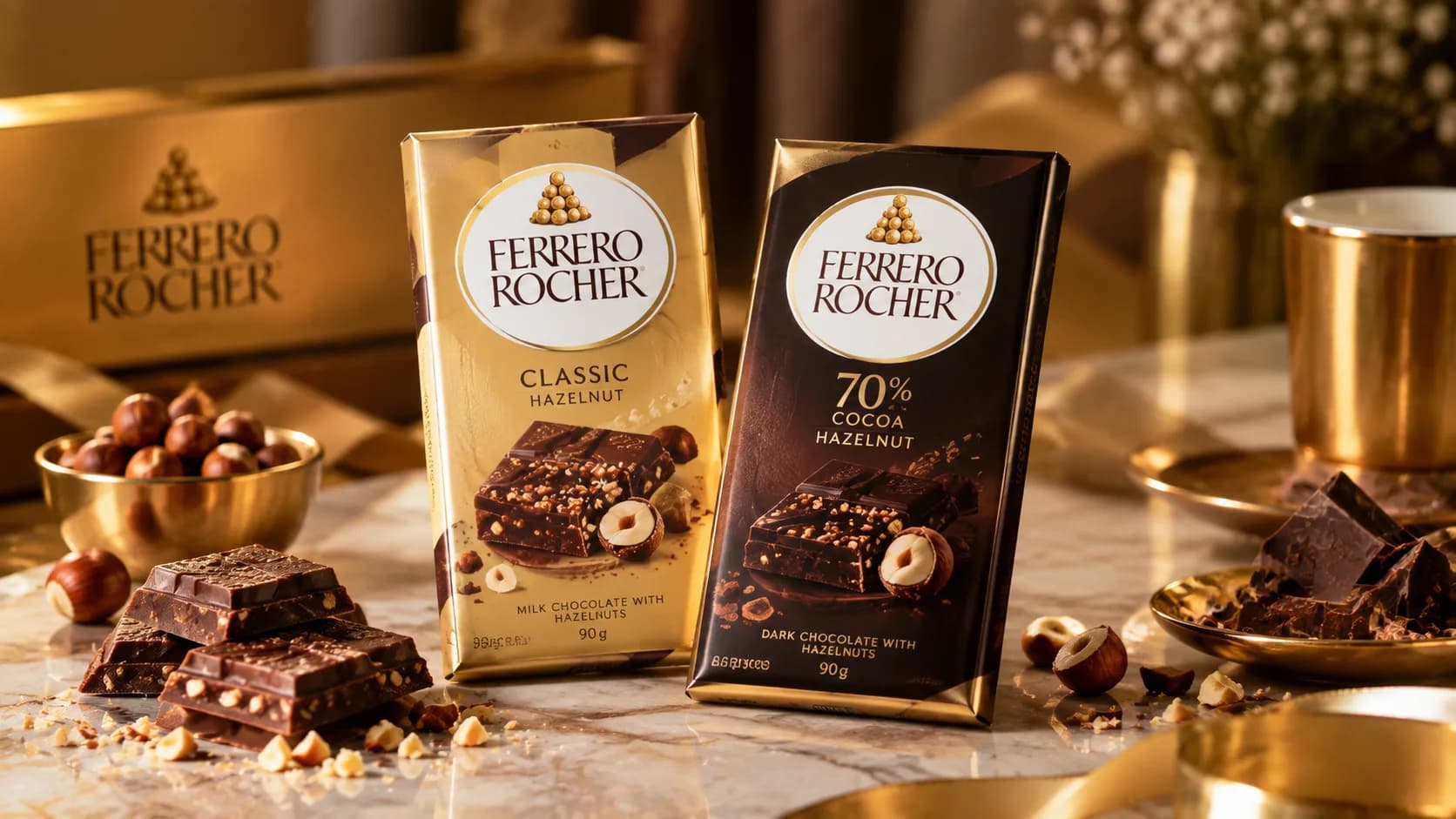
Ferrero is now trying to unpick it. On 8 September, the company announced Ferrero Rocher Bars in India: a 90g tablet at an MRP of ₹499, in Classic Hazelnut and 70% Cocoa Hazelnut, going first to quick commerce and then to modern trade and premium stores in key metros. A campaign titled "Ferrero Rocher is a Bar," fronted by Hrithik Roshan, carries it into the festive season.
Two things about that launch are worth knowing before the price argument starts. The bar is not new. And it is not made here.
Ferrero Rocher is now a ₹499 chocolate bar
The format is five years old. Ferrero entered the premium chocolate tablet category for the first time in its history in the UK in August 2021, rolled it across Europe, reached Canada in May 2022 and the United States in September 2022. The 90g size, the domed embossed squares, the gold wrapper all of it predates the India launch by half a decade.
India got two of the five variants that exist in the range, and Ferrero India's marketing head, Zoher Kapuswala, told afaqs! the bars are imported from Poland, with more variants possible later. That matters, because Ferrero has manufactured in India since the 2000s and runs a plant at Baramati near Pune that supplies export markets. The company makes chocolate here. It chose not to make this here at least not yet.
What the two bars contain
Ferrero describes the bars as combining its signature elements: chocolate, a creamy filling and crunchy hazelnut pieces, arranged in layered squares with a domed top that echoes the praline. The Classic variant is milk-based; the second is a 70% cocoa dark. (Ferrero's North American range has carried a 55% dark bar; India has received the 70% version.)
Ferrero has not published an India-specific ingredient breakdown, hazelnut percentage or nutritional panel, and this article does not assume the global specification applies unchanged.
Why Ferrero is moving beyond gifting
Ferrero's reasoning is unusually explicit. Kapuswala told afaqs! the company used Kantar's Needscope framework to split Indian gifting into three occasions formal, romantic, and year-round and assigned a brand to each: Ferrero Rocher to formal gifting, Ferrero Rocher Moments to year-round, Raffaello to romance.
Every one of those is someone buying for someone else. Ferrero has, by its own account, largely filled the gifting board. The remaining unoccupied square is self-consumption.
The trigger was behavioural data from e-commerce partners. Kapuswala described a spike in chocolate and sweet ordering after 9pm and 10pm a demand pattern that a gift box, by definition, cannot serve. Nobody orders a Diwali hamper at 10:40pm for themselves.
Why the ₹499 price point matters
Run the arithmetic. ₹499 for 90g works out to about ₹5.54 per gram roughly ₹55 per 10g, or ₹554 per 100g.
Now compare it to Ferrero's own icon. The 200g, 16-piece Ferrero Rocher box commonly retails in India in the ₹475–₹500 range, which is about ₹237–₹250 per 100g. On a per-gram basis, the bar costs roughly twice what the box costs.
That is not a scandal it is a positioning decision, and Ferrero is candid about it. Kapuswala's framing to afaqs! was that the brand carries heritage and will not enter the mass market. He also noted where the rest of the category is heading: brands that sat at ₹20–₹40 now launching at ₹150, and brands at ₹150–₹180 now launching at ₹350–₹375. Ferrero's intent is to price above that ladder rather than climb it.
Against imported peers, ₹499 looks less exceptional. Lindt Excellence 100g bars carry MRPs in the ₹599 range for high-cocoa variants, often discounted to the mid-₹400s; Lindt's 150g hazelnut milk tablet has listed around ₹600. Against Indian premium Cadbury Dairy Milk Silk at roughly ₹117/100g, Amul dark at roughly ₹93–₹120/100g it sits in a different market entirely. The honest summary: ₹499 is competitive with imported European tablets and roughly four to five times Indian mainstream premium.
Quick commerce, coolers and a five-year wait
So why 2026? Kapuswala gave the answer without being asked the question.
Ferrero Rocher, he explained, does not go everywhere. Distribution covers metros, tier-1, tier-2 and part of tier-3 and stops. The constraint is physical: the chocolate needs air-conditioned warehousing at the distributor, air-conditioned transport, and a working cooler at the point of sale. Most of Indian retail cannot supply that chain.
E-commerce, in his words, delivers to all PIN codes, and that becomes the unlock for the brand. Dark stores are climate-controlled by default. The delivery window is minutes. A 90g bar that would have melted in a shopfront in Nagpur in May can now survive the journey.
Read that alongside the five-year lag and the picture resolves: the bar didn't arrive late because Ferrero doubted Indian appetite. It arrived when the infrastructure could carry it and when Ferrero, per Business Standard, was expanding its own cooler footprint to widen the physical shelf behind the digital one.
Where the bar sits against premium rivals
The timing is not happening in a vacuum. On 4 September, four days before Ferrero's announcement, Lindt opened its first retail boutique in India about 1,100 sq ft at Worldmark, Aerocity in New Delhi, with Excellence, Extra Creamy and a LINDOR Pick & Mix counter.
Within one week, one global premium brand opened a physical destination in Delhi and another put a ₹499 tablet into ten-minute delivery. They are opposite bets on the same thesis: that Indian consumers will pay imported-chocolate prices for themselves, not just for gifts.
A further tailwind sits underneath both. Since 22 September 2025, chocolate has attracted 5% GST, down from 18% under the earlier structure a change that applies to imported and domestic chocolate alike, and which lowers the cost of putting a premium imported bar on an Indian shelf.
What this says about how India buys premium chocolate
Ferrero's own numbers, offered to Business Standard, are modest about the prize: the chocolate market growing around 7–8%, bars making up roughly half of it, a total bar category near ₹20,000 crore and the premium slice of that still small. Kapuswala's claim that Rocher will grow at double digits is a target, not a result, and should be read as one.
The more durable signal is what the bar assumes. It assumes an Indian consumer who will spend ₹499 on 90g of chocolate at 10pm with no occasion attached, no one to hand it to, and no festival to justify it. That consumer may well exist. But Ferrero spent twenty years teaching the country that this particular gold wrapper means you matter to me.
Asking it to now mean I deserve this is the harder piece of work harder than the recipe, and harder than the logistics that finally got the bar here.