

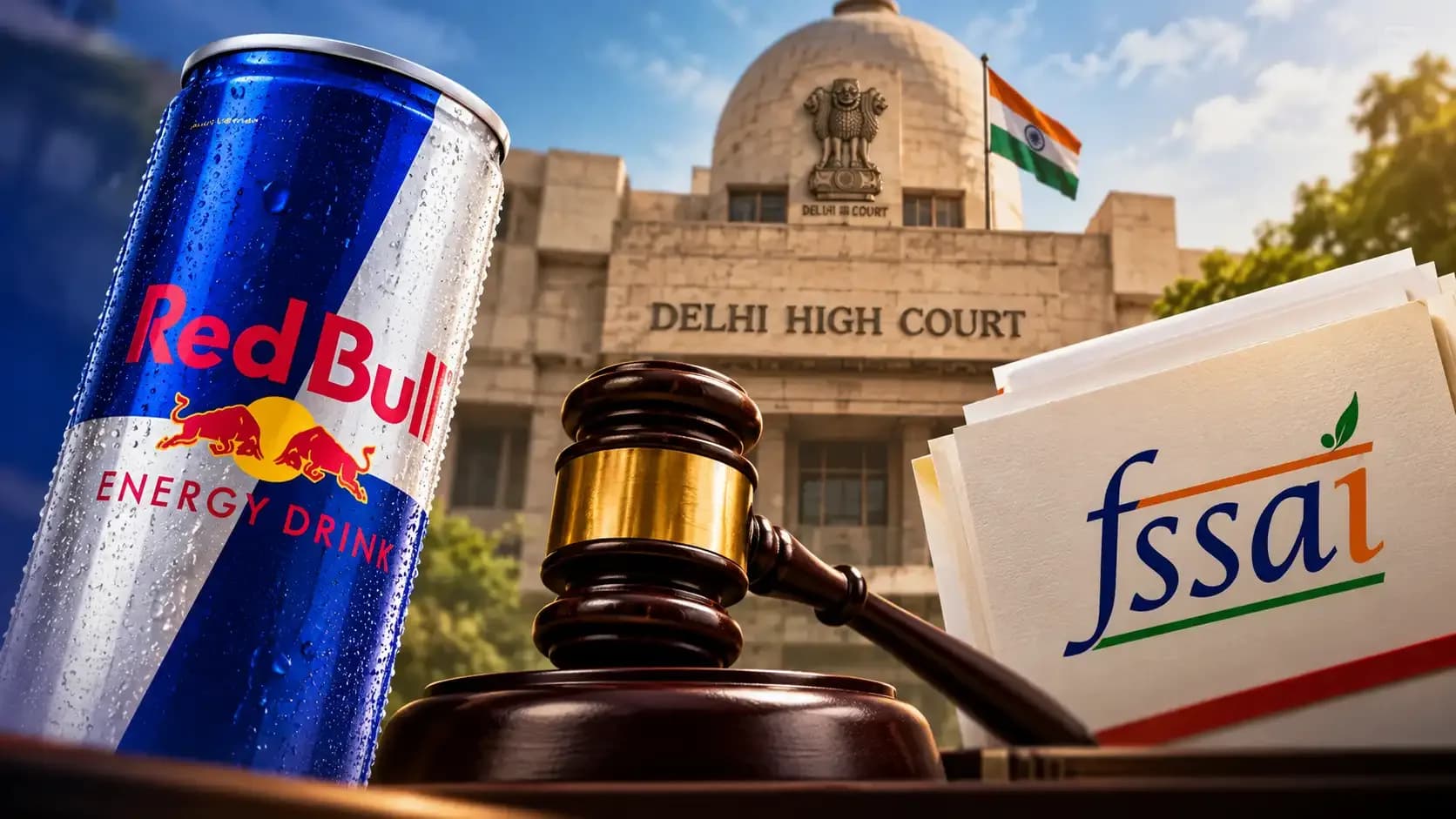
The Red Bull vs FSSAI dispute took a significant turn on Tuesday, September 29, with the Delhi High Court setting aside the Food Safety and Standards Authority of India’s (FSSAI) order directing Red Bull to stop using the term “Energy Drink” on its products.
The court’s decision gives Red Bull immediate relief from the June 30 regulatory order. However, the court did not make a final determination on whether the term “Energy Drink” is substantively permitted under India’s food regulations.
Instead, the order was set aside because Red Bull was not given an opportunity to respond before the regulator issued the direction.
Delhi High Court says Red Bull was not given an opportunity to respond
The dispute centres on an FSSAI order dated June 30, 2026, which directed Red Bull to stop using the descriptor “Energy Drink” for its caffeinated beverage products.
Red Bull challenged the order before the Delhi High Court, arguing that FSSAI had acted without issuing a show-cause notice or giving the company an opportunity to explain its position.
During the hearing, the court questioned FSSAI about whether Red Bull had been given notice before the order was issued.
The court subsequently set aside the FSSAI order.
The decision was based on the principle that the company should have been given an opportunity to present its case before such regulatory action was taken.
Red Bull can retain the ‘Energy Drink’ descriptor for now
With the June 30 order set aside, Red Bull receives relief from the direction to remove the term “Energy Drink” from its products.
However, the ruling should not be interpreted as a permanent judicial declaration that “Energy Drink” is an independently recognised regulatory category under FSSAI rules.
FSSAI can reconsider the matter after giving Red Bull an opportunity to be heard and following the appropriate regulatory process.
In practical terms, Red Bull gets relief for now, while the larger regulatory question remains open.
Why did FSSAI ask Red Bull to drop ‘Energy Drink’?
The dispute emerged from FSSAI’s broader action concerning the use of the term “Energy Drink” by several beverage companies.
FSSAI’s position was that “Energy Drink” is not a separately notified food category under India’s regulatory framework.
Products commonly marketed as energy drinks instead fall within the regulatory framework for caffeinated beverages.
The action affected several major brands, including:
Red Bull
Sting
PepsiCo’s Adrenaline Rush
Campa Energy Drink Gold Boost
Hell Energy
Monster Energy
The regulator also raised concerns about certain marketing claims associated with these products, particularly claims relating to energy, vitality and focus.
The 2024 FSSAI clarification that became important
One of the key arguments in Red Bull’s case relates to FSSAI’s own earlier position.
In 2024, FSSAI issued a clarification concerning the categorisation of products described as “Health Drinks” and “Energy Drinks” on e-commerce platforms.
The clarification stated that products licensed under the relevant caffeinated-beverage categories could use the term “Energy” in certain circumstances.
That earlier position became particularly important after FSSAI’s 2026 action.
Red Bull argued that the regulator had effectively changed its position without giving the company an opportunity to make its case.
FSSAI wanted companies to use ‘Caffeinated Beverage’
FSSAI’s 2026 position pointed companies towards terminology such as “Caffeinated Beverage”, reflecting the existing regulatory classification.
However, beverage companies have raised concerns about the terminology.
The industry has argued that “caffeinated beverage” is a much broader description and could potentially cover a wide range of products, creating confusion between traditional caffeinated beverages and products specifically marketed as energy drinks.
For companies such as Red Bull, the terminology is also commercially significant because “Energy Drink” has become closely associated with the product’s identity and positioning.
Red Bull challenged the order in the Delhi High Court
Red Bull’s legal challenge went beyond the commercial importance of the words printed on its cans.
The company argued that the sudden regulatory direction created significant uncertainty for its business, including potential consequences for packaging, marketing and investments.
Red Bull also pointed to its history of operating in India under the existing regulatory framework and argued that the terminology had previously been accepted by the regulator.
The central procedural issue, however, was whether FSSAI had given Red Bull an adequate opportunity to respond before issuing the June 30 direction.
The 90-day compliance deadline
FSSAI’s direction had put beverage companies under pressure to change their packaging and marketing within a specified period.
A change of this nature potentially affects:
Product packaging
Labels
Advertisements
Digital campaigns
E-commerce listings
Retailer listings
Marketing material
Existing inventory
For large beverage companies, changing the terminology on packaging can involve significant operational and financial consequences.
The issue became particularly urgent as the September 30 compliance deadline approached.
What today’s court ruling actually means
The distinction is important.
What Red Bull has won
The Delhi High Court has set aside the June 30 FSSAI order against Red Bull because the company was not given an adequate opportunity to respond before the order was issued.
What the court has not decided
The court has not permanently ruled that “Energy Drink” is an independently recognised FSSAI food category.
It has also not prevented FSSAI from regulating the terminology in the future.
FSSAI can reconsider the issue after following the appropriate process and giving Red Bull an opportunity to present its case.
Does this ruling apply to Sting, Monster and other brands?
Not automatically.
The broader FSSAI action involved several companies, including Sting, Monster, Campa Energy Drink Gold Boost, Hell Energy and PepsiCo’s Adrenaline Rush.
However, the Delhi High Court proceedings discussed here concern Red Bull’s challenge to the specific FSSAI order issued against it.
Therefore, the ruling should not be reported as though the court has automatically cancelled FSSAI’s directions for every energy-drink brand in India.
Each company’s regulatory position and any separate legal proceedings need to be considered individually.
This is not a finding that Red Bull is unsafe
Another important distinction for consumers is that the dispute should not be described as FSSAI declaring Red Bull unsafe.
The controversy primarily concerns:
Product classification → Labelling → Marketing claims → Regulatory procedure
It is not simply a case of FSSAI declaring that Red Bull has suddenly become an unsafe product.
India already has specific regulatory standards governing caffeinated beverages, including requirements relating to caffeine levels, ingredients and labelling.
Why caffeine limits matter
FSSAI’s caffeinated-beverage standards prescribe a caffeine range of 145 mg/L to 300 mg/L.
A standard 250 ml Red Bull can is commonly reported to contain approximately 75 mg of caffeine.
That works out to approximately:
75 mg ÷ 0.25 litre = 300 mg/L
This places the reported caffeine concentration at the upper end of the FSSAI limit for caffeinated beverages.
The regulations also require a declaration advising consumers not to consume more than 500 ml per day.
These existing requirements remain separate from the dispute over whether the product can be described as an “Energy Drink.”
Red Bull vs FSSAI: Complete Timeline
Date | Development |
|---|---|
2016 | FSSAI establishes standards for caffeinated beverages |
2024 | FSSAI issues clarification concerning “Energy Drinks” and relevant caffeinated-beverage categories |
June 30, 2026 | FSSAI directs Red Bull to stop using the “Energy Drink” descriptor |
July 2026 | Broader regulatory action involving major energy-drink brands |
September 2026 | Red Bull approaches the Delhi High Court |
September 28, 2026 | Delhi HC questions FSSAI over whether Red Bull was given prior notice |
September 29, 2026 | Delhi HC sets aside FSSAI’s order against Red Bull |
Next | FSSAI may reconsider the matter after hearing Red Bull and may pursue further legal remedies |
What happens next?
The September 29 ruling does not necessarily bring the dispute to an end.
FSSAI can reconsider its position after giving Red Bull an opportunity to respond.
The regulator is also reportedly considering an appeal against the High Court’s decision.
That means the broader question surrounding the use of “Energy Drink” versus “Caffeinated Beverage” in India remains unresolved.
For the beverage industry, the outcome could have implications well beyond Red Bull, particularly for packaging, advertising, e-commerce listings and brand positioning.
The Red Bull-FSSAI dispute highlights a larger regulatory question facing India’s fast-growing energy-drink market.
The industry has expanded rapidly, with established global players competing alongside Indian and multinational beverage companies.
For these companies, the words printed on the front of a can are more than just regulatory terminology. They influence how consumers identify a product, how retailers categorise it and how companies build their marketing around it.
That is why FSSAI’s decision to challenge the use of “Energy Drink” became a much bigger issue than a simple packaging change.
For now, the Delhi High Court has given Red Bull relief by setting aside the regulator’s order on procedural grounds.
But the underlying question remains:
Can products such as Red Bull legally and appropriately be marketed as “Energy Drinks” under India’s food-regulation framework?
That question could return to the regulator — and potentially the courts — in the next phase of the dispute.