

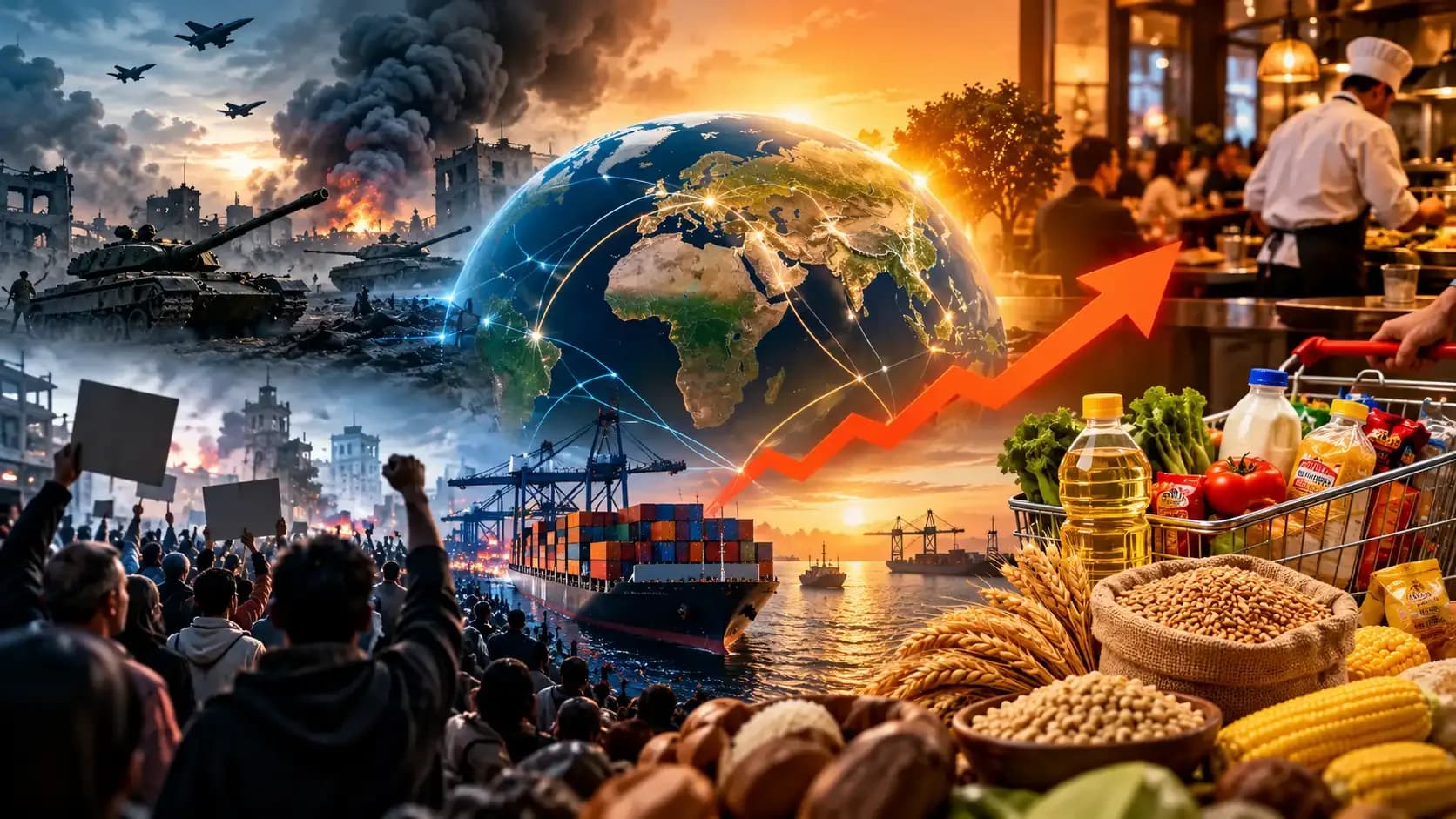
Global conflicts are increasingly becoming a business problem for the food industry. Wars, shipping disruptions, political instability and protests over living costs are affecting the movement of agricultural commodities, the availability of fertilisers, energy costs and the economics of manufacturing and selling everyday products.
The consequences extend well beyond the countries directly involved in these conflicts. A disruption to a major shipping route can affect the cost of imported ingredients. Higher fertiliser prices can influence agricultural production months later. Rising edible-oil costs can squeeze packaged-food manufacturers, while restaurants face the challenge of protecting margins without making meals unaffordable.
The latest data shows that these pressures are already visible in international commodity markets and India's consumer-price statistics.
According to the Food and Agriculture Organization of the United Nations (FAO), the global Food Price Index averaged 136.0 points in September 2026, up 1.5% from August and 5.8% from a year earlier. Meanwhile, India's provisional retail food inflation reached 7.74% in September, according to the Ministry of Statistics and Programme Implementation.
The developments raise an important question: How are wars, protests and geopolitical disruptions changing the economics of food, fast-moving consumer goods (FMCG) and the food and beverage (F&B) industry?
Global Food Prices Rise as Shipping Disruptions and Weather Risks Intensify
The latest FAO data points to renewed pressure across several internationally traded food commodities.
The FAO Food Price Index, which tracks monthly changes in international prices for a basket of food commodities, reached 136.0 points in September 2026. It was 5.8% higher than a year earlier but remained 15.1% below its peak in March 2022.
The September increase was driven by higher prices for cereals, vegetable oils and sugar. Meat prices declined, while the dairy index remained broadly stable.
The FAO said transportation disruptions and weather concerns were affecting commodity availability and prices, with geopolitical tensions around the Strait of Hormuz and the Black Sea contributing to pressure on energy, transport and food markets.
Source: FAO Food Price Index, 2 October 2026.
Latest global food-price indicators
Indicator | September 2026 reading | Change from a year earlier |
|---|---|---|
FAO Food Price Index | 136.0 points | +5.8% |
FAO Cereal Price Index | 122.8 points | +17.2% |
FAO Vegetable Oil Price Index | 198.6 points | +18.3% |
FAO Meat Price Index | 127.9 points | +4.4% |
FAO Sugar Price Index | 114.0 points | −8.5% |
FAO Dairy Price Index | 119.1 points | −18.8% |
Source: FAO Market and Trade Data Portal. Figures compare September 2026 with September 2025.
The figures highlight an uneven food-price environment. Cereals and vegetable oils have recorded substantial annual increases, while sugar and dairy remain below their year-earlier index levels.
For food manufacturers, the impact depends on the ingredients used in their products, their procurement contracts, inventory levels and the extent to which they can pass additional costs on to customers.
Higher cereal prices can affect flour, bakery products, breakfast cereals and animal feed. Vegetable-oil prices can influence snacks, biscuits, instant foods and commercial cooking. However, the international index does not directly measure retail prices in India or the actual input costs of an individual business.
Strait of Hormuz Disruption Begins Affecting Agricultural Production
One of the most consequential developments is the growing connection between shipping disruption, fertiliser availability and agricultural production.
On 15 October 2026, Reuters reported that the effects of disruption to shipping through the Strait of Hormuz were beginning to appear in agricultural harvests, according to Alvaro Lario, president of the United Nations' International Fund for Agricultural Development (IFAD).
Lario said fertiliser shipment disruptions, higher fuel and transport costs, the El Niño weather risk and disruptions to Black Sea wheat supplies were adding pressure throughout the food supply chain.
Existing fertiliser and fuel stocks initially helped cushion the shock. However, prolonged uncertainty had encouraged more cautious planting and reduced fertiliser use in some cases. Higher fuel costs were also affecting mechanised harvesting.
The report said agricultural commodity prices had risen 13% in the third quarter, according to Lario, who expected further increases in the fourth quarter of 2026 and the first quarter of 2027. This is an attributed assessment, not a forecast that every agricultural commodity will rise at the same rate.
Source: Reuters, 15 October 2026.
Why fertiliser matters to the food industry
Fertilisers are a crucial link between energy markets and food production. Nitrogen fertiliser manufacturing depends heavily on natural gas, while fertiliser distribution relies on energy, shipping and transport infrastructure.
When these inputs become more expensive or harder to obtain, farmers may reduce fertiliser application, change planting decisions or delay purchases. The effects can subsequently influence crop yields and the supply of grains, oilseeds and other agricultural commodities.
The impact is not immediate or uniform. It depends on planting calendars, weather, domestic inventories, alternative suppliers and the specific crops being grown.
Nevertheless, the agricultural time lag makes the current disruption particularly important. Even if transport conditions improve, some production decisions cannot be reversed once a planting window has passed.
For food manufacturers and retailers, this means monitoring agricultural output and input availability alongside current commodity prices.
Russia–Ukraine War Adds Pressure to Black Sea Grain Trade
The Russia–Ukraine war remains a significant source of uncertainty for global agricultural markets because both countries are important participants in international grain and oilseed trade.
Disruption to ports, storage facilities, transport routes and maritime operations can affect the movement of wheat, maize and sunflower oil. Even when exports continue, higher insurance premiums, uncertain shipping schedules and changes in available supply can influence market prices.
In September 2026, FAO reported that international wheat quotations had increased by 6.3% month-on-month. The agency attributed the increase partly to logistical constraints affecting Black Sea trade and dry weather in parts of North America ahead of sowing.
The development illustrates how geopolitical and weather-related risks can operate simultaneously.
For food businesses, higher wheat prices can affect bakeries, biscuit manufacturers, pasta producers and other companies that rely on grain-based ingredients. Maize-price movements can also affect animal feed, creating potential indirect pressure on poultry, meat and dairy production costs.
The actual impact varies according to the origin of supplies, domestic inventories, crop forecasts and the availability of alternative exporters.
Source: FAO, September 2026 food-price update.
Red Sea Shipping Risks Increase Supply-Chain Uncertainty
The Red Sea and the Bab el-Mandeb Strait are important links in trade between Asia, Europe and other markets. Security risks in the region have forced some shipping companies to reconsider routes, including voyages around the Cape of Good Hope.
Longer routes can increase transit time, fuel consumption, insurance costs and the amount of working capital tied up in goods in transit.
These effects matter to the food industry because international supply chains carry more than finished food products. They also transport ingredients, fertilisers, packaging materials, processing equipment and other inputs required by manufacturers.
The World Food Programme warned on 8 October 2026 that disruptions affecting the Strait of Hormuz, Red Sea and Black Sea were creating risks for food, fuel and fertiliser trade, with consequences for food security.
Source: World Food Programme, 8 October 2026.
For importers and manufacturers, the business consequences can include longer procurement cycles, greater inventory requirements and difficulty guaranteeing delivery schedules.
However, longer shipping routes do not automatically result in shortages or higher retail prices. The final impact depends on freight rates, supplier contracts, inventory buffers and the availability of alternative routes.
India's Food Inflation Reaches 7.74% in September
India is exposed to international food and energy markets through imported edible oils, fertilisers, fuel and other inputs. Domestic crop production, weather conditions, currency movements and government policies also play important roles in determining retail prices.
The latest official consumer-price data shows that food inflation increased in September 2026.
According to the Ministry of Statistics and Programme Implementation, India's provisional retail inflation reached 5.54% year-on-year in September, compared with 4.83% in August. Consumer food inflation rose to 7.74% from 5.97% over the same period.
Indicator | August 2026 | September 2026 |
|---|---|---|
Overall retail inflation | 4.83% | 5.54% |
Consumer food inflation | 5.97% | 7.74% |
Rural food inflation | 6.17% | 8.06% |
Urban food inflation | 5.64% | 7.18% |
Source: Ministry of Statistics and Programme Implementation, 12 October 2026.
These figures show that household food costs are under pressure. They do not, by themselves, establish how much of the increase is attributable to international conflict.
Domestic weather, crop availability, supply-chain conditions and changes in individual food prices can all influence the inflation rate.
For FMCG companies and restaurants, elevated food inflation matters because consumers may become more price-sensitive just as businesses face higher procurement and operating costs.
Edible Oil Prices Remain a Key Concern for Indian Food Manufacturers
Edible oils are among the most important imported agricultural commodities for India.
The country relies heavily on imports to meet domestic edible-oil demand, making international prices, exchange rates, shipping conditions and trade policy important factors in the cost of cooking oil.
Palm oil is particularly relevant to packaged-food manufacturers because vegetable oils are used in many snacks, biscuits, bakery products, instant foods and other processed products.
Rising oil costs can affect manufacturers in several ways:
Higher ingredient procurement costs.
Increased working-capital requirements when inventory becomes more expensive.
Pressure on gross margins when selling prices remain unchanged.
Potential changes to pack sizes, product formulations or pricing strategies.
Greater uncertainty when international prices and currency movements change quickly.
The effect differs between companies. A business with long-term purchasing contracts may experience the increase later than one that buys at prevailing market prices. A company with stronger pricing power may recover more of the increase than a business competing in a highly price-sensitive category.
Edible-oil prices are therefore a critical indicator to monitor when assessing the impact of geopolitical disruption on India's food manufacturing sector.
FMCG Companies Face Rising Costs and Margin Pressure
Indian FMCG companies are dealing with a difficult balance between protecting profitability and maintaining affordability.
A report published by The Times of India on 18 October 2026 cited Grant Thornton Bharat's assessment that palm oil prices in rupee terms were approximately 21% higher year-on-year in September, while sugar prices were around 18% higher. The report also highlighted crude-linked materials and packaging as important cost pressures.
The same report cited pre-results analyst estimates of approximately 45 basis points of year-on-year operating-margin compression across a group of major consumer-staples companies, with some estimates indicating declines of up to 150 basis points for the companies covered.
These are analyst estimates, not final earnings results for the entire FMCG industry.
Will consumers see higher prices after Diwali?
The report said companies were absorbing part of the increase through cost efficiencies and procurement measures instead of immediately passing all additional costs to consumers.
Parle Products Chief Marketing Officer Mayank Shah told PTI that some companies could consider price increases after the festive season, depending on commodity prices and geopolitical developments, potentially from December 2026.
This is a stated possibility, not confirmation that all FMCG companies will increase prices.
The pressure is particularly relevant for mass-market products, where consumers may be unwilling or unable to absorb significant price increases.
Companies can respond by reducing discounts, improving manufacturing efficiency, changing product mixes or adjusting prices. But higher selling prices can also affect demand, particularly when households are already facing food inflation.
Which FMCG categories are most exposed?
Packaged foods: Biscuits, snacks, instant foods and bakery products can be affected by edible oils, wheat, sugar, energy and packaging.
Personal care and home care: Crude-linked chemicals, surfactants, fragrances and plastic packaging can expose soaps, detergents and shampoos to energy-market volatility.
Beverages: PET bottles, caps, labels, cartons, transport and refrigeration can influence the cost of bottled water and soft drinks.
Dairy and animal-feed-linked products: Feed costs, agricultural inputs and energy can affect production economics, although the impact may emerge with a delay.
No single cost shock affects every company equally. Ingredient intensity, purchasing arrangements, brand positioning and pricing power determine how much pressure reaches the bottom line.
Restaurants and QSR Chains Face a Different Challenge
Restaurants, cafés, hotels and quick-service restaurant chains face a more complex cost structure than packaged-food manufacturers.
Their expenses include ingredients, cooking oil, electricity, commercial fuel, refrigeration, packaging, staff, rent and delivery. A disruption can affect several of these costs at the same time.
Restaurants also have to consider customer traffic. Raising menu prices may help recover higher costs, but it can discourage visits or push consumers towards cheaper meals.
Quick-service restaurants
QSR operators can be exposed to edible-oil prices, flour, dairy, meat, packaging and delivery costs. Businesses with standardised menus may have stronger procurement systems, but large operating networks can also be exposed to transport and energy costs across multiple locations.
Cafés and coffee chains
Coffee businesses face exposure to coffee-bean prices, milk, sugar, cups, electricity and refrigeration. Coffee prices also depend on harvest conditions in producing countries and currency movements.
Geopolitical disruption can affect transport and costs, but it would be inaccurate to attribute every coffee-price increase directly to war.
Cloud kitchens and food delivery
Cloud kitchens and delivery-focused businesses need to manage ingredients, packaging, delivery costs, commissions and promotional spending. If consumers reduce discretionary orders or become more price-sensitive, the impact can extend beyond food procurement costs.
Hotels and institutional catering
Hotels, caterers and institutional kitchens often work with large procurement volumes and contractual pricing. Their exposure depends on how frequently contracts are revised and whether they can adjust menus or negotiate with suppliers.
India's official CPI data also recorded 9.39% year-on-year inflation in the food and beverage serving-services category in September 2026. This is a consumer-price indicator; it does not directly measure restaurants' ingredient inflation or operating margins.
The central challenge for food-service businesses is to manage costs without undermining customer demand.
Protests and Political Instability Can Disrupt Food Distribution
Wars are not the only source of disruption. Protests over fuel prices, wages, food affordability and living conditions can affect businesses when they interrupt transport, close retail areas or delay agricultural processing.
The impact depends on the type and location of the protest.
Demonstrations that temporarily close shopping districts may affect footfall and sales. Transport strikes can delay deliveries of perishable products. Agricultural protests can affect the movement of crops or the operations of mills and other processing facilities.
In India, protests over sugarcane prices and sugar-sector issues can influence the timing of mill operations. Delayed processing may affect the timing of sugar production, although the final impact on prices depends on inventories, output and government policy.
It is important to distinguish a disruption to local business operations from a nationwide food-supply problem. A protest does not automatically lead to food shortages or inflation across an entire country.
The same principle applies internationally: verified evidence of closures, transport delays or production interruptions is necessary before assigning a measurable industry impact.
How the Crisis Reaches Consumers
When food and manufacturing costs rise, businesses must decide how to distribute the additional expense between their own margins and customers.
Consumers may experience the impact through several channels.
Higher retail prices: Manufacturers and retailers may increase prices when input costs remain elevated.
Smaller packs: Companies may retain familiar price points while changing pack sizes, subject to applicable labelling and consumer-protection requirements.
Cheaper alternatives: Households may switch from premium brands to lower-priced products or store brands.
Reduced discretionary spending: Consumers may cut back on restaurant visits, premium cafés and food delivery while prioritising essential groceries.
Different purchasing patterns: Consumers may change purchase frequency, promotional preferences or the mix of products they buy.
These outcomes are possible responses to inflation, not guaranteed changes in every market.
For businesses, the key metric is not simply revenue growth. A company may report higher sales value because prices have increased even if it sells fewer units. Volume growth, price realisation and operating margins must be examined together to understand the actual performance of the business.
Could the Current Disruption Lead to a Larger Food-Supply Crisis?
The greatest concern is that several risks may reinforce one another.
Energy and fertiliser disruption can increase farm costs. Weather problems can affect yields. Shipping delays can make imported inputs more expensive. Higher agricultural procurement costs can then influence food manufacturers, restaurants and consumers.
The World Food Programme has warned that disruptions to major trade routes can have consequences for global food security, particularly for vulnerable communities and countries dependent on imported food and agricultural inputs.
However, a wider food crisis is not inevitable. Domestic production, existing inventories, alternative suppliers, government measures and improvements in shipping conditions can help absorb shocks.
The key issue is duration. A short-lived transport disruption may primarily affect freight and working capital. A prolonged disruption that interferes with agricultural planting and harvesting can create more persistent supply risks.
For this reason, food companies and policymakers need to watch fertiliser availability, crop forecasts, inventories and trade flows alongside current food-price indices.
What Food and FMCG Businesses Should Monitor Next
Several indicators will help establish whether the current pressure is intensifying or easing.
Global commodity prices: The FAO Food Price Index and its cereal, vegetable-oil, sugar, meat and dairy components provide a consistent international benchmark.
Shipping conditions: Developments around Hormuz, the Red Sea and the Black Sea can affect transport costs, delivery times and availability.
Fertiliser availability: Prices and shipment volumes can provide early indications of agricultural production risks.
Indian inflation: CPI and consumer food inflation show how price pressures are reaching households.
FMCG earnings: Gross margins, operating margins, volume growth and management commentary reveal how companies are managing higher input costs.
Restaurant economics: Food costs, energy, packaging, customer traffic and average order values help establish whether restaurants can maintain profitability.
Consumer demand: Changes in pack sizes, discounts, purchase frequency and trading down can reveal how households are responding.
The next FAO Food Price Index release is scheduled for 6 November 2026, according to the agency's published calendar. It will provide the next monthly benchmark for assessing international food-price movements.
Conclusion: Geopolitics Is Becoming a Food-Business Issue
The latest evidence shows that wars and geopolitical disruptions are affecting food markets through interconnected channels rather than through a single commodity or trade route.
The FAO Food Price Index rose to 136.0 points in September 2026, with cereals and vegetable oils recording substantial annual increases. India's consumer food inflation reached 7.74%, while FMCG companies reported pressure from palm oil, sugar, packaging and crude-linked materials.
The latest warning from IFAD is particularly important because it points to a potential transition from shipping disruption to agricultural production risk. If higher fuel and fertiliser costs influence planting and harvesting decisions, the consequences could extend beyond immediate freight costs into future food availability and procurement prices.
For FMCG manufacturers, the challenge is to protect margins without making everyday products unaffordable. For restaurants, it is to manage ingredient and operating costs while maintaining customer demand. For consumers, the concern is the pressure that higher food prices can place on household budgets.
The relationship between conflict and food prices is not automatic, and the outcome will depend on production, weather, trade flows, inventories, government policies and the duration of disruptions.
But the business implications are clear: food companies can no longer assess commodity prices, logistics, agricultural inputs and consumer demand in isolation. Understanding how these risks interact will be essential to navigating the months ahead.
For the food industry, the next phase of the global crisis may be determined not only by what happens at ports and shipping routes, but also by what farmers can afford to plant, what manufacturers can afford to produce and what consumers can afford to buy.
Editorial note: Figures reflect the reporting and release dates stated above. Commodity indices, domestic inflation rates and analyst estimates measure different things and should not be compared as if they were equivalent. Potential future impacts are described as risks rather than confirmed outcomes.