


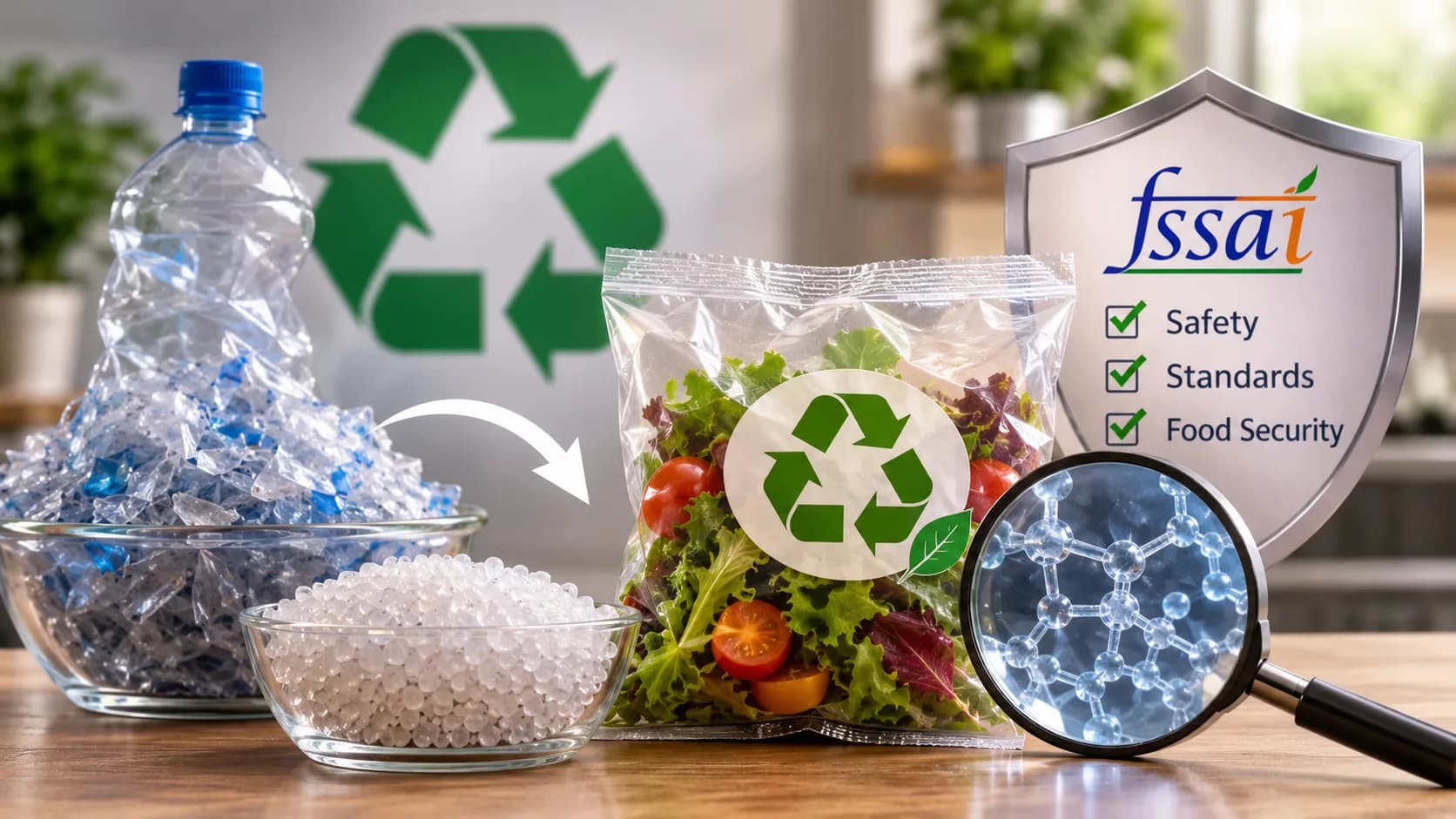
Pick up a packet of namkeen, a tub of curd or a roll of cling film. The plastic you are holding is, under current Indian rules, either virgin material or, in the case of PET bottles, recycled PET approved under FSSAI's 2025 framework. A draft now open for comment could add two new routes for recycled polyethylene (PE) and polypropylene (PP).
The draft is not a permit. It would not let recycled plastic touch food freely. It sets conditions, and the real question is whether those conditions, and the systems to check them, are strong enough.
What exactly has FSSAI proposed?
The Food Safety and Standards Authority of India has drafted an amendment to regulation 4(4) of the Food Safety and Standards (Packaging) Regulations, 2018. One report says CEO Rajit Punhani signed it on 2 November 2026 and that it was published in the Gazette on 3 November, TaxGuru gives the 2 November notification date but does not state a Gazette date. IFT could not open the Gazette copy itself, so the dates and clause numbering below come from secondary reporting. TaxGuru describes two new clauses inserted after clause (e); we could not confirm how they are lettered.
Provision one: chemically recycled PE and PP. Recycled PE and PP made by chemical recycling "via the monomer route", as defined in IS 14534, may be used for food-contact materials only if the end product is considered equivalent to virgin material and meets the criteria that apply to virgin material.
Provision two: recycled outer layers. Recycled polymer derived exclusively from food-grade packaging material may be used in the outermost layer of multilayer food-contact packaging, provided inner layers have adequate barrier properties to stop migration and the pack meets the already prescribed migration limits.
These are different bets. The first is about the material itself: chemically recycled plastic that must pass as virgin. The second is about structure: recycled plastic kept away from food by a barrier. Transclew reports that mechanically recycled PE and PP would remain barred from direct food contact. Objections and suggestions go to the CEO, FSSAI, FDA Bhawan, Kotla Road, New Delhi 110002, and will be considered after 60 days from when Gazette copies are made available. That points to early January 2027, though the exact date depends on the Gazette's availability date.
Chemical recycling, and a definitional gap
Mechanical recycling sorts, washes, shreds and melts plastic into new pellets. The polymer chains stay intact, and so does much of what was in the plastic, including additives and absorbed residues.
Chemical recycling changes the chemistry. IS 14534:2023, the Bureau of Indian Standards guideline on plastics recycling, defines it as "conversion to monomer or production of new raw materials by changing the chemical structure of plastics waste". In the monomer idea, a polymer is broken back into its building blocks and rebuilt, in principle erasing the history of the old plastic.
Here the draft meets a wrinkle. IS 14534 defines depolymerisation and monomers, but IFT's reading of the standard found no defined term "monomer route". For PE and PP, which are polyolefins, reporting on industry practice describes a different path. Transclew cites a Reliance executive describing pyrolysis oil fed into a cracker alongside conventional feedstock, with recycled content credited through "mass balance" accounting. Reliance and HPCL-Mittal Energy have separately announced chemically recycled PE and PP; those are company claims IFT could not verify.
Whether such mass-balance products would count under the draft's "monomer route" wording is unclear from the text we could review. It is a question for FSSAI to answer in the final rule.
There is also a scientific dispute. Zero Waste Europe, an advocacy group, argues that pyrolysis oil from plastic waste carries chlorine, nitrogen, metals and other contaminants that must be purified or diluted. That is an NGO position, not a neutral finding, and industry disputes such characterisations. IFT did not find an independent Indian assessment.
Can chemicals move into food?
Migration is the transfer of substances from packaging into food. Heat, fat, acidity, contact time and storage all change how much moves. A dry biscuit wrapper and an oily, hot gravy tub are very different tests.
The worry with recycled material is contaminants and non-intentionally added substances (NIAS): chemicals nobody added on purpose, such as degradation products or leftovers from previous use. A review in Cambridge Prisms: Plastics found hundreds of food-contact chemicals reported in recycled PET and said some contaminants are hard to remove. It is a hazard review, not a risk assessment, and its evidence on recycled PE and PP is limited. It does not show that recycled packaging is unsafe. It shows why testing must look beyond a short list of known chemicals.
The draft's safeguard is its equivalence test: material that behaves like virgin plastic should carry virgin-plastic risk. That is a sensible principle, but the text we reviewed does not say how equivalence is proven, which tests are mandatory, or who certifies the result. It also gives no migration values, referring only to "already prescribed migration limits". For recycled PET, FSSAI's May 2025 guidelines, as summarised by SGS, require challenge, extraction and migration tests in accredited labs. Nothing in the draft says the same package applies to PE and PP.
Meeting a general limit also does not prove safety under every use. A pack tested for dry food has not been tested for hot oil. Independent scientists we could find in published sources have not yet commented on this draft, and IFT has not obtained interviews. Those expert views remain the missing piece.
What changes for food companies?
There is a regulatory incentive. Under the Plastic Waste Management Rules, companies face rising recycled-content targets, for example rigid packaging rising from 30% in 2025-26 to 60% in 2028-29 and flexible from 10% to 20%, Transclew reports. Companies can claim exemption where another law does not permit recycled content. Because only recycled PET is currently permitted in food contact, a company packing food in PE or PP may be able to claim that exemption today; Transclew argues it would be harder to claim for some multilayer packs if the draft is finalised, though no authority has said so.
The draft does not change everything. IS 11805 still requires milk pouches to be made from virgin polyethylene, per the same report. No company has confirmed plans to use recycled PE or PP in food packs, and we did not assume any.
Who does what is the harder question. The draft, as reported, does not set out a certification scheme, feedstock-verification rules or batch-level traceability for the new routes. Verifying that outer-layer polymer comes "exclusively from food-grade packaging" is a feedstock-control problem. IS 14534 itself says claims of recycled content need audit and certification, referring to ISO 22095 and EN 15343 for traceability, but that is a general standard, not a food-safety rule.
Sustainability versus safety
India's recycling push is real, but chemical recycling is not automatically greener. A BASF-funded life-cycle study in the journal Science of the Total Environment, reviewed by IFT, found pyrolysis of mixed plastic waste had lower climate impact than energy recovery and a similar impact to mechanical recycling, but worse results on most other categories, with "no out-right preferred technology". It modelled a 2030 German system, so it does not describe India. The result hinges on process efficiency and energy source.
Recycling is also not reduction. A pack that is recycled still has to be made, and the demand for recycled polymer can reduce pressure to use less plastic or can simply sustain it. That is a policy choice, not a chemistry one.
What consumers will see
Possibly nothing. IFT found no recycled-content label in the draft as reported; TaxGuru says labelling, traceability and testing are not specified. For recycled PET, FSSAI's guidelines do authorise an FCM-rPET-X symbol or a statement that the pack is made with recycled PET, per SGS. IS 14534 also suggests marking recycled products with a symbol or percentage, such as R25. Whether consumers would get comparable disclosure for PE and PP is unknown. Consumers cannot read a certificate; they can only read a pack.
Who is responsible if a pack fails? The draft as reported is silent. Under food-safety law, food businesses generally bear responsibility for what they sell, but this analysis does not rest on a legal reading, and the final text may say more.
What happens next
Nothing changes until FSSAI considers the comments and issues a final notification. The consultation is the moment for scientists, recyclers, packaging firms and consumer groups to ask for precise definitions, named tests, traceability and disclosure.
India can build a food-safe recycling market, but only if the evidence is public and the rules say who proves what. Recycled content may be good for waste. For food, the proof has to come before the permission.